

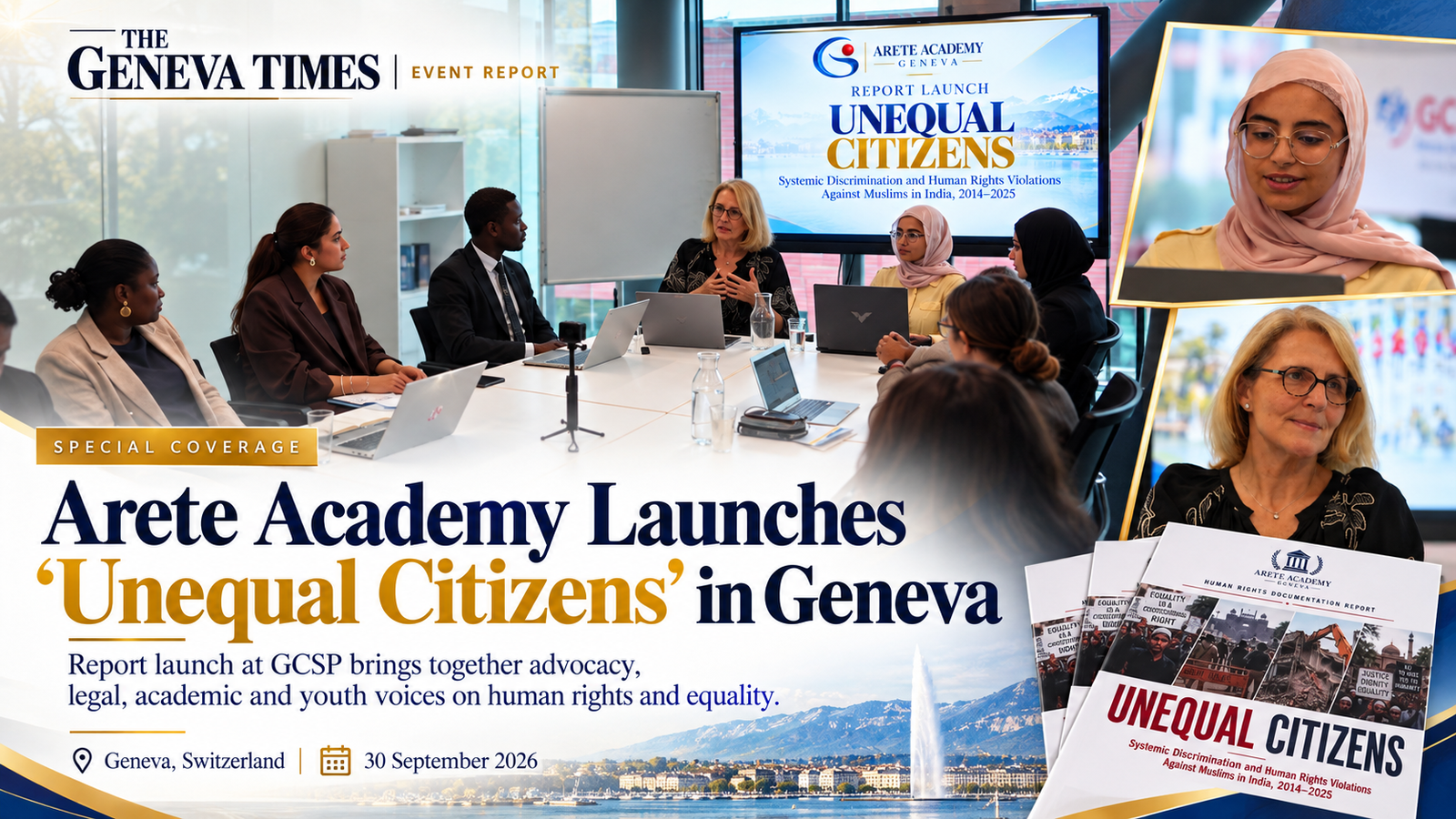
Report examining alleged systemic discrimination and human-rights violations affecting Muslims in India from 2014 to 2025 launched at Geneva Centre for Security Policy, bringing together legal, academic, advocacy and youth perspectives
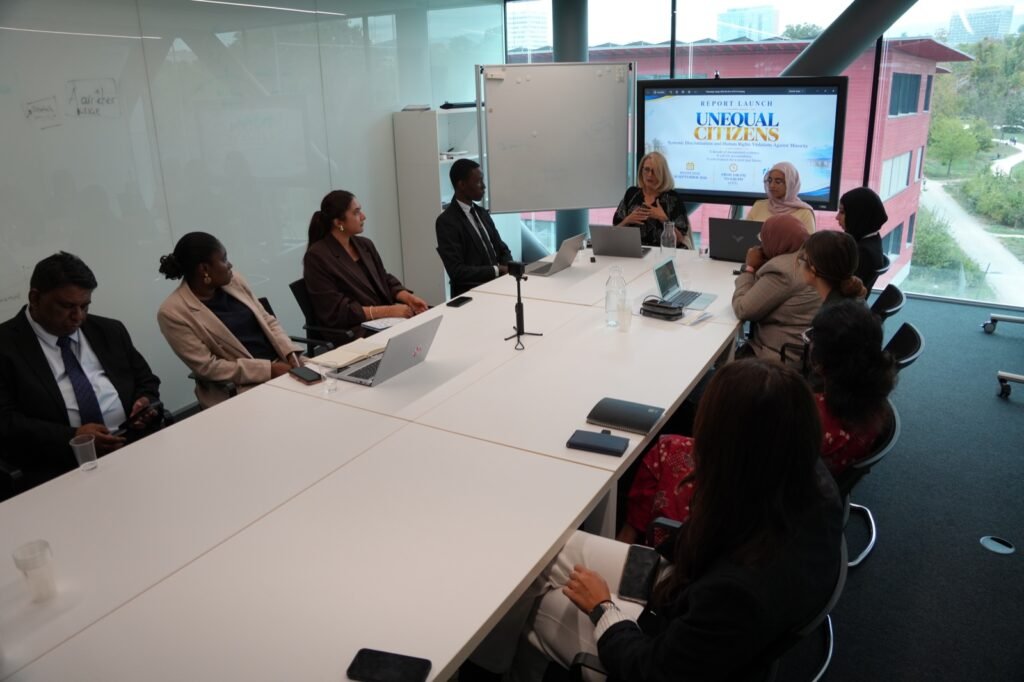
GENEVA, 1 October 2026 — A new human-rights documentation report examining the treatment of Muslims in India over more than a decade was formally launched in Geneva on Wednesday, bringing together lawyers, academics, advocates and young voices for a discussion centred on equality, minority protection, accountability and the role of evidence in human-rights advocacy.
Published by Arete Academy Geneva, the report, titled “Unequal Citizens: Systemic Discrimination and Human Rights Violations Against Muslims in India, 2014–2025,” was presented during an event at the Geneva Centre for Security Policy (GCSP), Maison de la paix, on 30 September.
The report says it examines developments between 2014 and 2025 using material drawn from international human-rights organisations, United Nations bodies, legal and government documents, quantitative datasets and international media reporting.
The launch came against the backdrop of continuing international scrutiny of minority-rights conditions in India. In August, the UN Committee on the Elimination of Racial Discrimination expressed concern over reported violations affecting ethnic and ethno-religious groups and called for investigations and accountability. The Indian government subsequently rejected the Committee’s observations, describing references in the report as politically motivated.
A Geneva Forum Built Around Evidence and Dialogue
Opening the discussion, moderator Imen Belhoucine of University Jean Moulin Lyon III, France, framed the gathering as more than the unveiling of a publication.
The event, she said, sought to create a space for serious reflection on human dignity, equality before the law, minority rights, accountability and democratic governance, while stressing that such a sensitive subject required evidence-based and respectful discussion.
That emphasis became a defining theme of the Geneva gathering: that human-rights claims should be documented carefully, scrutinised seriously and discussed without reducing difficult questions to political slogans.
The programme brought together four speakers representing distinctly different perspectives — advocacy, law, academia and youth engagement.
Sibylle Rupprecht: Turning Documentation Into Responsible Advocacy
Among the speakers was Sibylle Rupprecht, an experienced advocate and Founder and Director of SpringBoards Solutions.
Rupprecht has held senior positions across companies and international non-governmental organisations and has worked in advocacy involving the European Union, United Nations, development banks and government institutions. Her professional background also encompasses ethical leadership, communication, coaching and international advocacy.
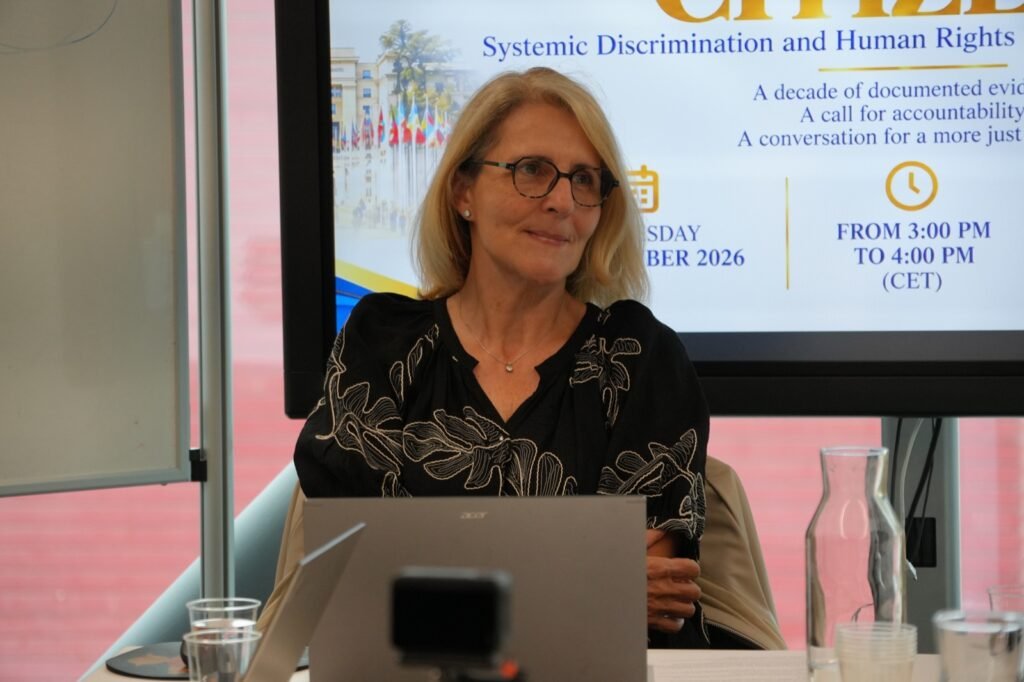
Her participation brought attention to a central question surrounding human-rights documentation: what happens after evidence is collected?
The discussion underscored that documentation has its greatest public value when it can be communicated responsibly, subjected to scrutiny and used to encourage constructive engagement among institutions, governments and civil society.
Law and Accountability at the Centre of the Debate
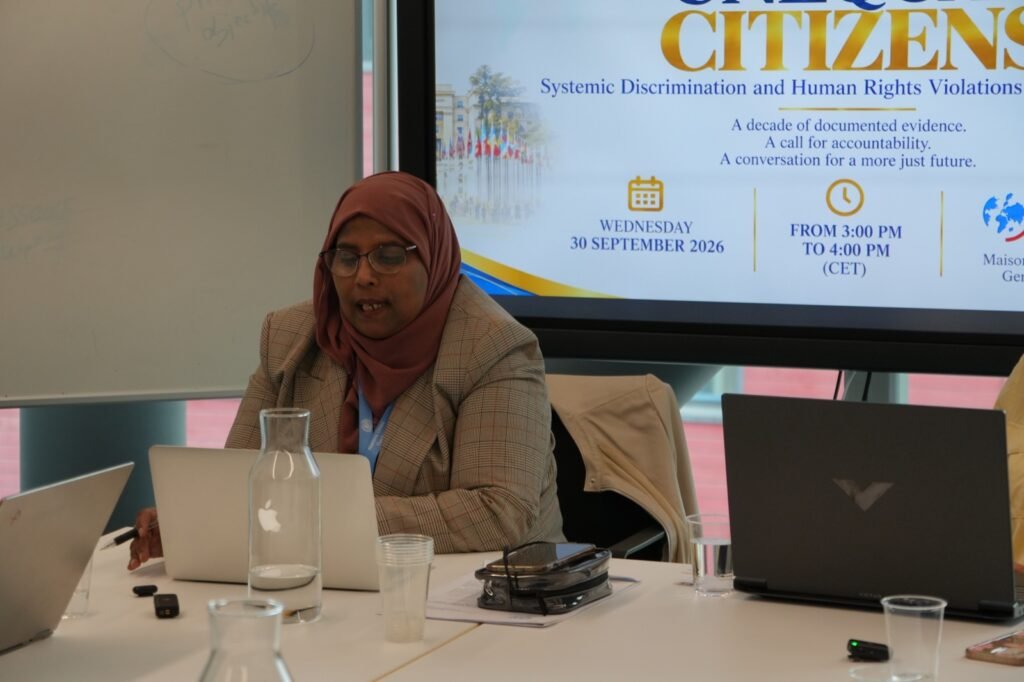
The legal dimension was represented by Zareena Abdul Azeez, an attorney, LLB Honours graduate and international human-rights activist. Speakers
Her contribution placed questions of discrimination within the framework of constitutional guarantees and international human-rights principles, including equality, religious freedom, due process, freedom of expression, protection against arbitrary detention and access to effective remedies.
The moderator noted that allegations of violations require more than political argument: they call for credible evidence, careful legal examination, due process and effective accountability mechanisms.
International organisations have separately raised concerns about minority protections in India. The UN Human Rights Committee said in 2024 that it was concerned about discrimination and violence affecting religious minorities including Muslims, Christians and Sikhs, alongside Scheduled Castes, Scheduled Tribes and other groups.
India, however, has strongly disputed a number of international assessments of its minority-rights record. In March 2026, its Ministry of External Affairs rejected the US Commission on International Religious Freedom’s annual assessment as “motivated and biased,” arguing that such reports present a distorted picture of India’s pluralistic society.
Academic Scrutiny Beyond Political Slogans
Solomon Ngoussi of University Jean Moulin Lyon III brought an academic perspective to the discussion.
His segment highlighted the role universities can play in examining politically and socially sensitive human-rights questions through research, critical inquiry and the testing of evidence.
As the moderator observed, human-rights challenges often intersect with law, governance, political institutions, identity, social structures, public policy and international relations, making academic scrutiny particularly important. MODERATOR TRANSCRIPT
The discussion reflected an important principle for human-rights research: documentation should not merely ask what happened, but examine why patterns emerge, how institutions respond and whether existing safeguards function as intended.
A Youth Voice at the Table
One of the most distinctive features of the launch was the participation of Amal Muzammil, Youth Advocate for Minority Rights and Empowerment.
Her presence brought a generational dimension to a discussion often dominated by institutions, governments, courts and established organisations.
The event stressed that young people experience the consequences of inclusion, exclusion, tolerance and discrimination directly — and increasingly play a role in shaping conversations around equality, justice and social cohesion. Speakers
The moderator described meaningful youth participation as something that should go beyond symbolism, arguing that younger generations should be given substantive opportunities to contribute to discussions concerning justice, peace, equality and social inclusion.
A Report Covering More Than a Decade
According to material presented at the launch, “Unequal Citizens” addresses subjects including legislation and public policy, communal violence, policing, property demolitions, detention, economic and social marginalisation and questions under international law.
Importantly, the event also acknowledged that the report records government responses to concerns raised and that differing positions should be recognised when examining its conclusions.
That qualification is significant.
Independent organisations have documented concerns over the treatment of Muslims and other minorities in recent years. Human Rights Watch, for example, reported concerns relating to communal violence, property demolitions, hate speech, detention and government treatment of critics and minority communities during 2024 and 2025.
At the same time, New Delhi has repeatedly contested outside assessments it considers selective or politically driven, maintaining that India remains a pluralistic democracy encompassing communities from across the world’s major religions.
The competing assessments underline precisely why documentation, methodology and transparent examination of evidence matter.
“The Strongest Response to Disagreement Is Better Evidence”
Perhaps the strongest message to emerge from the Geneva gathering was not a political slogan but a methodological one.
The closing reflection argued that credible human-rights advocacy must remain willing to investigate serious allegations while preserving fairness, evidence and intellectual integrity.
“The strongest response to disagreement is not silence. It is better evidence. Better research. Better dialogue.”
The message captured the wider purpose organisers sought to attach to the launch: not merely publication, but continued scrutiny, debate and responsible engagement.
The session concluded with appreciation to Sibylle Rupprecht, Zareena Abdul Azeez, Solomon Ngoussi and Amal Muzammil, as well as participants and organisers who contributed to the Geneva programme.
For Arete Academy, the report’s significance will ultimately depend less on the attention generated on launch day than on whether its evidence is read, questioned, verified and debated.
That may prove to be the most consequential message from Geneva: in an era when human-rights disputes are increasingly entangled with geopolitics and polarised public debate, credible documentation must withstand scrutiny rather than avoid it.
And for a report bearing the title “Unequal Citizens,” the question placed before its audience was ultimately broader than one publication or one event — how effectively do institutions uphold the principle that fundamental rights belong equally to every person?

