

“Força, Equilibri, Valor i Seny” – strength, balance, courage and mindfulness – is the motto of Catalonia’s most famous and spectacular cultural tradition.
Els Castells, which means ‘castles’ in Catalan but are best described as human towers, represent solidarity and team spirit for Catalan people.
On these depend the success of the tower and even the life of the aixecadors, the young children that climb up to airy heights of more than eight meters to complete the tower.
The experience of watching a team of castelleres forming a tower is quite breath-taking. During many cultural festivals in Catalonia, big groups of people, dressed in colourful shirts and mostly white trousers, gather in a square that is full of spectators.
To the sound of the Gralles, traditional flutes, and the drums that seem to accompany almost every traditional Catalan event, a group of the stockier members of the team forms a circle.
All around, other members are supporting them from behind. They are the pinya (pine cone), the foundation of the castell.
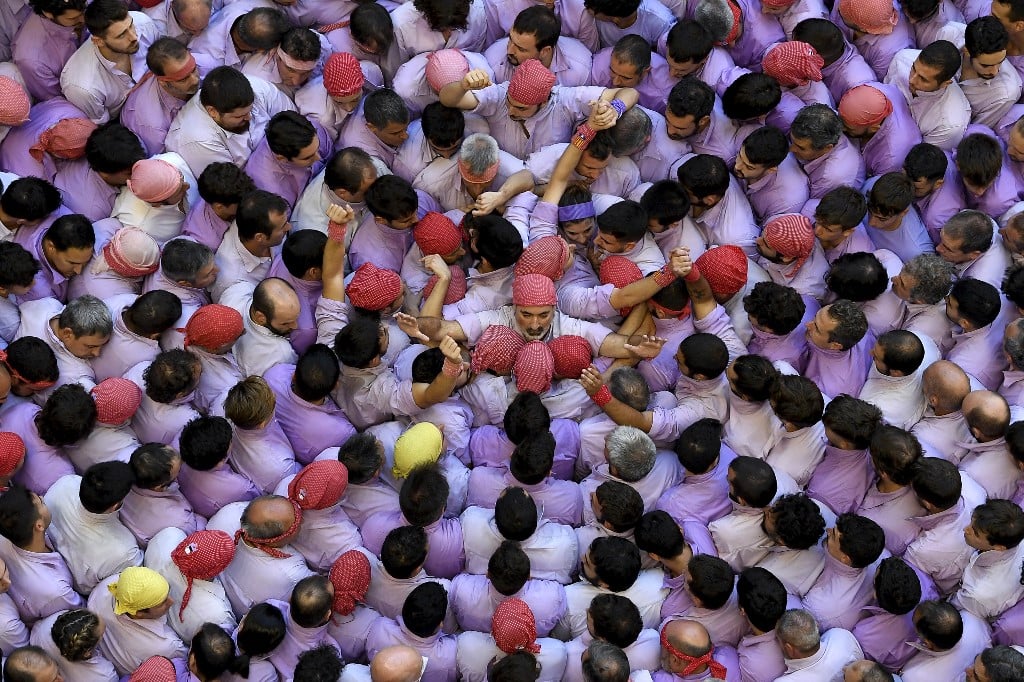 The bigger the pinya, the stronger the stucture. (Photo by Josep LAGO / AFP)
Now the more athletic and limber women and men start climbing on their shoulders to build the tronc (trunk) that consists of up to ten identical levels. They use the sash that every member carries around their waist to hold on to.
By now, the square has gone completely quiet. Everyone is watching the castellers climb higher and higher while the melodies of the flutes change with every level.
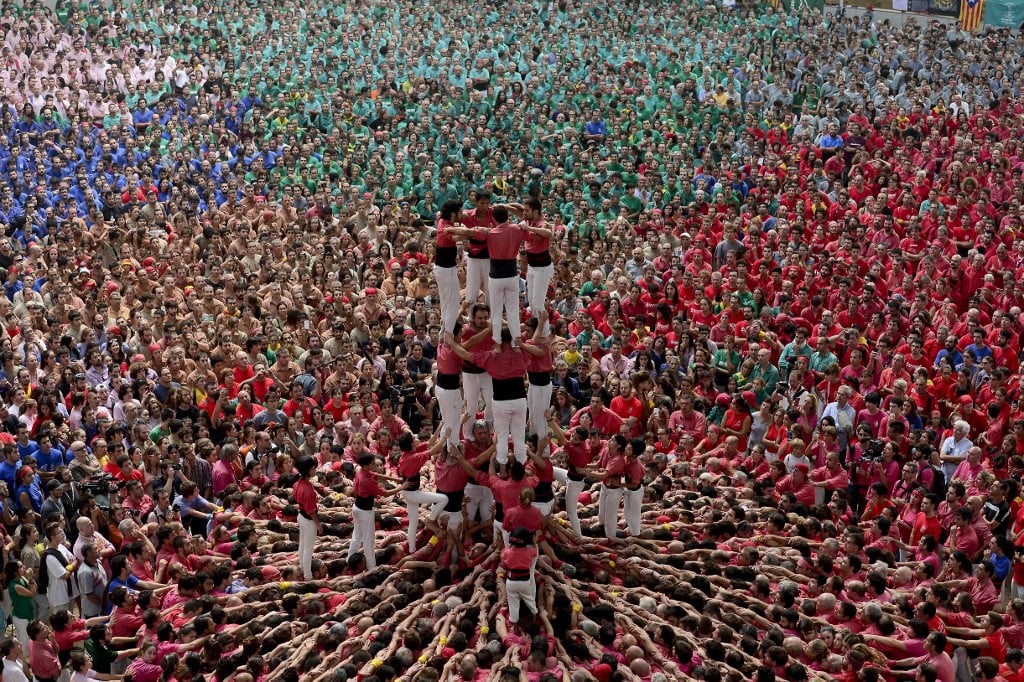 Watching ‘castells’ be formed is a visual spectacle. (Photo by JOSEP LAGO / AFP)
Once the tower has reached its desired height, four children climb up to complete the pom de dalt (upper knob). The last one that goes all the way is the enxaneta.
The child chosen for this role is usually the smallest and lightest and also the one that is celebrated the most after he or she greets the audience with a short wave from the top of the castell.
But only after everyone has made it to the ground in the right order and without falling – because only then is the tower finished successfully.
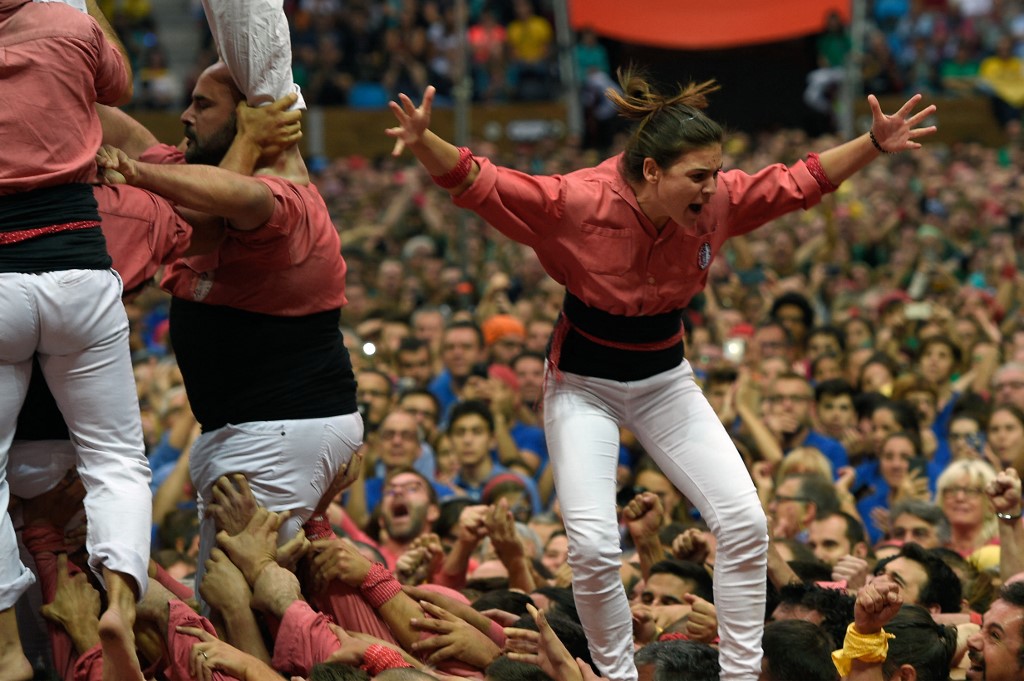 Members of a human tower team celebrate after forming a “castell” successfully. (Photo by LLUIS GENE / AFP)
This is a rule that was only recently established – just like the obligatory helmets for children that climb to the top – after an accident in 2006 when a 12-year-old girl died after falling from the top of a castell. There have been three recorded deadly accidents in the history of the human towers.
Starting off as just one of many cultural activities at village fiestas, building castells has become a competitive sport with its own championship. Since 1952 it has been held every two years in October at Tarragona’s Tàrraco Arena Plaça.
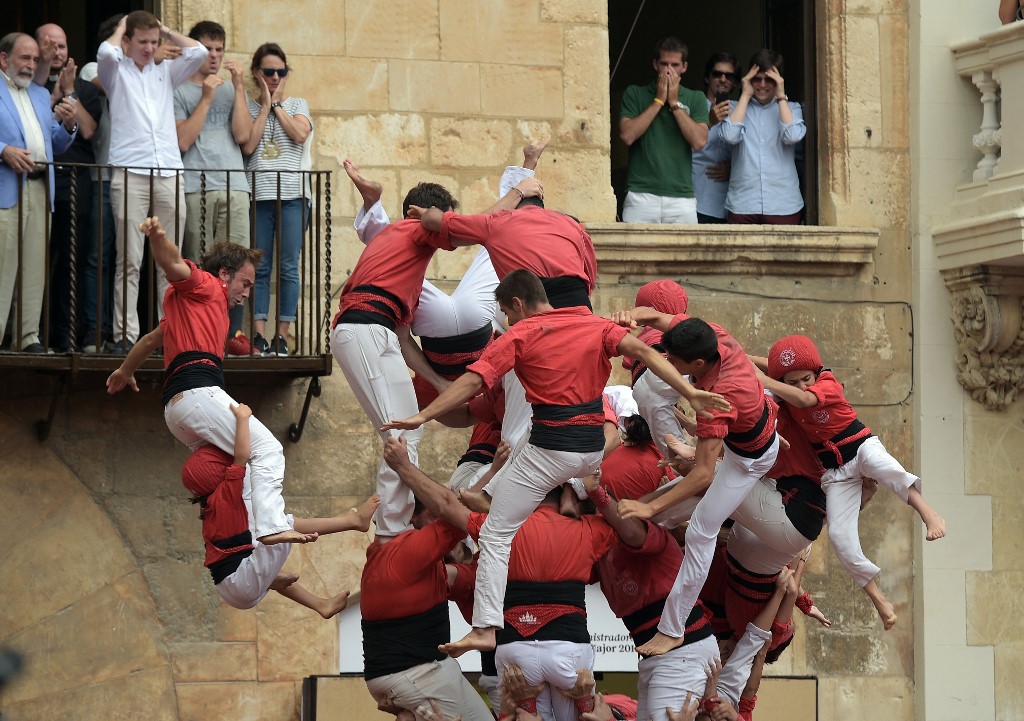 Some ‘castells’ collapse before reaching completion. (Photo by LLUIS GENE / AFP)
A bit of history
People in Catalonia started to build castells in the early 18th century. They took inspiration from traditional Valencian dances, the Balls de Valencias, which used to end with a small human pyramid.
By the mid 19th century, the human towers had become popular across Catalonia, and at the end of the century the tradition reached its peak period when the Xiquets de Valls, the fellows from Valls, set the record as the first team ever to build towers with eight and nine levels.
After that, the towers lost some of their popularity.
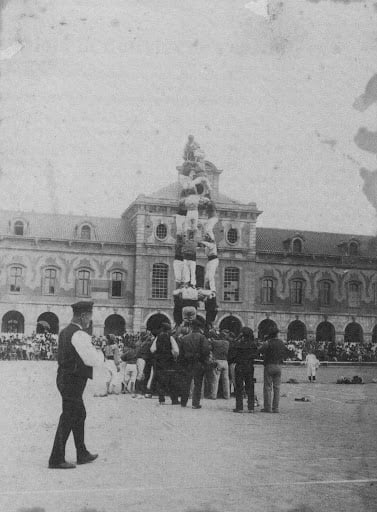 A human tower being formed in 1902 in Barcelona. Photo: Wikipedia/Public Domain
The tradition reached a low point under the Franco regime (1936 to 1975) when the dictatorship banned not just the Catalan language but also many of the region’s traditions.
After his death in 1975 there was resurgence of the tradition and in 1998 a team managed for the first time ever to build a tower with ten levels – at an event that included more than 800 castellers and marked a new high point – literally!
In 2010, Unesco awarded the castells with World Cultural Heritage status.
Links to Catalan independence movement
In recent years, the popularity of the sport has been growing fast and human towers are now more popular than ever before.
One reason for this can be attributed to the rise of Catalan nationalism. Even though most of the over 60 teams across Catalonia don’t explicitly follow a political agenda, many members do support Catalan independence.
Interest in the tradition has particularly grown amongst young people, bucking the wider trend that sees the number of youths participating in traditional cultural events around the world declining.
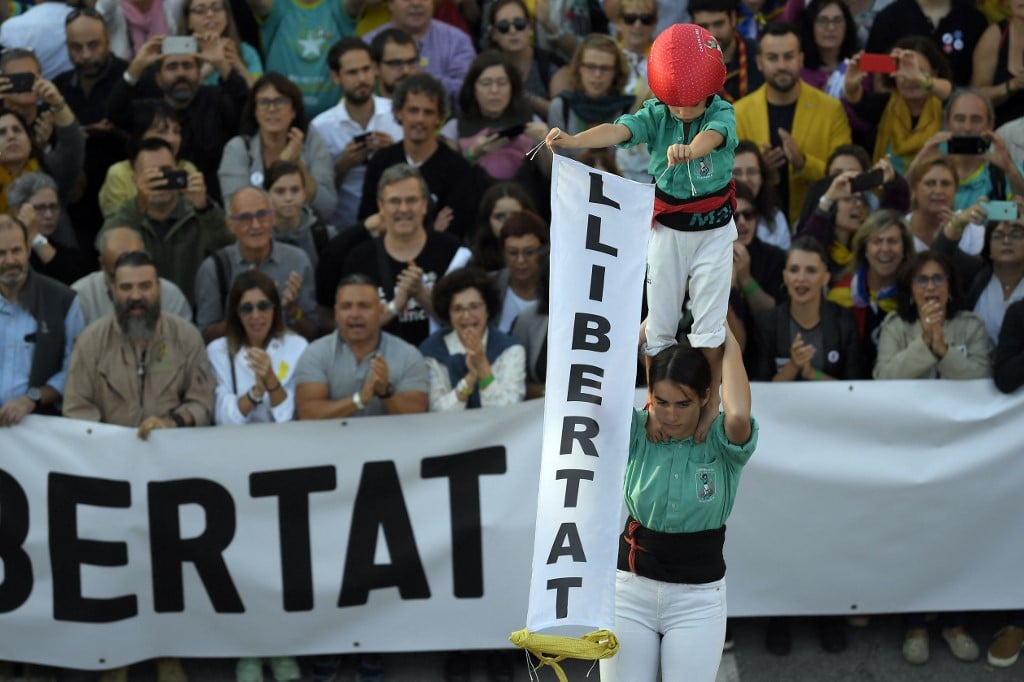 A child on top of a human tower (castell) unfolds a banner reading “freedom” during a pro-independence ‘human tower’ demonstration against the conviction of Catalan separatist leaders for the 2017 attempted secession, in Barcelona, on October 26, 2019. (Photo by LLUIS GENE / AFP)
This has led to criticism from some that that the independence movement uses the castells to harvest support for its cause, when the tradition, though deeply embedded in Catalonia is not automatically connected to the struggle for independence.
Maybe most importantly, it is the social element that makes the human towers so attractive. Not only does their construction require strength, balance, courage and mindfulness, but they also bring together people from different age groups and backgrounds who want to celebrate their culture.
Article by Leslie Fried
READ ALSO: Ten colourful Catalan phrases you should learn right now
