

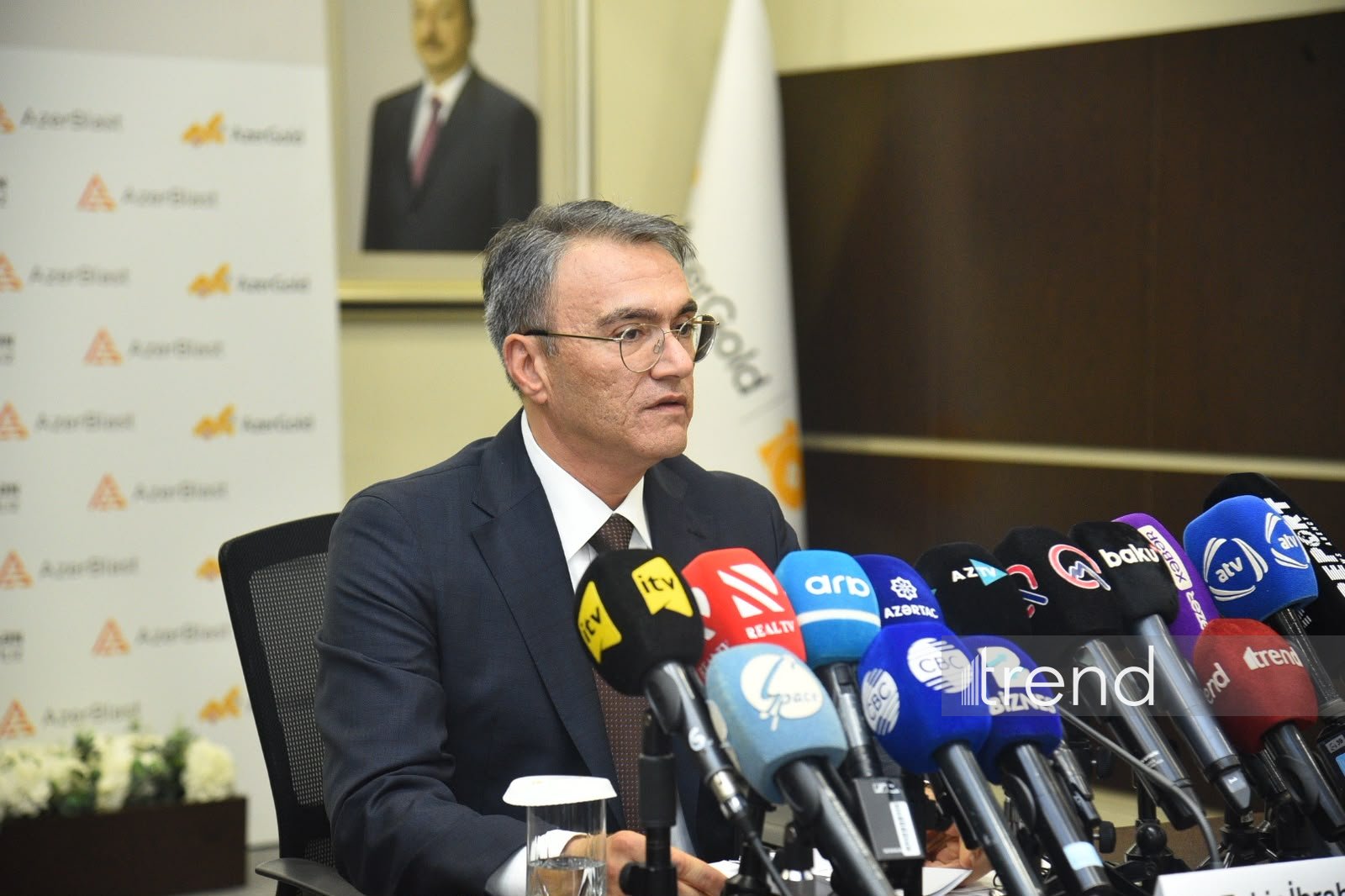
BAKU, Azerbaijan, September 24. As part of the
State Program, AzerGold CJSC is implementing four strategic
projects with a total investment of approximately 3.63 billion
manat ($2.1 billion), the Chairman of the Executive Board of
AzerGold CJSC, Zakir Ibrahimov, said at a briefing held today,
Trend’s correspondent
reports from the event.
According to him, these projects include the “Soyudlu” gold
mining project in the Kalbajar District, the “Ortakend” gold mining
project in Nakhchivan, the “Filizchay” polymetallic project in
Balakan, and the “Dashkesan” iron ore project.
“The total investment in these projects amounts to approximately
3.63 billion manat ($2.1 billion), and the total economic value is
60.4 billion manat ($35.5 billion). As is well known, mining and
metallurgical projects require large capital investments and
long-term financing. The President also noted at the meeting that,
alongside government investments in this sector, opportunities to
attract local and foreign private capital should be expanded,” Z.
Ibrahimov said.
He noted that “AzerGold” plans to finance its strategic projects
primarily through its own revenues and borrowed funds.
“At the same time, we are considering the possibility of
attracting private and foreign investors, especially for large and
capital-intensive projects. The projects I have listed will be
financed through the company’s own and borrowed funds, the state
budget, and contributions from potential investors. Only 10% of the
funding will come from the state budget,” the chairman
emphasized.
Ibrahimov reported that the first project to begin production,
in chronological order, will be the Soyudlu gold deposit in
Kalbajar.
“The project’s operational period, starting in 2028, is expected
to last 9 years, with gold reserves of 1.03 million ounces, an
economic value of 7.5 billion manat ($4.4 billion), and required
investments of 425 million manat ($250.04 million). The project
will be financed through AzerGold’s own and borrowed funds,” he
said.
Noting that the second project is the Ortakend gold deposit
located in Nakhchivan, Ibrahimov stated that production is expected
to begin in 2029.
“The project’s operational life is 9 years, with gold reserves
of 246,000 ounces, an economic value of 1.8 billion manat ($1.1
billion), and required investments of 255 million manat ($150.02
million). The project will be financed using AzerGold’s own funds
and borrowed capital,” the chairman of the board of directors
stated.
According to him, the addition of approximately 1.28 million
ounces of gold reserves through the “Soyudlu” and “Ortakend”
projects will enable the country to increase gold production and
exports.
Production at the Filizchay deposit is scheduled to begin in
2031–2032. The chairman of the board of AzerGold stated that
production at the Filizchay polymetallic deposit is scheduled to
begin in 2031–2032.
“Over the 34-year operating period, we plan to produce 363,000
metric tons of copper, 2.7 million metric tons of zinc, and 1
million metric tons of lead. The project’s economic value is 29.7
billion manat ($17.4 billion), and the required investment is 1
billion manat ($590 million),” Z. Ibrahimov noted.
He reported that during the initial phase of the “Filizchay”
project, AzerGold will hold 100% ownership of the deposit.
“It was emphasized that as operations progress, the economic
value of the deposit will grow, and then, if necessary, the
involvement of foreign investors in the project on a certain equity
basis may be considered,” the chairman added.
According to Ibrahimov, the implementation of the “Filizchay”
project will create new export opportunities and conditions for the
development of a new industrial sector in the country.
“At the same time, this will give impetus to the region’s
socioeconomic development, the creation of new jobs, and the
formation of related industries around the mining sector. The
project’s implementation will also create new opportunities for
local contractors and service providers working in manufacturing
and processing, as well as logistics and other service sectors, to
expand their operations,” he said.
The chairman of the board of directors also announced that
production at the Dashkesan iron ore project is scheduled to begin
in 2030.
“The project, which includes mining, beneficiation, pipeline,
pelletizing, and hot-briquetted iron ore (HBI) plants, plans to
produce 40 million metric tons of HBI products over 20 years of
operation. The project’s economic value is 24 billion manat ($14.1
billion), and the required investment is 1.95 billion manat ($1.1
billion). Funding will be provided through the state budget,
borrowed funds, and investor participation,” Z. Ibrahimov said.
According to him, the ore mined at the Dashkesan mine as part of
the project will first be processed at a concentrator to be built
on the mine site and turned into concentrate.
“The concentrate will then be transported to a plant planned for
construction in the Shamkir region for the production of pellets.
To this end, plans are in place to construct a slurry pipeline over
40 kilometers long, the first of its kind in the country. In the
final stage of the production chain, the pellets will be used to
produce hot-briquetted iron, one of the main raw materials for the
steel industry,” he noted.
Moreover, Ibrahimov reported that the plant, with an annual
production capacity of 2 million metric tons, will be built in the
section of the Western Industrial Park (Garb Senaye Park) located
in the Shamkir region.
“The implementation of this project will help establish a
sustainable raw materials base in the country for the production of
high-quality steel. Annual production of 2 million metric tons will
meet the needs of the domestic market, and any surplus will be
exported. This will help, on the one hand, reduce dependence on
imports and, on the other hand, expand export potential, develop
the non-resource sector, and generate additional revenue for the
state budget,” the chairman of the board of directors of AzerGold
emphasized.
