

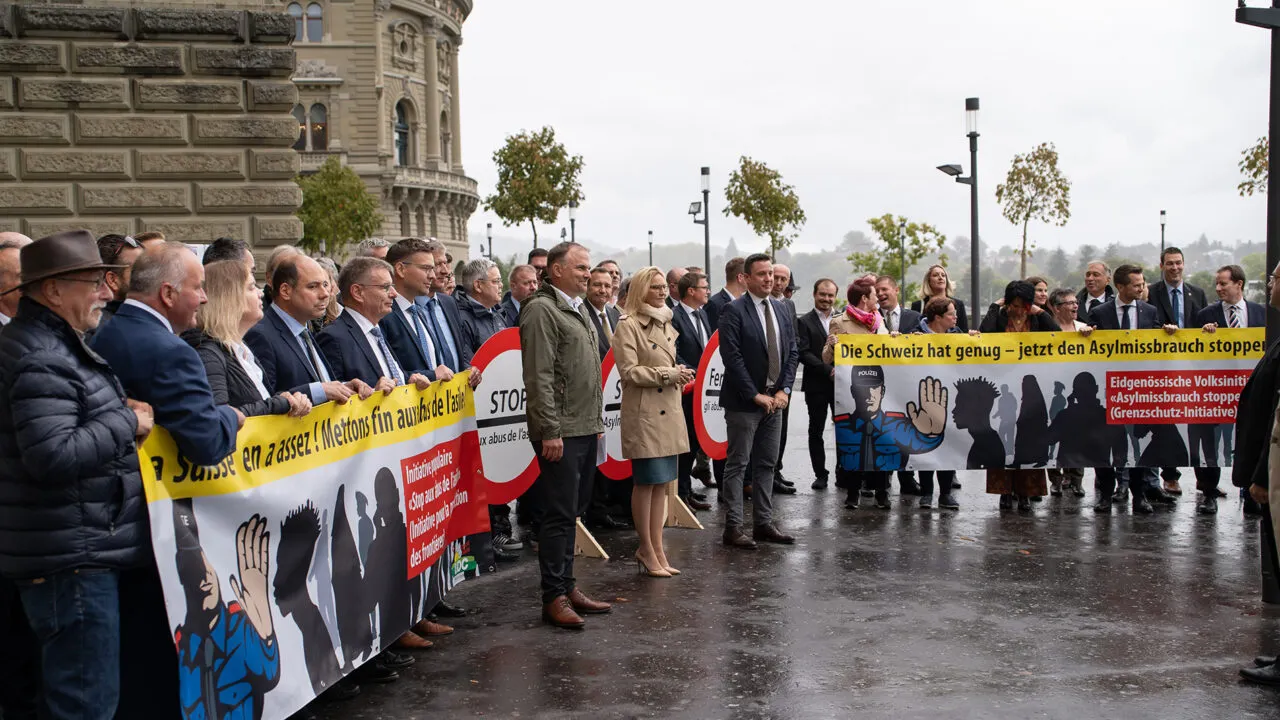
Among political actions currently on the agenda of the populist Swiss People’s Party (SVP) is the bid to introduce more systematic controls at the country’s borders.
The SVP has long complained about Switzerland’s lax policies in regard to people seeking political asylum.
Claiming that tens of thousands of asylum seekers in Switzerland “are connected to criminal gangs” and commit “violent and sexual offences, burglaries, and thefts,” the party wants the government to introduce stricter and more systematic controls at Swiss borders.
The goal of this measure is to stem the influx of “abusive’ asylum seekers into the country.
The SVP has launched an initiative on the border-tightening measure and collected enough signatures to bring it to the ballot box, though the date for the vote has not yet been set.
What exactly does it seek?
The initiative aims to ensure that all persons entering Switzerland undergo systematic checks and that the country’s borders are fully monitored.
Anyone failing to meet entry requirements would be turned back.
Additionally, the SVP wants to cap the number of asylum seekers admitted to Switzerland at a maximum of 5,000 people per year.
To put this figure into context, 7,382 people received asylum in Switzerland in 2025 – primarily from Afghanistan, Eritrea, Turkey, and Algeria.
On top of that, 4,589 people were granted ‘temporary’ admission.
The SVP also calls for individuals staying in Switzerland illegally they to be reported to the federal authorities, excluded from social security and health insurance benefits, and required to leave the country within three months.
The government, however, opposes this move.
‘Detrimental consequences’
On September 18th, the Federal Council has spoken against the initiative, listing its multiple objections to the SVP’s proposal.
“In addition to being difficult to implement, it would have extremely detrimental consequences,” the government said.
For instance, “permanent, systematic border controls – given the approximately 2.2 million daily border crossings and the hundreds of thousands of cross-border commuters – would place a heavy burden on the economy, on commuter traffic, and on tourism, while also resulting in traffic congestion costs running into the billions,” the Federal Council argues.
Furthermore, “significantly more personnel would be required to secure the borders, entailing very high costs.”
Lastly, there is also a matter of Europe-wide cooperation.
By reintroducing systematic border controls, “Switzerland would jeopardise its participation in the Schengen/Dublin system” the Federal Council said, pointing out that “exclusion from this system would lead to a deterioration in internal security, as Switzerland would lose access to European Union search databases.”
