

The reopening of the Russian Pavilion at the Venice Biennale in early May 2026 was met with criticism – and rightly so. The pavilion, critics argued, cannot be separated from the Russian state. It functions as an instrument of Russian soft power—and even of hybrid warfare – normalising Russia’s war against Ukraine while undermining the European sanctions and support for Kyiv.
The official defenders of the reopening dismissed such criticism as an attempt to censor art and culture. In the words of Biennale president Pietrangelo Buttafuoco, the Biennale is “not a court, but a place of dialogue and peace.” For Mikhail Shvydkoy, the “Presidential envoy for international cultural cooperation” – as such, the commander-in-chief of Russia’s cultural forces – art, as a bridge between societies, stands above politics even in wartime.
Both these arguments rest on the same assumption: that Russian culture can be separated from the Russian state. Let us dwell on this claim. The problem is not merely that Russia, of all countries, now invokes the autonomy of art while thousands of artists have fled the country because of political censorship and hundreds of others have been imprisone.
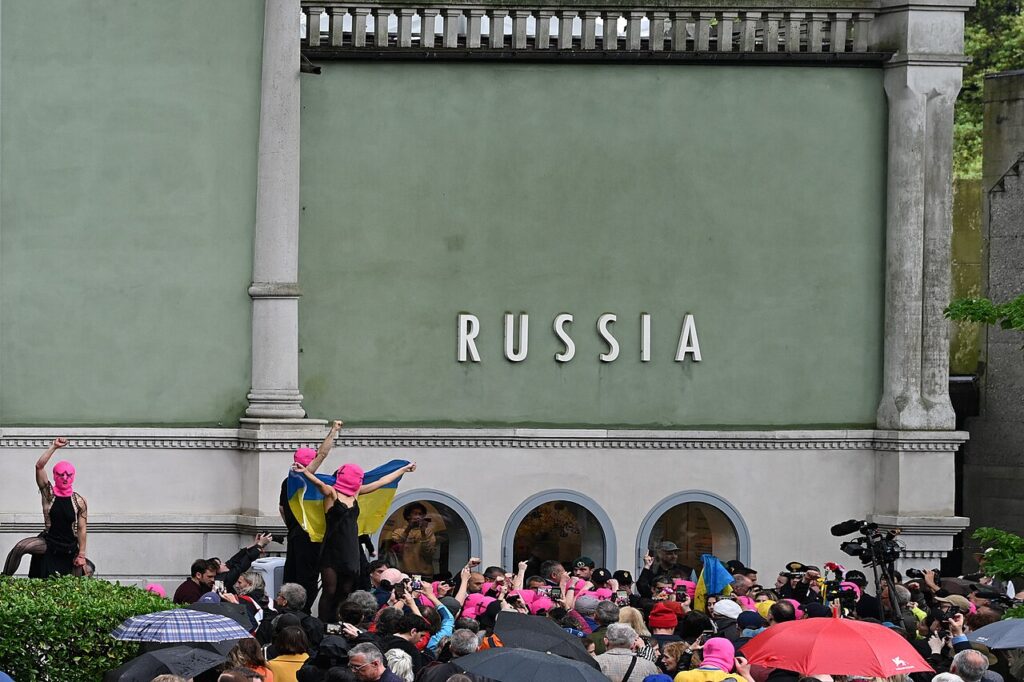
More troubling still is the narrative that Shvydkoy and Buttafuoco have helped construct. According to this narrative, Russia is defending the freedom of art, while other countries – above all Ukraine – are attacking “great Russian culture” by, for example, removing monuments to writer Mikhail Bulgakov and poet Alexander Pushkin from public squares. Russian state media lament that Russian culture is being “cancelled” around the world, while insisting that it is apolitical, embodying universal humanist values that retain their validity at all times and under all circumstances – including during a war of aggression.
It is precisely this claim I want to challenge – not by cataloguing the imperialist and chauvinist statements of Russian writers, which others have already done so convincingly, bu by showing how the Russian state consistently turns its culture into a weapon and deploys it, quite successfully, in hybrid warfare. The Venice Biennale is a case in point.
The Russian state consistently turns its culture into a weapon and edeploys it, quite successfully, in hybrid warfare. The Venice Biennale is a case in point
I want to describe this mechanism – the reforging of cultural ploughshares into swords – as part of Russia’s long imperial history. It produces an amalgam in which the innocent face of art disappears behind the grimace of political power, while that same power presents itself to the world wearing the Apollonian face of art. Let me illustrate this amalgam with an anecdote from the annus terribilis of 1937: the year in which Stalin’s regime annihilated hundreds of outstanding artists from Georgia, Ukraine, Armenia and many other Soviet republics – including Russia itself. It was also the year of the centenary of Pushkin’s death, celebrated across the Soviet Union with extraordinary pomp.
Stalin is presented with designs for a monument to the poet. The first depicts Stalin reading Pushkin. “Historically correct,” he remarks, “but politically wrong. Where is the General Line?” The second shows Pushkin reading Stalin. “Politically correct,” Stalin replies, “but historically wrong. Comrade Stalin hadn’t written any books back then.” When the monument is finally unveiled, it presents the only version that is both historically and politically correct: Stalin reading Stalin.
The amalgam of poet and political power, which the anecdote takes to its absurd conclusion, is far less absurd than it first appears. An illuminating example is provided by the history of the Pushkin bust in the Georgian capital of Tbilisi.
Thorvaldsen and Pushkin in Tbilisi
Pushkin was the first poet in Russia to be honoured with a monument. The best-known, Alexander Opekushin’s bronze statue in Moscow, was unveiled in 1880, followed by the St Petersburg monument in 1884; by 1917, another thirty-three Pushkin monuments had been erected across the Russian Empire.
The Tbilisi bust was among the earliest Pushkin monuments in the empire. It was financed through private donations, the principal benefactor being B.V. Rossinsky, the city’s chief of police, who imposed two conditions: the monument was to stand in a small garden named after the poet on the central Paskevich-Erivansky Square – today’s Freedom Square – and it was to be modelled on Bertel Thorvaldsen’s bust of Tsar Alexander I. The square was named after the Russian Field Marshal and Viceroy of Poland Ivan Paskevich, notorious for brutally crushing the Polish and Hungarian uprisings.
The Danish sculptor was one of the most celebrated artists of his age and portrayed many of Europe’s crowned heads. What Rossinski did not know was either Pushkin’s deep aversion to Alexander I, or the biting epigram the poet had written precisely about Thorvaldsen’s bust of the Tsar.
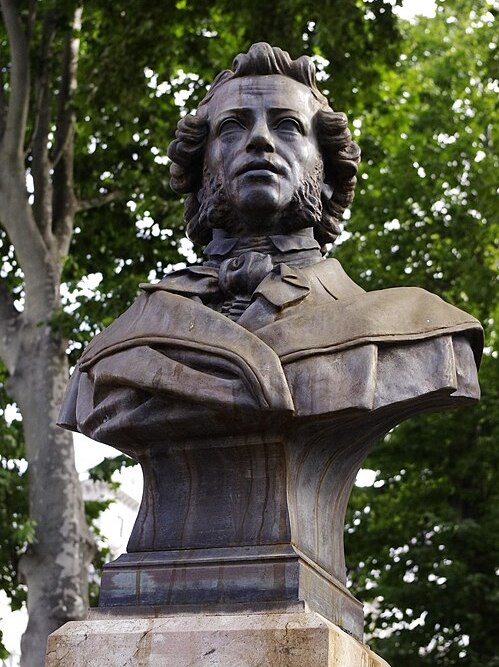
In To the Bust of the Conqueror (K byustu zavoyevatelya, 1828–29), Pushkin pointed to the “bilingualism” of imperial representation: what appears to the viewer as a mistake – the coexistence of irreconcilable emotions, an angry brow and a smiling mouth – is in fact its governing principle. Sixty years later, Pushkin himself had become part of that principle. For an imperial official, the former rebel came to represent the empire almost as fully as the Tsar. The face of the Emperor and the face of the poet began to oscillate until they could scarcely be distinguished: the poet became the Tsar’s cultural double; and together they formed an imperial amalgam.
This shift of the poet towards the imperial pole was ruthlessly exploited by the government during the centenary celebrations of Pushkin’s birth in 1899, when the Tsarist state took control of the jubilee and promoted an image of Pushkin as the loyal subject and favourite of Nicholas I. While the Tbilisi bust fused the face of the poet with the face of imperial conquest, Pushkin now gave Russian culture a face that the empire could proudly present to the outside world.
The symbolic capital that the Tsarist Empire had invested in Pushkin was transformed by Stalin into a cultural weapon against living artists. The Russian classics were deployed to intervene directly in the literary life of the Soviet present. Dead writers became aesthetic yardsticks by which the freedom of living artists was measured – and constrained.
The cultural hero, whether Pushkin, Gorky or Mayakovsky, became representatives of state power within the field of art, making artistic freedom and autonomy all but impossible. At the same time, these figures were recast as imperial teachers of the other national cultures of the Soviet Union, elevating Russian culture while and diminishing the rest.
Russia’s cultural genocide in Ukraine
The amalgam of state and culture acquired a new function under Putin. Russian culture no longer served merely to legitimise the empire, or as a weapon against artistic freedom; it became an instrument weapon of hybrid warfare.
This brings us back to Venice. Russia is waging not only a military war against Ukraine’s civilian population, but also a cultural genocide: Ukrainian artists are being killed; museums, archives, theatres and cultural monuments are being deliberately destroyed; the cultural memory of an entire country is being systematically targeted. Against this background, the Russian Pavilion fulfils its true political function — not to associate Russia’s international presence with these war crimes, but with a supposedly timeless high culture.
This inversion of victim and aggressor lies at the heart of the narrative that the Russian Pavilion in Venice tells in a different aesthetic register
The exhibition’s leitmotif – “A tree rooted in the sky” – invokes the ancient symbol of the arbor inversa. Its two epigraphs, philosopher Simone Weil and the obligatory Pushkin, inscribe Russian culture into a universal horizon. The musical performances, bringing together artists from Mali, Argentina, Mexico and Brazil alongside performers from Tuva, Buryatia and Komi, read as a staged updating of Pushkin’s Monument: “My fame shall spread throughout great Rus’, / and every people in it shall name me: / the proud descendant of the Slavs, the Finn, / the still-wild Tungus, and the Kalmyk, friend of the steppes.” What appears apolitical is in fact a worldwide homage to Russian imperial culture.
Imperial conquest as a moral maxim
What the Pavilion conceals beneath flowers, music and the vocabulary of universal culture is laid bare in the St Petersburg exhibition Russian Imperative, which opened almost simultaneously. Where the Pavilion cultivates the impression of an art detached from politics, Russian Imperative presents art openly as an instrument of empire, political mobilisation and symbolic warfare. The exhibition stages the continuity of the Russian imperial project, tracing Russia’s military history “from the emergence of the Russian state to the present day.”
Here, the Pavilion’s universalism is abandoned entirely. In place of Kant’s categorical imperative stands the “Russian Imperative,” which elevates imperial conquest into a moral maxim. The Russian Pavilion in Venice and the exhibition at the St Petersburg manege are therefore not opposites but two faces of the same amalgam: here the seemingly apolitical face of Russian culture; there its openly imperial and martial face.
Visitors to the Manege are greeted by a monumental installation: a gigantic steel-helmeted soldier’s head set into a red-framed structure, its eyes reduced to glowing slits. According to the curators, it is based on the monument to “Hero of the Soviet Union” Alexander Matrossov, designed by the Soviet sculptor Yevgeny Vuchetich – the same artist behind the Soviet Soldier-Liberator in Berlin, The Motherland Calls in Volgograd, Mother Ukraine in Kyiv, and Swords into Ploughshares at the United Nations in New York.
Yet its visual language recalls the political aesthetics of the late Weimar Republic more than Vuchetich’s Soviet monuments. During public discussion of the exhibition, attention was drawn to Ludwig Hohlwein’s 1929 poster UND DU? – the work of an artist who would later join the Nazi Party.
There too, a soldier’s head is monumentalised, the face hardened into a mask, the gaze obscured beneath the helmet, the individual transformed into a superhuman figure of mobilisation. More important than the formal resemblance, however, is the shared political logic. In both images, militarism, imperialism and violence are presented as responses to an alleged threat to the national community. The aggressor is cast as the victim; aggression becomes self-defence.
The exhibition text stresses that the Matrossov monument – cited as the model for the Manege’s steel-helmeted head – was demolished in Dnipro in 2023 on the orders of the Ukrainian authorities. At the very moment when Russia is waging a genocidal war against Ukraine while mobilising its own population through art, it casts itself as the victim of an alleged cultural destruction.
This inversion of victim and aggressor lies at the heart of the narrative that the Russian Pavilion in Venice tells in a different aesthetic register. Culture is once again enlisted to make that inversion appear credible. Yet the familiar face of Russian culture now appears in the steel helmet of the soldier-conqueror.
Against this background, the reopening of the Russian Pavilion in Venice is not a gesture of dialogue, but a symptom of a dangerous European self-deception. Anyone who wishes to avoid that self-deception must understand how Russia turns culture into a weapon – because precisely where it invokes artistic freedom, it answers the freedom of others with terror and violence. Whoever turns culture into a weapon changes the way it is perceived. It no longer appears autonomous, but as part of the war.
It is therefore not others who are “cancelling” Russian culture. Russia itself is destroying its own culture – by reforging it into a weapon.
.
Do you like our work?
Help multilingual European journalism to thrive, without ads or paywalls. Your one-off or regular support will keep our newsroom independent. Thank you!
