

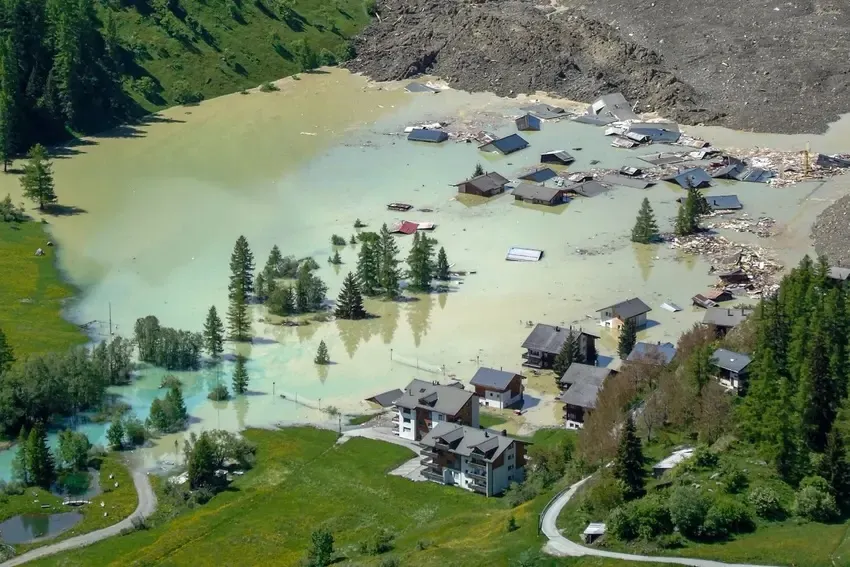
As a Valais glacier is breaking off piece by piece, with debris hanging precariously over a town below, you may be wondering whether other Swiss glaciers could collapse as well.
Pieces of the Weisshorn glacier, located at an altitude of 4,505 metres near Zermatt, could tumble down into Randa, a town lying at the mountain’s foot.
Local authorities have alerted its residents to the risk of the broken fragments falling off, calling the mountain ‘unstable’.
READ MORE: Swiss glacier near Zermatt under threat of imminent collapse
This situation not only poses a significant risk to Randa’s population but, on a larger scale, highlights the problem of Switzerland’s glaciers collapsing due to unabated global warming.
The Weisshorn is not the first glacier to break down.
In May 2025, in one of the most dramatic cases to date, the village of Blatten, also in Valais, was wiped out by a dramatic glacier collapse.
Though its 300 residents were evacuated to safety, tons of rock, ice and scree hurtling down the mountain slope flooded and devastated the village.
More of the same?
Experts say that such occurrences are likely to become more frequent because heatwaves will become more frequent, hotter and last longer in the future, due to climate change caused by the burning of fossil fuels.
And Switzerland’s glaciers will suffer in the process, raising the odds of other collapses.
Various studies show that “Swiss glaciers and unstable rock faces are at risk of collapse due to climate change and permafrost thaw.”
Concretely, studies carried out by the Swiss Federal Institute for Forest, Snow and Landscape Research (WSL) and the Glacier Monitoring Network (GLAMOS) indicate that melting glaciers increase the risk of landslides and flooding in the valleys below.
This trend is also confirmed by Markus Stoffel, a specialist in mountain disaster risks at the University of Geneva.
“Melting glaciers, shrinking snow cover and thawing permafrost are destabilising mountains, triggering more rockfalls, debris flows and cascading hazards that threaten communities and infrastructure,” he said.
Unfortunately, it is not always possible to know in advance which glacier will collapse – or when.
“In the Alps, it is very difficult to predict which point will collapse next,” said Mylène Jacquemart, researcher in glaciology at the Federal Technology Institute (ETH) in Zurich.
“People living in the mountains and satellite data can provide valuable information. But it’s impossible to monitor every rock face in Switzerland,” she pointed out.
This is what we do know
Currently under the risk is Kandersteg, a village in the Bernese Oberland which is scenically but precariously surrounded by glaciers.
According to media reports, “a mountainside rock formation called Spitze Stei, part of a mountain landscape increasingly affected by thawing permafrost, threatens to collapse into the valley.”
The situation is being monitored and so far, no evacuation of the village’s 1,300 residents has been ordered.
Why are Swiss glaciers at such risk of collapsing?
Actually, they are not the only mountain range under threat – melting glaciers are a global phenomenon.
On August 26th, for instance, a collapsed glacier triggered a massive flash flood in Nepal, killing hundreds of people, with many more still missing at the time of writing.
Switzerland is, however, warming faster than many other parts of the world.
The reason is that Switzerland is landlocked so it doesn’t benefit from the buffering effect of the oceans, which are able to absorb large amounts of heat.
Additionally, the altitude and morphology of the Alps also play an important role in accelerating global warming.
Consequently, snow and ice at high altitudes are melting faster and faster, destabilising glaciers and making them more prone to collapse.
In fact, Swiss glaciers are losing 400 cubic metres of water per second, the amount of damage that experts describe as “quite exceptional.”
