

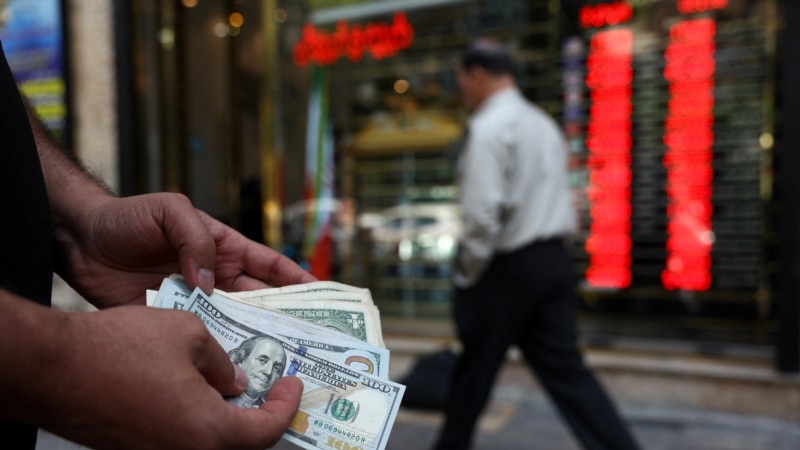
Iran’s already battered economy is showing renewed signs of stress as Washington prepares to unveil what US officials have described as some of the toughest sanctions yet against Tehran.
The Iranian currency fell to a new low on August 24, with the dollar reaching 2,016,400 rials on the open market.
The milestone came as US Treasury Secretary Scott Bessent warned that Washington was preparing an “economic D-Day” for Iran, with tougher sanctions and possible secondary measures against countries and companies that continue doing business with Tehran.
Ahmad Alavi, an Iranian economics professor based in Sweden, says the recent volatility is being driven not only by the country’s longstanding structural problems but also by expectations of what tougher sanctions could bring.
Iran’s economy already suffers from ineffective policymaking, poor governance, sanctions, and a wartime environment, Alavi told RFE/RL’s Radio Farda. But because those underlying conditions have not dramatically changed in recent days, he believes market psychology is playing an increasingly important role.
“A rise in the exchange rate intensifies inflation, and expected and real inflation causes the exchange rate to rise again. This vicious cycle, so to speak, keeps going,” Alavi said. Given the war economy and Iran’s structural constraints, he added, “it seems this will continue.”
Alavi was also skeptical that increasing non-oil exports can provide a quick fix, given Iran’s banking isolation and reliance on intermediaries to repatriate export revenues.
But not everyone is convinced that bolstering sanctions will have the desired effect.
US-based political analyst Ebrahim Roshandel told Radio Farda that sanctions may not necessarily weaken the forces opposed to negotiations with Washington. He argues that sanctions have shrunk Iran’s formal economy while increasing the relative power of opaque, sanctions-resistant networks linked to powerful institutions.
He added that President Masud Pezeshkian has little real authority, describing a government boxed in by parallel, unelected power centers.
“The government, as representative of the people, and Pezeshkian at its head, has no tools at its disposal,” he said, calling it “merely a bureaucratic government” sidelined by the Islamic Revolutionary Guards Corps (IRGC) and other powerful entities that answer only to the supreme leader.
“Sanctions haven’t punished opponents of a deal, they’ve financed them,” he said, arguing that every month of delay increases the IRGC’s share of the economy and decision-making power.
