

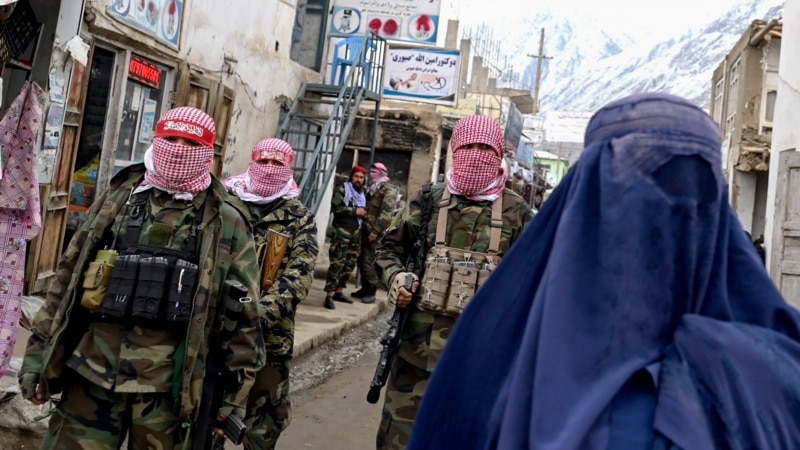
The absence of war in Afghanistan in the five years since the Taliban retook power as international forces withdrew from the country doesn’t mean security for the Afghan people, according to a panel discussion hosted by Radio Free Europe/Radio Liberty.
The panel — featuring RFE/RL Vice President and Chief Operating Officer Lisa Curtis, former US national-security adviser General H.R. McMaster, ex-Afghan Ambassador to Norway Shukria Barakzai, and regional expert Ahmad Khalid Majidyar — noted that while it has been five years since the Taliban seized back power, Afghanistan remains at a critical crossroads, with women sidelined from public life, the free press muzzled, and civil society stifled.
“Security is more than absence of war,” Barakzai told the panel, knocking down the argument made by Taliban officials that they have brought stability and security to a country ravaged by decades of war.
“If a girl cannot go to school, a woman cannot go to work or a woman cannot move freely, a journalist cannot speak out in Afghanistan and cannot cover the issue, if the people cannot participate to decide what their country’s future is, that is not a genuine security.”
When they seized power in August 2021, Taliban officials promised Afghans would have more freedoms and rights than under the strict regime that previously held power. But the Taliban-led government has failed to live up to its pledges, cracking down hard on many groups, especially women and girls.
The Taliban has largely erased women from public life and imposed severe restrictions on their appearances, freedom of movement, and right to work and study. Over the past three years, not a single female has graduated from university after a sweeping ban on females studying beyond sixth grade.
In a sign of how the Taliban crackdown is showing no signs of letting up, the hard-line regime in late May adopted a new law legalizing the marriage of girls as young as 9 years old. The Taliban’s reclusive chief Mullah Haibatullah Akhundzada has also reportedly issued new directives banning the use of smart phones.
McMaster, a retired United States Army lieutenant general who served as the 25th United States national-security adviser from 2017 to 2018 during the first administration of US President Donald Trump, noted that in order to keep pressure on the Taliban, countries and officials must recognize that this is group is a “transnational terrorist organization connected to Al-Qaeda, connected to Pakistan’s [powerful military intelligence agency] ISI, who arm trade and equip them.”
In addition, the world needs “to weaken their security forces, these arms of the government that brutally repress freedom,” McMaster said.
The Taliban has abolished all democratic institutions and advisory authorities, centralizing decision-making around Akhundzada, who has issued a stream of edicts — many relating to girls and women — without setting out any comprehensive plan or road map to ensure good governance and economic prosperity.
At the same time, the predominantly ethnic-Pashtun Taliban, whose roots lie largely in southern and southeastern Afghanistan, has concentrated power at all levels among its own senior leaders, commanders, and members.
The Taliban has also begun trying to make inroads into the international community, a push analysts say is likely tied at least in part to efforts to attract foreign aid and investment as well as to stabilize the economy.
Meanwhile, the current lack of governance, coupled with growing economic insecurity, has raised concerns among some that Afghanistan could return to being a cauldron of insecurity.
Curtis, who will take over as RFE/RL president next month, said political inclusion is essential for the long-term stability of Afghanistan.
Right now, however, “there’s no way for those who oppose this totalitarian regime to do so without risking harm to themselves or being unlawfully detained,” she added.
“I do think the United States and other like-minded countries are increasingly concerned about the Taliban’s repressive policies, particularly toward women, but also civil society and the media,” she said.
“I think, as we recognize that, we will see greater efforts in the United States to hold the Taliban to account and on Capitol Hill, especially because I know on Capitol Hill that the issue of protecting Afghan women and girls is bipartisan.”
