

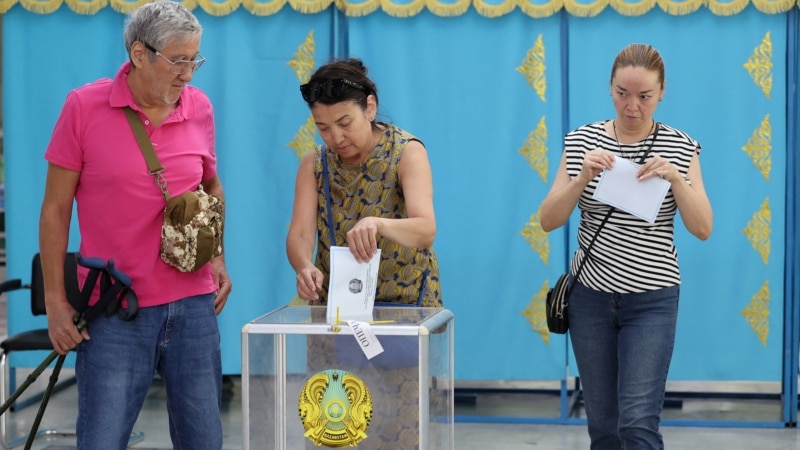
Kazakhstan has elected its new, unicameral parliament in a tightly controlled process following changes to the country’s constitution, with genuine opposition groups excluded from the race.
Seven state-vetted parties contested the election, while opposition groups were denied the status of political parties under legislation used to exclude them.
The Central Election Commission said 72.15% of the more than 12.6 million voters on the electoral register had cast ballots by 6 p.m. local time. Preliminary results are expected on August 24.
President Qasym-Zhomart Toqaev, whose reform agenda paved the way for the creation of the new unicameral parliament, cast his ballot at a polling station in Astana, calling the election an “important historic event” for Kazakhstan. He said the vote was only the beginning of a broader reform effort.
Asked at the polling station whether he plans to seek another presidential term, Toqaev said it was too early to discuss the issue. His comments come after constitutional changes that have opened a legal path for him to seek another seven-year term.
Toqaev also said there would be changes to the government following the election, without providing details.
Under Kazakhstan’s new constitutional system, the formation of a new parliament is expected to be followed by the resignation and re-formation of the government.
The election took place amid reports of pressure on independent activists and media.
Almaty-based civil activist Asset Abishev said police blocked access to his home on August 23, which he described as interference with his right to vote. Police did not immediately comment on the allegation.
Another activist, Nurbol Arterkhan, who is under probation and subject to electronic monitoring, said he was repeatedly required to report to probation officials on election day and that police later visited his home. Arterkhan has previously faced prosecution over statements critical of the authorities.
The restrictions extended to independent election monitoring.
Under the election-monitoring rules, domestic nongovernmental groups receiving direct or indirect foreign funding cannot observe inside polling stations.
This has left independent Kazakh watchdogs outside the official monitoring process.
The authorities say 777 foreign observers are accredited, many representing regional organizations including the Commonwealth of Independent States (CIS) and the Shanghai Cooperation Organization (SCO).
The SCO said its observers had recorded no violations or complaints during the first half of voting on August 23. The SCO mission said it would issue its final assessment after polling, with a news conference scheduled for August 24.
The OSCE Office for Democratic Institutions and Human Rights (ODIHR), whose interim report noted the absence of genuine opposition parties and independent candidates and concerns over restrictions on political expression, is also observing the vote.
More than 70 parliamentarians and staff from around 30 countries were deployed as part of the OSCE Parliamentary Assembly observation mission, its 13th election observation mission in Kazakhstan since 1994.
The OSCE has criticized all of the elections held in this period, noting a lack of genuine political competition in an authoritarian country dominated for decades by presidents Nursultan Nazarbaev (1991-2019) and his successor as head of state, Qasym-Zhomart Toqaev.
The vote also took place amid pressure on independent media.
According to the Committee to Protect Journalists, five prominent journalists have been jailed or convicted since mid-July, while criminal cases have been opened against two others. Several have also been barred from practicing journalism.
The CEC is expected to release preliminary results on August 24, with final results due within seven days. Separately, the OSCE Office for Democratic Institutions and Human Rights (ODIHR) will present its preliminary findings on August 24.
The vote follows constitutional changes approved in a March referendum that replaced the previous bicameral parliament with a single chamber, the Kurultai.
The Adilet party, which absorbed the former ruling party’s political structures as a new vehicle for the post-Nazarbaev era, is expected to dominate the first Kurultai.
A nationwide poll by the Kazakhstan Institute of Public Development put the party at 70.2 percent support, positioning it to further cement Toqaev’s grip on power.
