


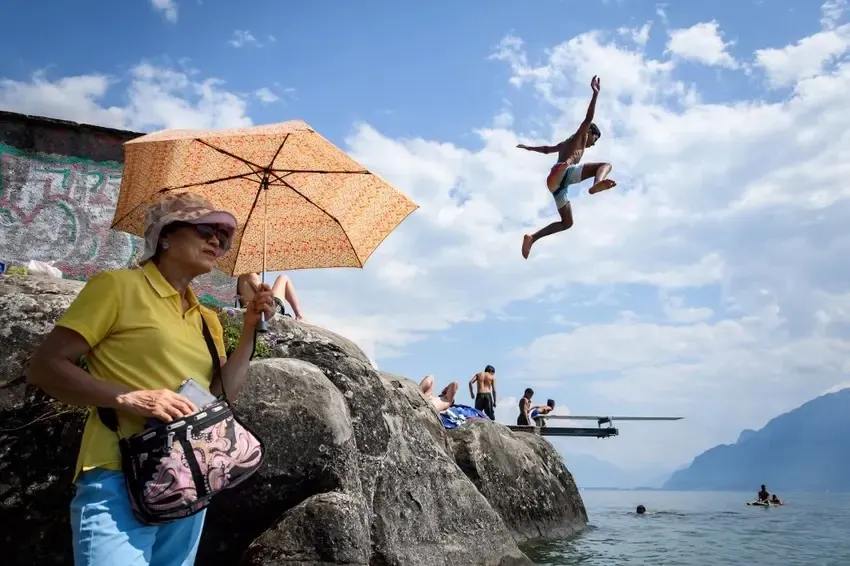
Due to the persistent hot weather, the water in many of Switzerland’s lakes is not refreshing – in fact, it is on the upper range of what is considered ‘normal’ for a summer season. But is it safe to swim in?
According to the Federal Office for the Environment (BAFU), “As a result of climate change, the water temperature of many lakes has risen.”
Typically between 21C and 24C at the beginning on the 21st century, the temperature in some lakes is now measured at 25C to 27C – and sometimes even higher.
You can see the current temperatures in Swiss lakes here.
The hottest at the moment are Katzensee and Mettmenhaslisee – both at 28C, followed by Lake Zurich, Burgäschisee, Greifensee, Lützelsee, Pfäffikersee, and Türlersee. Temperature in all of them is 27C.
Does such warm water automatically mean more bacteria are present, and there is therefore an increased health risk for swimmers?
What lurks beneath
“In principle, bacteria multiply more rapidly at higher water temperatures,” Zurich’s cantonal chemist Martin Brunner said in an interview with 20 Minuten news platform.
“We sometimes also observe fecal microorganisms.”
But though all of this sounds sickening, it is not dangerous.
That’s because “UV rays during sunny weather reduce bacterial counts, particularly in the upper layers of the water,” Brunner pointed out.
In fact, “swimming accidents are far more common than the serious consequences of accidentally swallowing a mouthful of [bacteria-filled] lake water,” he said.
Are there any other health risks you should be aware of?
As The Local reported in July 2025, the blue-green algae present in very warm lake water can be toxic to both humans and animals.
“So if you see any (it often appears as a paint-like layer on the water rather than the long stringy appearance of normal green algae), make sure you steer clear of the often-foul-smelling blooms.”
What about swimming in rivers?
Swiss rivers are cooler in the summer than the lakes.
Typically, their temperature ranges between 13C and 22C, because “melt water from snow and glaciers cools them,” according to the Swiss Federal Institute for Forest, Snow and Landscape Research WSL.
They are therefore much more refreshing to swim in, but that is changing.
WSL’s research shows that due to human-caused climate change and the melting of the glaciers, rivers “are warming up more than expected.”
And the situation will only worsen in future given heatwaves are forecast to become more frequent, hotter and last longer due to climate change, caused by the burning of fossil fuels.


