

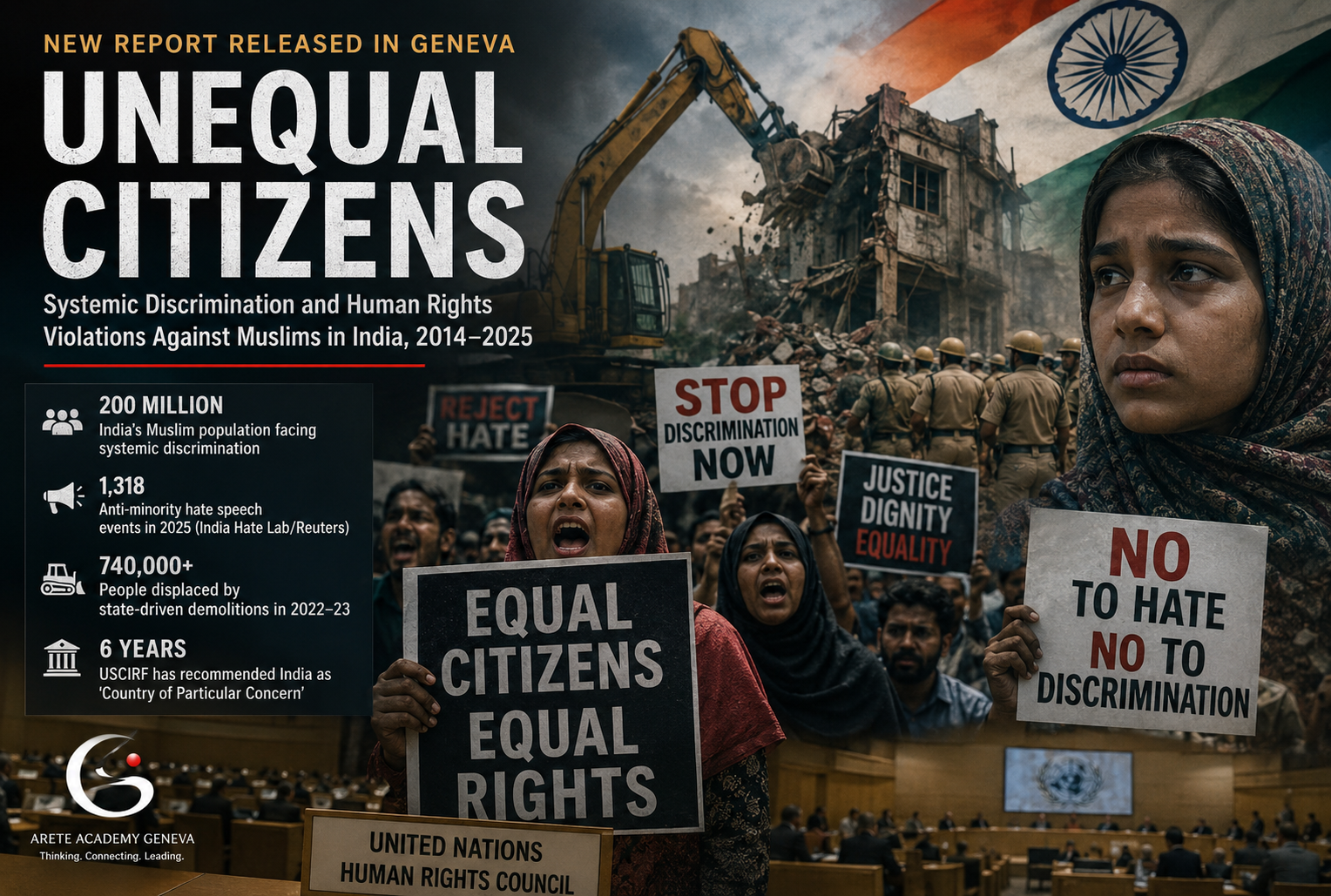
“Unequal Citizens” examines a decade of legislation, communal violence, policing, property demolitions, arbitrary detention and social marginalisation affecting India’s Muslim minority
GENEVA — Arete Academy Geneva has released a major human rights documentation report examining what it describes as a decade-long pattern of systemic discrimination, state-enabled violence and institutional marginalisation affecting Muslims in India.
Titled “Unequal Citizens: Systemic Discrimination and Human Rights Violations Against Muslims in India, 2014–2025,” the report covers developments over an eleven-year period and examines the situation of a Muslim population estimated at approximately 200 million people. It is intended for consideration by the United Nations Human Rights Council, international non-governmental organisations, academic institutions and legal bodies.
The report represents an extensive attempt to bring together evidence from international human rights organisations, United Nations mechanisms, government sources, judicial decisions, quantitative monitoring initiatives and international media reporting into a single human rights documentation framework.
Its central conclusion is stark. Arete Academy argues that the violations documented should not be understood merely as isolated incidents of communal tension or administrative misconduct, but as interconnected patterns operating through legislation, policing, demolition of property, criminal prosecution and broader forms of social and economic exclusion.
A Decade Under Examination
The report begins its review in 2014, when the Bharatiya Janata Party (BJP) came to national power under Prime Minister Narendra Modi, and traces developments through the end of 2025.
Among the issues examined are the Citizenship (Amendment) Act, or CAA; the National Register of Citizens; communal violence; alleged police brutality and extrajudicial killings; the use of counter-terrorism and security legislation; restrictions affecting religious practices; economic marginalisation; and the demolition of Muslim-owned homes and businesses under the practice widely referred to as “bulldozer justice.”
The report also assesses the experiences of particularly vulnerable groups, including Muslim women, young people, Rohingya refugees and Dalit Muslims.
Rather than relying on a single body of evidence, the study says it uses a mixed-methods approach combining secondary-source analysis, comparative legal review and qualitative case documentation. Its evidence base includes material from Human Rights Watch, Amnesty International, the U.S. Commission on International Religious Freedom, UN human rights mechanisms, the U.S. Congressional Research Service, European Parliament material, Indian court judgments and quantitative monitoring organisations.
Reuters, Associated Press, AFP, BBC, Al Jazeera, Voice of America and Deutsche Welle are among the international media sources referenced. The report states that digital evidence was cross-checked against at least two independent sources and cautions that some statistics should be regarded as minimum estimates because of underreporting.
Hate Speech and an Escalating Climate of Hostility
One of the report’s most significant concerns is the documented increase in anti-minority hate speech.
Citing India Hate Lab data reported by international media, the report records 1,318 anti-minority hate speech events in 2025, compared with 668 in 2023 — an increase of approximately 97 per cent over two years.
The report further states that 1,164 of the 1,318 documented events in 2025 occurred in BJP-governed states, arguing that the geographical concentration of such incidents warrants serious scrutiny of the relationship between political rhetoric, institutional behaviour and violence against minority communities.
Arete Academy places this trend within a wider concern about the normalisation of religious hostility in political and public discourse.
Citizenship and the Question of Equal Protection
A substantial section of Unequal Citizens examines the Citizenship (Amendment) Act of 2019.
The report argues that the CAA introduced a religion-based distinction into India’s citizenship framework by providing an expedited pathway to citizenship for members of six specified religious communities from Afghanistan, Bangladesh and Pakistan while excluding Muslims.
It further examines the potential interaction between the CAA and the National Register of Citizens, particularly concerns that Muslims unable to establish citizenship through documentation could face greater difficulty regularising their status.
The report notes that the Office of the UN High Commissioner for Human Rights has described the CAA as “fundamentally discriminatory,” while Amnesty International and the U.S. Commission on International Religious Freedom have also raised serious concerns about the legislation.
The issue assumes additional significance in Assam, where approximately 1.9 million people were excluded from the final National Register of Citizens, according to figures examined in the report.
Delhi 2020 and Allegations of Police Complicity
The February 2020 communal violence in northeast Delhi occupies a central place in the investigation.
At least 53 people were killed during the violence, the majority of them Muslims, while hundreds were injured and thousands displaced, according to sources compiled in the report.
Beyond the death toll, Unequal Citizens focuses on allegations concerning the conduct of law-enforcement authorities and the subsequent pursuit of accountability.
Drawing heavily on Human Rights Watch documentation, the report examines allegations that police officers participated in attacks, failed to protect Muslim residents and disproportionately pursued Muslim activists and victims through subsequent investigations.
The report consequently raises a wider question that runs throughout its findings: whether institutions responsible for protecting citizens have, in particular circumstances, instead contributed to unequal treatment.
Police Violence and Arbitrary Detention
The report also examines the crackdown on protests against the CAA, particularly in Uttar Pradesh in December 2019 and January 2020.
According to figures cited in the report, 23 Muslims were killed, more than 3,000 people were arrested, approximately 5,000 individuals were named in around 350 First Information Reports, and an extraordinary 100,000 “unnamed suspects” were included across police cases.
Arete Academy argues that the use of such large categories of unidentified suspects created the possibility of subsequent arrests on an exceptionally broad scale.
The study also considers more recent concerns raised by UN experts. In February 2026, UN Special Rapporteurs warned of allegations pointing to systemic law-enforcement failures, including excessive force, deaths in custody and torture. The report notes that the experts described allegations of policing violence as “not sporadic, but systemic.”
“Bulldozer Justice” and the Destruction of Property
Among the report’s most extensively documented subjects is the demolition of homes and businesses.
The practice commonly known as “bulldozer justice” has become one of the most controversial features of communal and political disputes in several Indian states.
The report cites research indicating that more than 740,000 people were displaced by state-driven demolitions during 2022–23, while more than 150,000 homes were demolished during the same period.
It further cites an Amnesty International investigation documenting approximately 2,840 demolished properties across multiple states between 2020 and 2022.
The report argues that in a number of cases demolition appeared to function not simply as enforcement of planning regulations but as punishment imposed following communal disturbances or political protests.
India’s Supreme Court intervened decisively in November 2024. In a landmark judgment, the Court held punitive “bulldozer justice” to be unconstitutional, finding that such practices violated fundamental principles including the right to shelter, due process and the presumption of innocence.
For Arete Academy, however, the legal ruling does not close the issue. The report cites subsequent civil-society monitoring suggesting that demolitions continued in 2025, raising questions over implementation and compliance.
Counter-Terrorism Laws and the Criminalisation of Dissent
Unequal Citizens also examines the use of India’s Unlawful Activities (Prevention) Act, or UAPA, against activists, students, journalists and human rights defenders.
The report argues that prolonged pre-trial detention under stringent national-security legislation can itself become punitive when defendants remain imprisoned for years without conviction.
It highlights cases involving Muslim activists associated with protests against the CAA and the aftermath of the Delhi violence, arguing that the contrast between prosecutions of activists and the alleged lack of accountability for individuals accused of inciting communal hostility raises concerns about equal application of the law.
The broader issue, according to the report, is not simply whether a state possesses legitimate counter-terrorism powers, but whether those powers are being exercised consistently with international standards governing freedom of expression, peaceful assembly, liberty and due process.
International Law and Accountability
The report places its findings within the framework of India’s international human rights obligations.
Its legal assessment considers the International Covenant on Civil and Political Rights, the International Covenant on Economic, Social and Cultural Rights and the International Convention on the Elimination of All Forms of Racial Discrimination.
Arete Academy argues that the cumulative evidence involving discriminatory legislation, alleged extrajudicial killings, mass demolitions, arbitrary detention, economic boycotts and state-enabled hate speech constitutes a pattern requiring sustained international monitoring and accountability.
The report therefore seeks to move the discussion beyond individual incidents and toward the larger question of whether multiple institutions and policies, considered together, are producing structural discrimination.
India’s Government Rejects the Characterisation
Importantly, the report also records the Indian government’s rejection of many of the criticisms levelled against its policies.
On the Citizenship Amendment Act, Indian officials have maintained that the legislation is designed to provide protection to persecuted religious minorities from neighbouring countries and does not remove the citizenship rights of Indian Muslims. Prime Minister Modi has publicly stated that Muslims are part of the nation with equal rights.
State governments have generally defended property demolitions as lawful enforcement against unauthorised construction.
India’s Ministry of External Affairs has also strongly rejected USCIRF’s assessments. Responding to its 2025 findings, the ministry described the commission’s report as “malicious” and accused it of misrepresenting facts and advancing a motivated narrative.
These competing positions are central to the international debate: the Indian government insists that constitutional equality and religious freedom remain protected, while international rights organisations and monitoring mechanisms have increasingly raised concerns about discriminatory laws, impunity, communal rhetoric and minority protection.
Recommendations to India, the UN and International Community
The report concludes with recommendations directed not only at the Government of India but also at the United Nations, the United States and the wider international community.
Among its recommendations to New Delhi are the repeal of the CAA’s religion-based exclusion, an immediate end to punitive demolitions, compensation for victims, independent investigations into deaths connected to anti-CAA protests, accountability for police misconduct, safeguards against statelessness associated with the NRC and an end to the deportation of Rohingya refugees where such action would violate the principle of non-refoulement.
For the UN human rights system, the report calls for visits by relevant Special Rapporteurs, greater attention to India during the Universal Periodic Review process and focused scrutiny by UN treaty bodies.
It also urges governments to raise minority-rights concerns through diplomatic channels and calls for stronger international support for independent journalism and human rights monitoring.
A Geneva-Based Contribution to an International Debate
The publication of Unequal Citizens places Arete Academy Geneva within a difficult but increasingly important international discussion: how democratic institutions should be assessed when constitutional guarantees of equality coexist with persistent allegations of discriminatory state practice.
The significance of the report lies not only in individual statistics or incidents, but in its attempt to connect legislation, policing, citizenship, housing, criminal justice, political rhetoric and economic marginalisation within a single analytical framework.
Arete Academy states that the report was prepared for human rights documentation purposes using publicly available and independently verified material, with information drawn from UN agencies, international human rights organisations, peer-reviewed research and major news services.
Its publication comes at a time when questions surrounding religious freedom, minority protection, democratic institutions and accountability in India are receiving sustained international attention.
In presenting the report, Arete Academy Geneva calls on the United Nations Human Rights Council, governments, civil society organisations, academic institutions and legal experts to examine its findings and engage with the evidence it has assembled.
For the international human rights community, the central question raised by Unequal Citizens is ultimately larger than any particular government or political party. It concerns the meaning of equal citizenship itself: whether constitutional guarantees remain effective when members of a minority community experience the institutions of the state not as equal citizens in practice, but, as the report’s title warns, as “unequal citizens.”


