


People from all over the world will flock to northern Spain next week in the hope of witnessing a once-in-a-lifetime experience: a total solar eclipse.
Suddenly, the world is plunged into an eerie, violet darkness. The temperature drops. Birds and other animals, bewildered by unforeseen night, start behaving strangely. Stars and planets appear in the sky next to the blotted-out Sun.
“It feels like it’s the end of the world… you’re changed forever if you see one,” said Elizabeth Warning, one of four self-described “eclipse-chasers” who spoke to AFP ahead of the August 12th event.
However, with devastating fires still raging in some areas of Spain where the eclipse will be visible, the 51-year-old TV researcher may cancel her plans to travel from Sydney, Australia.
“It’s very sad,” Warning said. But as an Australian well-versed with the threat of bushfires, she said her heart went out to people in Spain mourning “lost houses and lost loved ones”.
READ ALSO: How to get free safety glasses for the total eclipse in Spain
She is just one member of a small but growing community who plan holidays around seeing total solar eclipses, which take place every year or two.
Witnessing these remarkable events often requires intricate and expensive travel plans. However the total eclipse in Spain — the first visible in mainland Europe this century — is an easier trip than some in the past.
‘Adrenaline rush’
Ryan Milligan, a solar physicist at Queen’s University Belfast in Northern Ireland, has travelled for 12 different eclipses, to places as far-ranging as Siberia, Chile and the Faroe Islands.
“A total eclipse is not something you see, it’s something you experience,” he told AFP.
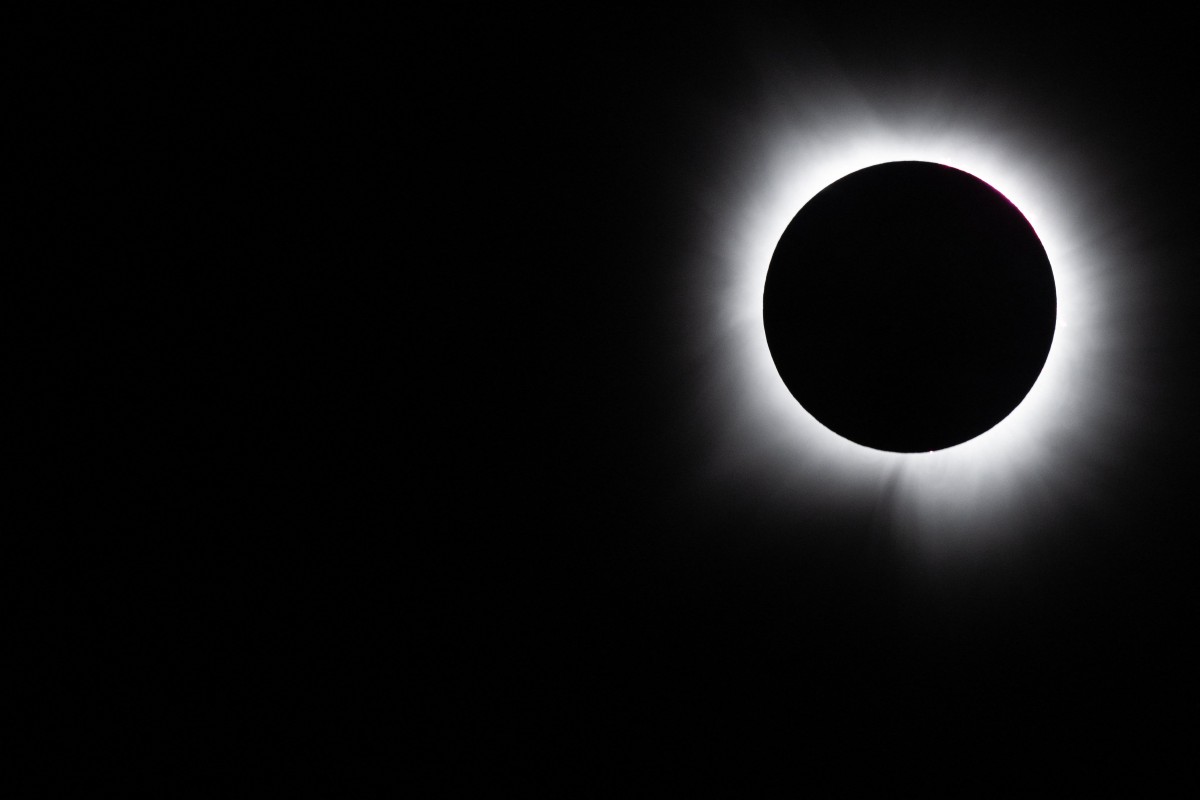
A total solar eclipse on April 8th 2024, seen from Brady, Texas. Photo: Brandon Bell/Getty/AFP
“The temperature drops, the light and the shadows are all in the wrong place, the colours are muted, there’s a 360 degree sunset, the animals go to sleep — these things you cannot convey to people through a picture or a video or a news article,” Milligan said.
READ ALSO: Where to travel in Spain to see the solar eclipse this summer
“It’s that adrenaline rush of trying to experience all that within a few minutes that pushes us literally to go to the ends of the Earth.”
Then once the brief thrill is over, the chasers start planning for their next hit.
“It’s a very expensive, very odd addiction,” Warning said with a laugh.
Lucie Green went all the way to Antarctica in 2021, only to be thwarted by that common enemy of eclipse chasers: clouds.
“I’ve got about a two-thirds success rate,” said the solar physicist at University College London.
Sometimes it works out. Warning described how the “the clouds parted” at the last second in the Faroe Islands in 2015, allowing her to see an eclipse that people just hundreds of metres away missed.
Milligan was one of those who saw only clouds.
“I was distraught… not least because they told me I would have seen it if I’d stayed in my hotel,” he said.
Because they are travelling to the same place at the same time, members of this small community often meet up.
For example, while driving in the extremely remote northwest Australia to see an eclipse in 2019, Green said she bumped into Milligan.
‘Breath-taking’
For next week’s eclipse, Jenny Winker, a 60-year-old retiree in St Paul, Minnesota, is travelling to northern Spain with nine other family members.
“If you’ve never seen a total eclipse, it is breathtaking,” she said.
While watching smoke from wildfires in Canada drift over Minnesota, Winker said she has also been monitoring the Spanish fires.
Green explained that because the eclipse will occur just before sunset, particles from the fires could create a more “hazy” or “fuzzy” view.
Some chasers are already planning for a total eclipse next year that will be the longest humans will be able to see until 2114.
In Luxor, home to the Valley of the Kings in Egypt, the totality — when the Moon fully covers the Sun — will last six minutes and 22 seconds.
Article by Daniel Lawler


