


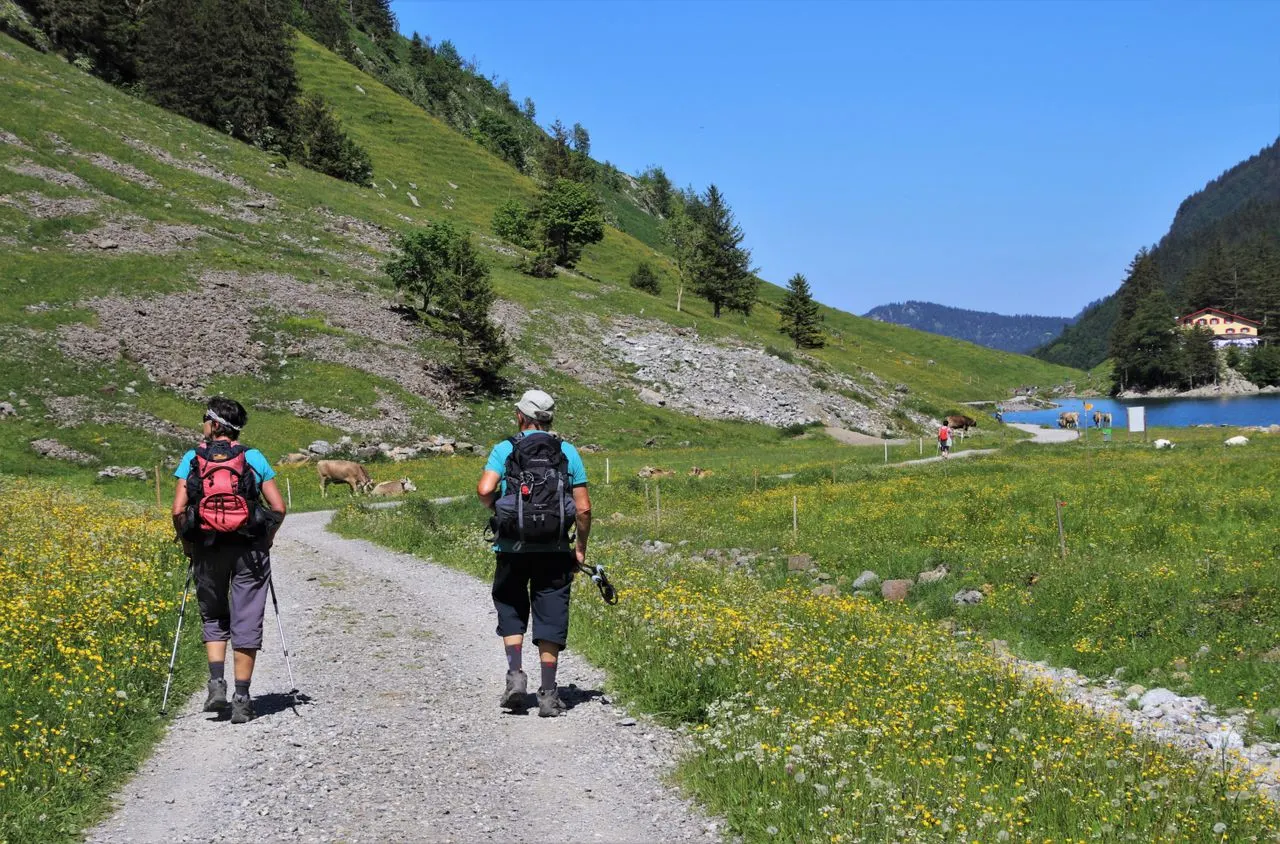
Peak travel season in the Swiss Alps usually falls between December and March, when tourists visit for the winter sports. But record-breaking heatwaves mean this year is different.
During the summer months, Swiss tourists traditionally seek the warm weather of beach hotspots like France and Italy, as well as ones farther away, including Greece, Spain, Portugal, and Turkey.
This year, however, since much of Europe has been sweltering under record-breaking heatwaves, many more Swiss than usual have opted to stay in their own country – and travel upwards rather than outwards.
READ MORE: Where are the worst parts of Switzerland to be in heatwaves?
What is going on?
Call it the ‘great escape’. Tourists are escaping the 30C or more temperatures in most parts of Switzerland for far more comfortable temperatures in the 20s at altitude, and sometimes, depending on the elevation, even cooler.
“The heat is driving Swiss tourists to the cooler mountains,” said Katja Wildhaber, a spokesperson for the Flumserberg (SG) ski lifts.
Up until the end of July, the ski station recorded 15 percent more arrivals than in previous years at the same time.
Numbers are even higher in other Alpine resorts.
Leuzerheide, in Graubünden, recorded a 25.6 percent increase compared to the same period last year, while Engstligenalp in the Bernese Oberland registered 30 percent more Swiss tourists than in the summer of 2025.
And this year another phenomenon has also emerged, according to tourism officials: spontaneous travel.
Though the Swiss normally plan their vacations well in advance, this summer a lot of reservations were ‘last-minute’ and driven mostly by the weather.
Is it really cooler in the mountains right now?
It is.
Just as an example, at the present time, temperatures in the Graubünden resort of St. Moritz, located at an altitude of 1,856 metres, range from 12C in the morning to the maximum of 24C during the day.
At the same time, temps in the canton’s capital of Chur – sitting just below the 600-metre mark, range from lows of 23C to highs of 35C.
Generally speaking, average temperatures in high alpine areas are 10-20C lower than on the plain.


