


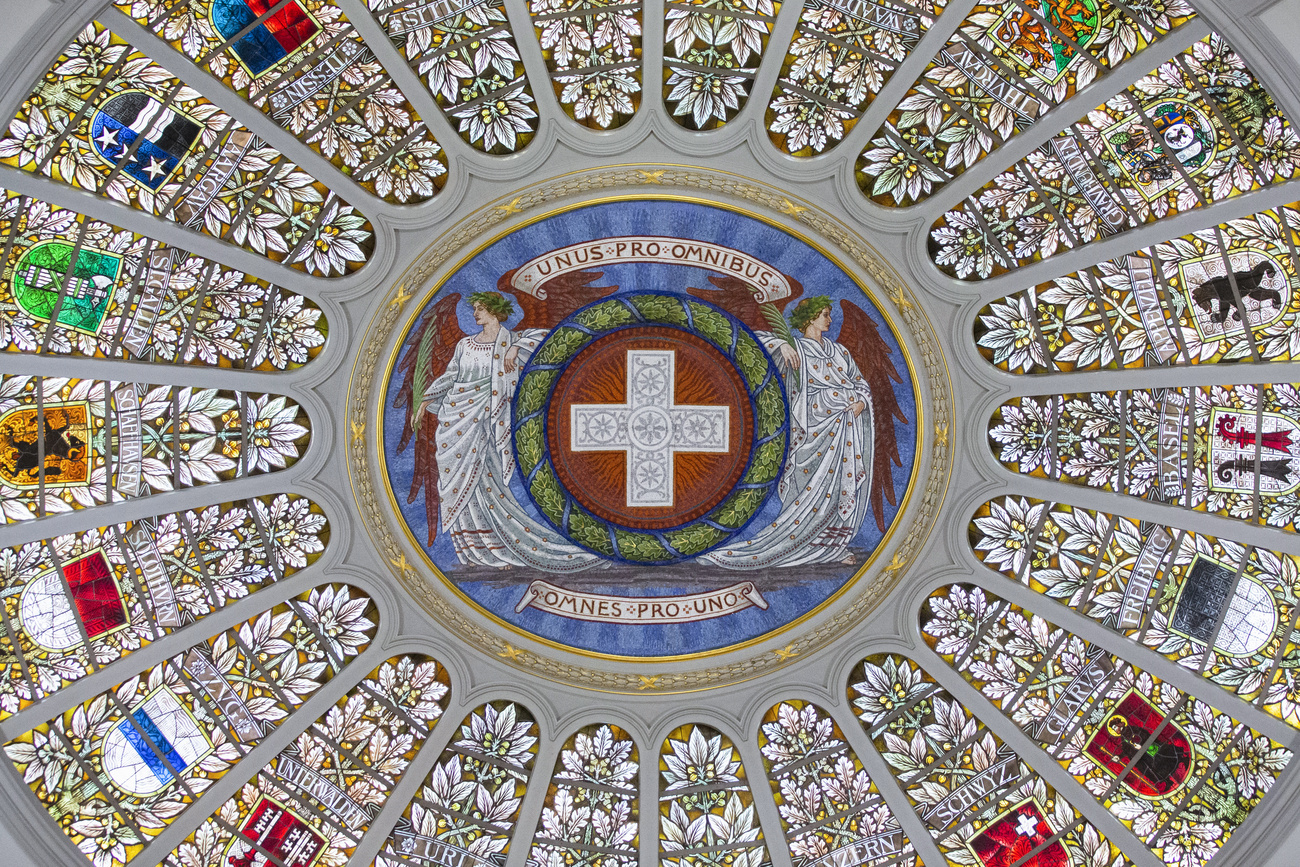
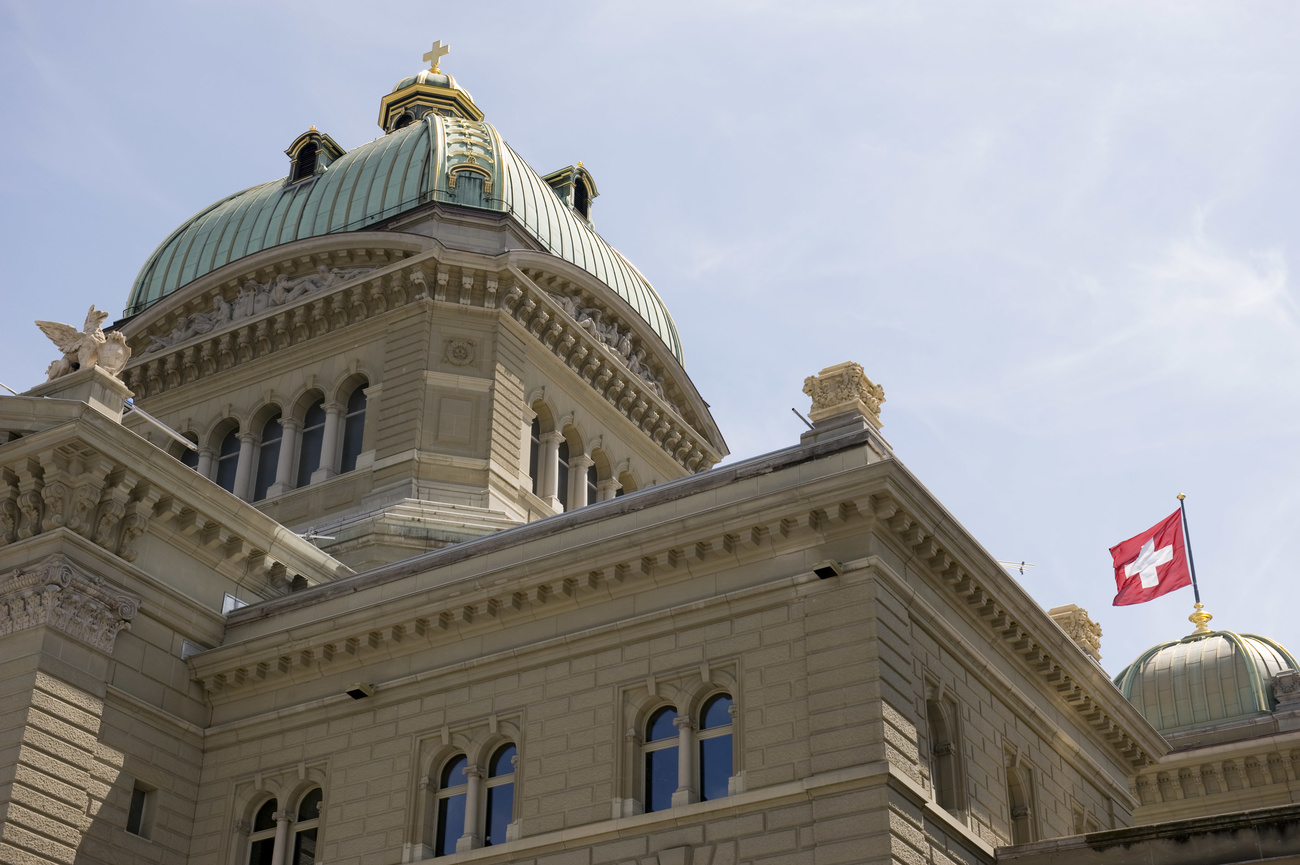
A tribute to federalism: the central, domed hall in Swiss parliament buildings in Bern.
Keystone / Peter Klaunzer
Switzerland has a motto, albeit not an official one. Closely interwoven with the nation’s best-known founding myths, the phrase “Unus pro omnibus, omnes pro uno” is part of the invisible fabric that has held the country together since the dawn of the federal state.

On hearing the words “one for all, all for one”, many would first think of Alexandre Dumas’s The Three Musketeers – although, to be exact, D’Artagnan and his companions say it the other way around (“all for one, one for all”). For Switzerland, however, it is much more than just a literary quote. It is the country’s de facto motto.
“It encapsulates federalism in only six words,” explains journalist and Swiss history expert Jonas Marti.
Overcoming mutual mistrust
The origins of the phrase are lost in the mists of time, and it is impossible to say who first uttered it on Swiss soil. It became popular above all in the mid-19th century when Switzerland became a modern federal state, in 1848.
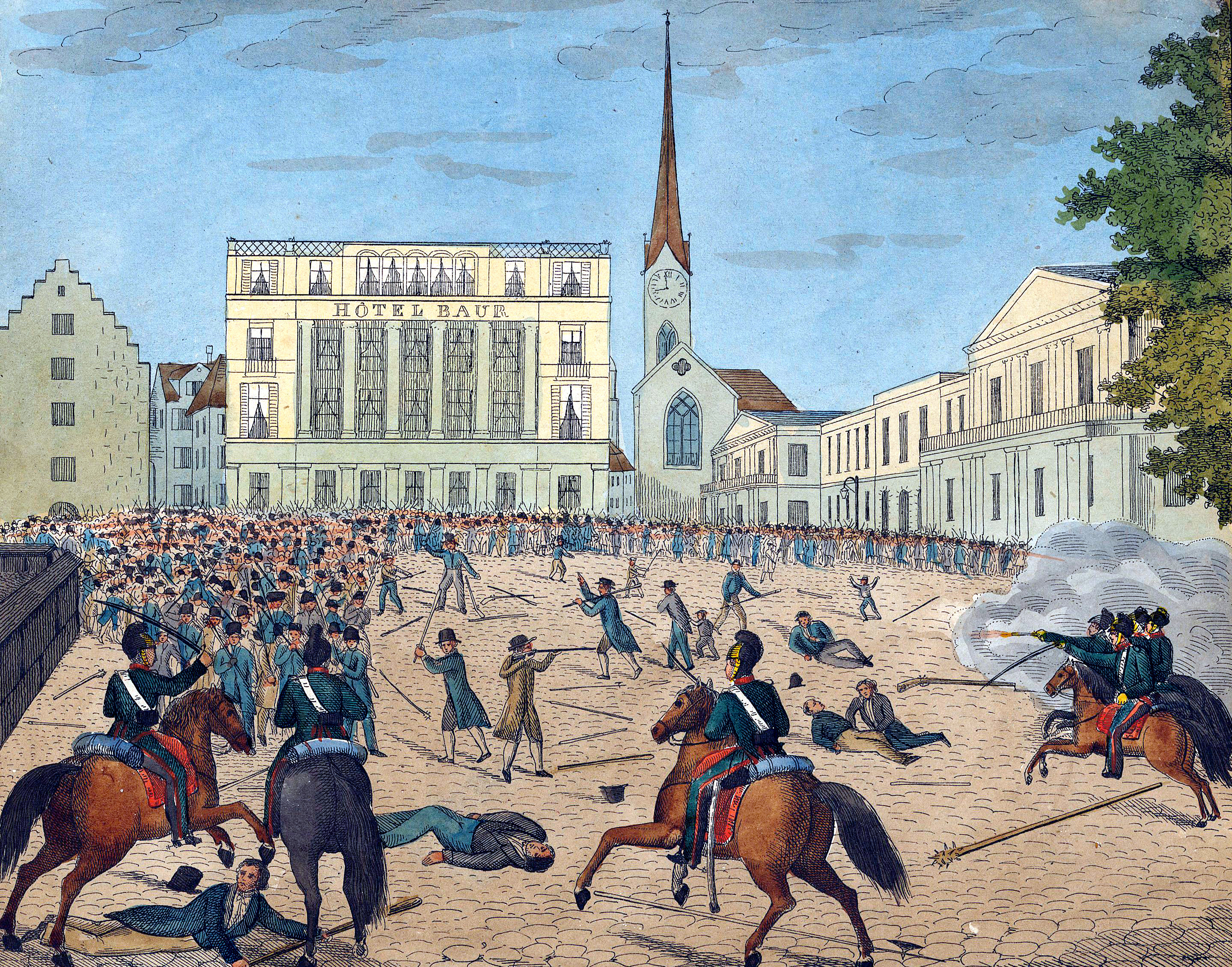
This moment was, as Marti describes it, “a huge revolution”, as it forced the cantons to hand over part of their sovereignty to Bern. The process was far from painless. It sparked considerable resistance, stemming as much from economic interests (in particular the loss of revenue from customs duties) as political distrust between conservative and liberal cantons, after the latter emerged victorious from the Sonderbund civil war of 1847.
More
More
Putsch: the most revolutionary Swiss-German word in the world
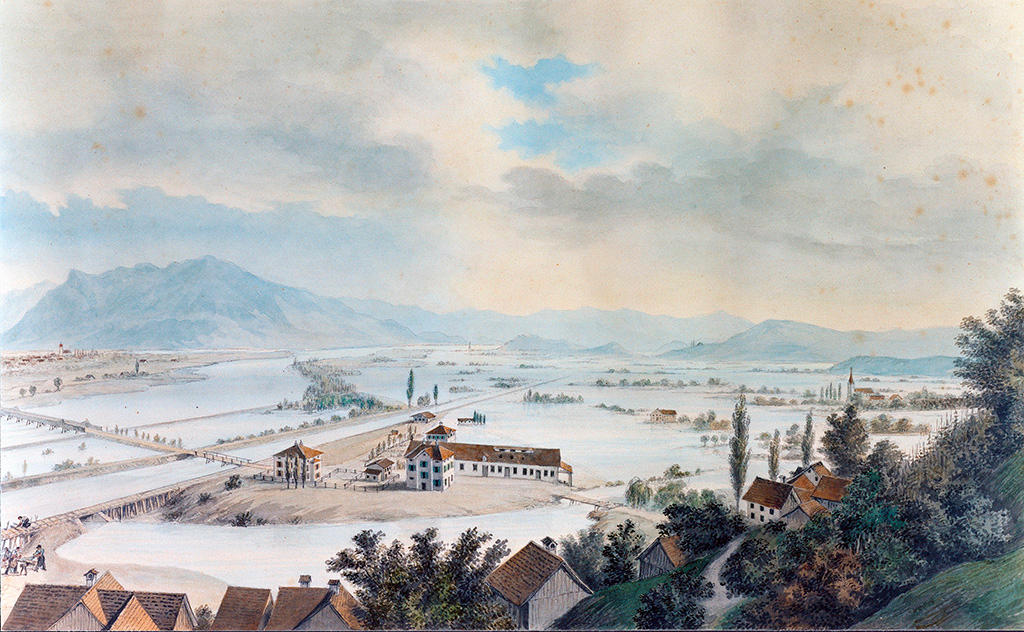
The motto also gained prominence after two tragedies. “One for all, all for one” was the slogan used for the fundraising campaigns organised after the Glarus fire of 1861, which reduced two-thirds of the city to ashes, and the floods that struck several cantons in 1868, especially Ticino, Valais, Graubünden, Uri and St Gallen. Fifty-one people lost their lives in the floods, and the damage came to around CHF40 million at the time – almost CHF1 billion ($1.2 billion) today.
More
More
The natural catastrophe that changed Switzerland
In the aftermath of these disasters, “the phrase explained in simple terms why a citizen of Zurich, for example, should be concerned about – and pay for – something that had happened in another canton,” says Marti.
Like a hammer in the hands of a skilled blacksmith, the motto forged Swiss intercantonal cohesion and solidarity, come what may.

Commemorative sheet marking the revision of the Swiss federal constitution in 1874.
Public domain / Zentralbibliothek Zürich
A few years later, the authorities used it for a more subtle purpose, as noted in a blog articleExternal link by the Swiss National Museum, namely to promote and present the overhauled federal constitution of 1874; this introduced the optional referendum and fundamental rights such as freedom of conscience and worship, among other things.
Since 1902, the Latin version “unus pro omnibus, omnes pro uno” (chosen so as not to upset any of the different linguistic regions) has adorned the inside of the dome of the Swiss parliament building, the Federal Palace – itself a symbol of federalism, built with materials sourced from across the country. The Federal Palace “embodied how Switzerland wanted to present itself to itself”, explains Marti.
Despite occupying such a prestigious place, the motto has never become official, however. This illustrates another Swiss characteristic, that of allowing national symbols to take root through custom rather than by the will of the authorities. This is perhaps a way to avoid unduly fuelling the cantons’ mistrust of a central state and its top-down regulations.
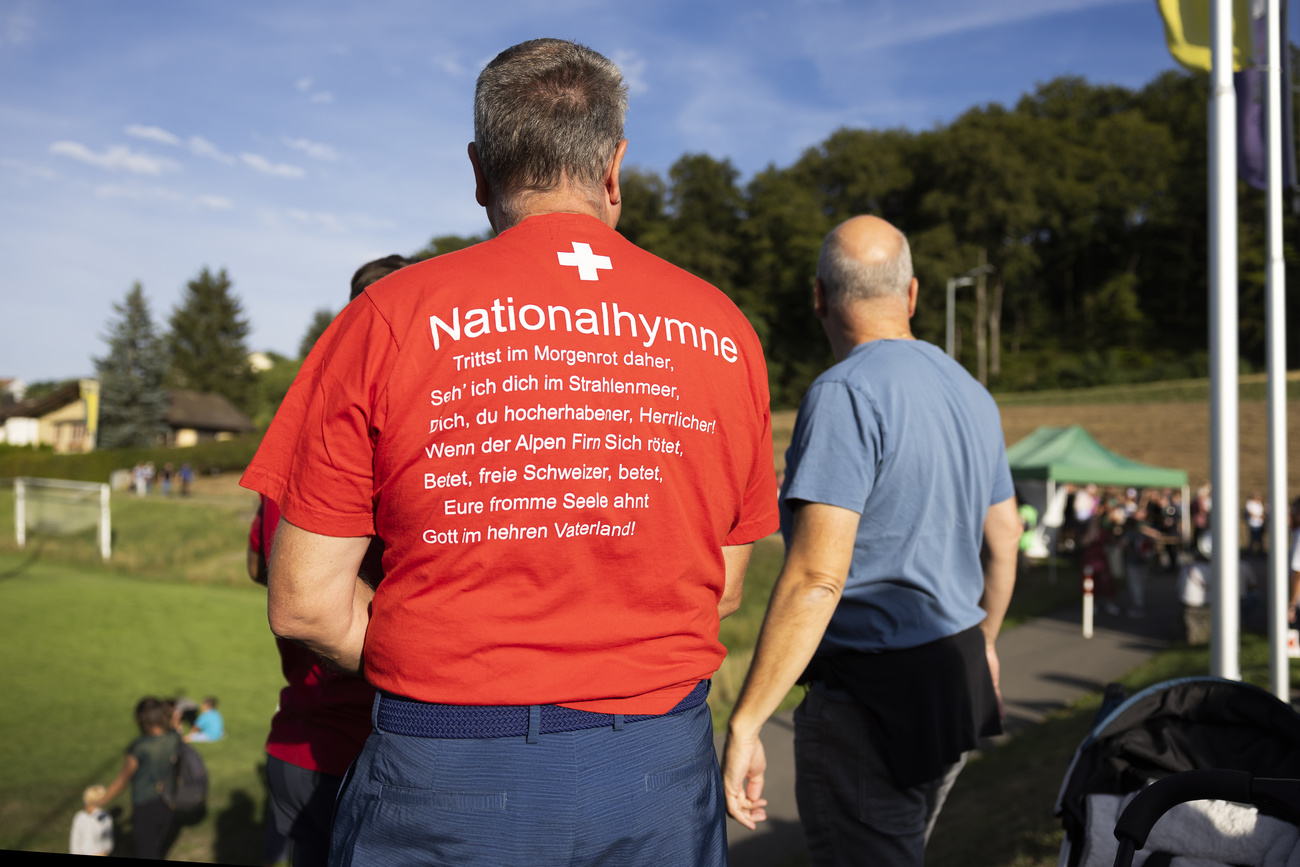
>> The Swiss government showed reluctance before formally adopting the national anthem:
More
More
The Swiss national anthem: outdated but resilient
But “One for all, all for one” is not just a nice phrase, detached from time and place. In Switzerland, it is associated with a specific national myth, as bloody as many national myths (see Romulus and Remus, or Joan of Arc). To understand this, we must take a step back into the distant past.
Death of Winkelried
Sempach, near Lucerne, 1386. In the heat of battle, Arnold Winkelried of Nidwalden sees his comrades fall to the long lances of the Habsburg troops. The Swiss Confederates’ short weapons are proving tragically ineffective. “If only we could force a small breach!”, Winkelried says to himself, and makes a drastic decision.
“I’ll clear the way for you!” (one for all), he shouts, spreading his arms wide. “Take care, dear fellow citizens, of my wife and children!” (all for one), he exclaims, and throws himself into the sharp pikes, taking down as many as he can with his body. By letting himself be impaled, he creates the vital breach. The “dear fellow citizens” rush through, slaughter the enemy, win the war, free themselves of the Habsburg yoke and consolidate the Swiss Confederation. A myth is born.
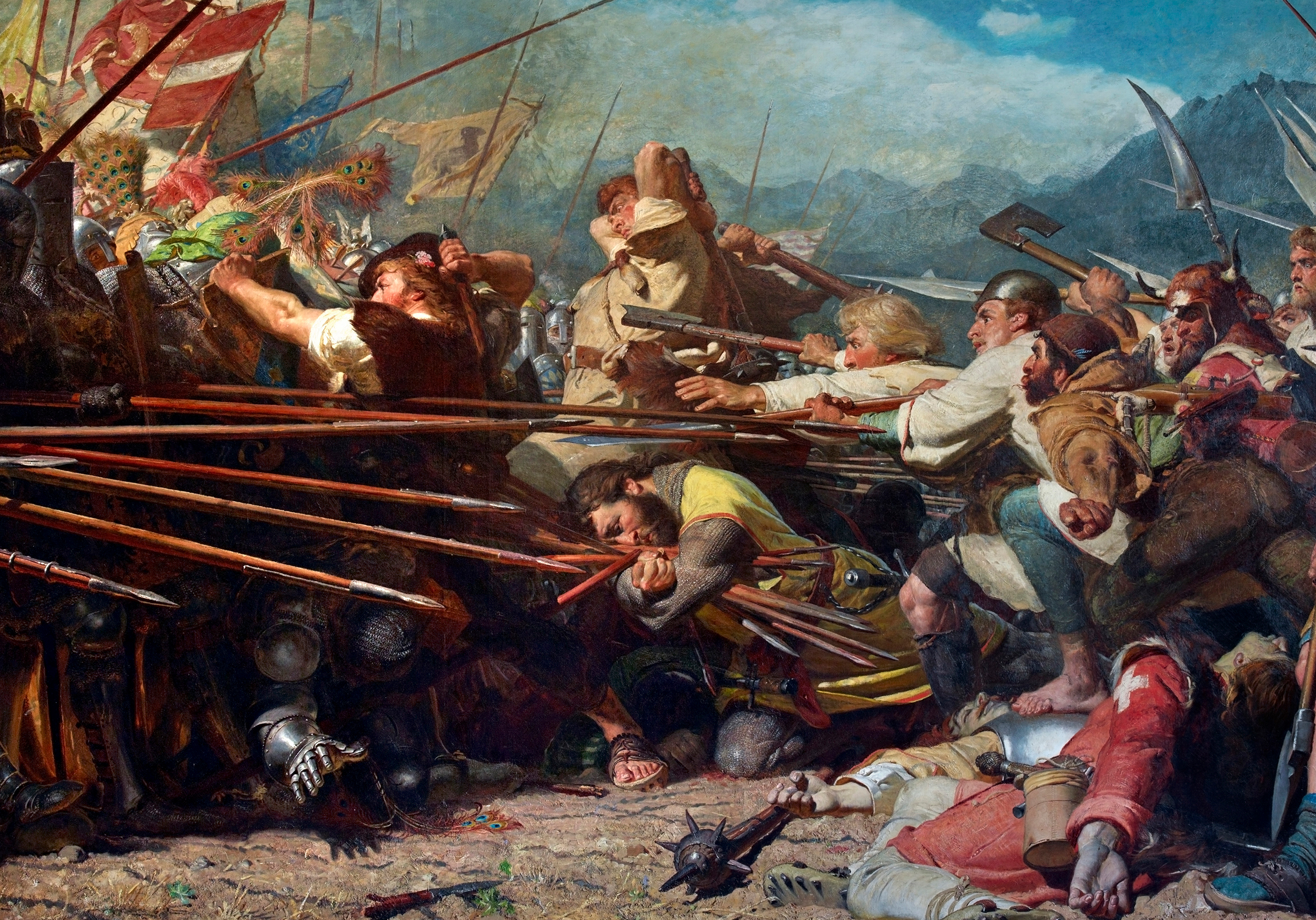
“The Death of Winkelried at Sempach”, by Konrad Grob (1828–1904).
Public domain / Konrad Grob
There is no evidence that Winkelried ever existed. The first account of his heroic deed and the words he is said to have spoken dates back more than a century later, appearing in the Halbsuterlied of 1533, according to the Historical Dictionary of SwitzerlandExternal link. “The legend arose from the need to strengthen the sense of cohesion within the fragile system of confederate alliances, which was threatened by internal conflicts, and from the 17th century it became firmly rooted in popular culture,” the dictionary says.
The motto is also echoed in another founding story, that of the Federal Charter of 1291, which is closely linked to the legendary Rütli Oath. This was named after the Rütli meadow in central Switzerland, where representatives of the three founding cantons (Uri, Schwyz and Unterwalden) set aside their mistrust, and their differences, for the greater good. It was an alliance of mutual aid, directed, in this case too, against the Habsburgs.
Neither Winkelried nor the founding fathers actually uttered the words “one for all, all for one”. Yet their stories can be summed up in this phrase, which became the perfect motto for Swiss federalism.
Constantly renewing vows
The Habsburgs no longer pose a threat, but the power of the slogan “one for all, all for one” remains as relevant as ever; for, although times have changed, federalism “is by no means natural” and should not be taken for granted, Marti stresses. Even today, he notes, a person living in Italian-speaking Switzerland, for example, has very little in common – in terms of priorities, needs, language and mindset – with a fellow Swiss in the northernmost canton of Schaffhausen.
More
More
Why Switzerland hasn’t got a capital city
The beauty of Switzerland, he is convinced, lies precisely in this choice to remain united despite all the differences, because it is better to stand together than alone. However, it is a relationship that must be continually nurtured, especially when times are hard.
“It’s rather like a marriage between 26 husbands and wives. Every day, the marriage vows must be renewed in some way.”
This task is regularly seen to by the seven members of the government. In their speeches, they often invoke this motto, which has lost none of its rhetorical power.
During the Covid-19 pandemic, then-Health Minister Alain Berset used it repeatedly to emphasise collective responsibility, when urging the public to stay at home to prevent the spread of the virus.
In 2019External link Italian-speaking Foreign Minister Ignazio Cassis used it to describe the essence of a country united not by a single language but by a cohesion pact in which intercultural understanding is a daily endeavour.
In his 2013 New Year’s addressExternal link, Ueli Maurer, former defence minister and later finance minister, paraphrased it to ask the people to temper their expectations and promote a spirit of community. “Swiss society cannot function in the long term if we only ask ourselves what the state should do for us.”
Meanwhile, Doris Leuthard, who held the rotating Swiss presidency in 2010, concluded her August 1External link address with this motto, after stressing Switzerland’s humanitarian duties towards the rest of the world and calling for mutual respect in political debate.
There are many more examples going back over a century. One can’t help wonder, however, how different these speeches might have been if Winkelried, instead of uttering those heroic words before throwing himself onto the enemy pikes, had shouted what many schoolchildren who were forced to study his legend think he actually said: “Which idiot pushed me?!”
More
Edited by Daniele Mariani. Adapted from Italian by Julia Bassam/ts


