


Residents of the Spanish island of Mallorca gathered in Palma on Sunday to protest how overtourism is leading to spiralling property prices and dwindling living standards for locals, with the demo ending with clashes with police.
According to local police, around 25,000 people joined the march in the capital, while organisers said where were around 70,000.
The demonstration was organised by the group ‘Menys Turisme, Més Vida‘ (Less Tourism, More Life) and was supported by 134 social organisations across the Balearic Islands.
Protesters are denouncing the current living situation in the archipelago, from the very high cost of living, to the housing deficits, environment problems, and more problems brought on by an economic model which favours the tourism industry over local living standards.
Environmental groups, housing rights organisations, unions, families, young people, workers, and retirees all marched through the streets of Palma calling for change, just as they did in 2025 and 2024. However, 2026 has proven to be a year with comparatively fewer protests against mass tourism in Spain.
The march began at Plaça d’Espanya in Palma and wound its way towards Plaça de ses Voltes, near Palma Cathedral.
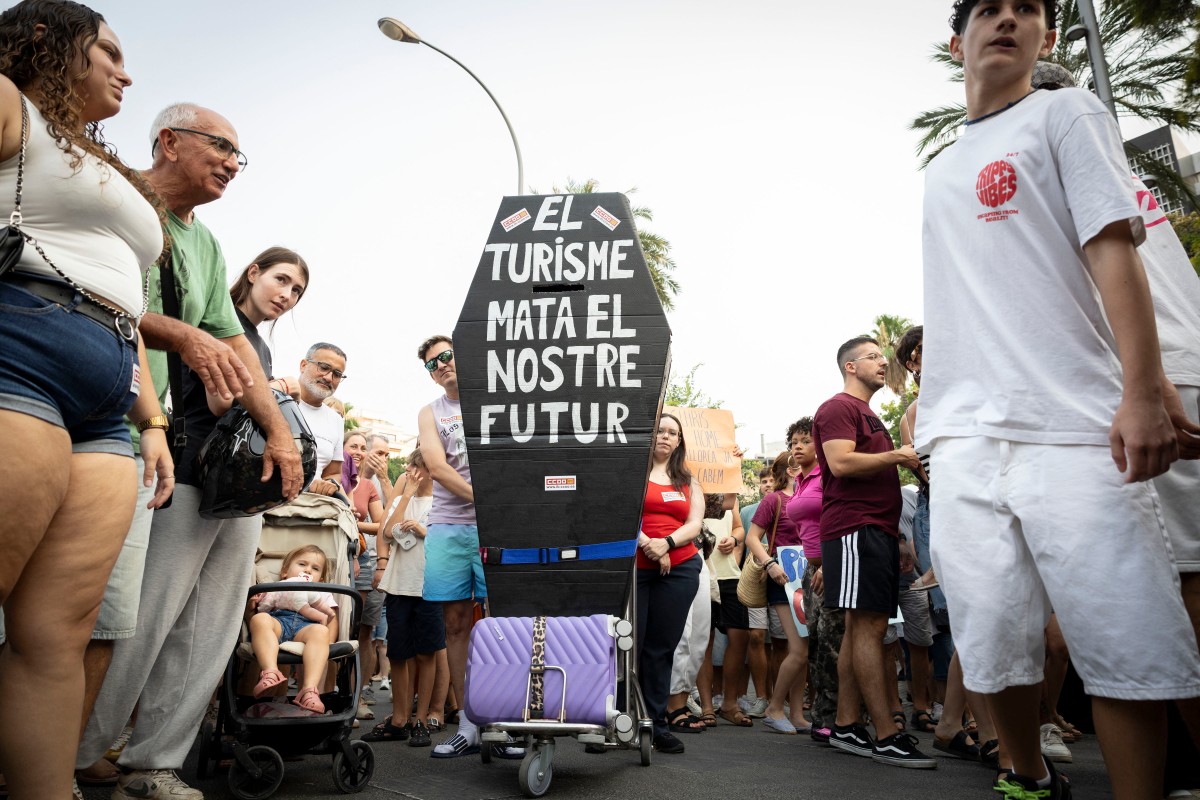
Protesters hold a banner which reads ‘Tourism kills our future’ during a demonstration against overtourism in Palma Mallorca. Photo: JAIME REINA / AFP
It began peacefully, but tensions arose towards the end when police initially refused to let many of the demonstrators into the square, even though maximum capacity hadn’t been reached. Although they were eventually let in, at some point police began firing rubber bullets and using batons against the protesters.
READ ALSO: Foreign buyers in Spain allured by Mallorca’s medieval inheritance laws
According to Spanish news agency Europa Press, some protesters threw objects at the police and were chastised for this by other members of the march. When several demonstrators tried to negotiate with the officers, the police reportedly charged at them using riot gear.
As a result of the skirmishes, around a dozen people were injured, according to the protest organisers. One of the injured is a photojournalist who was covering the demonstration.

Police face protesters at the end of a demonstration against overtourism and housing prices in Palma de Mallorca. (Photo by JAIME REINA / AFP)
Amid the tension, the crowd raised their arms to show they were not resisting and sang La Balanguera, the anthem of Mallorca, as a sign of peaceful protest. One man remains in custody at the National Police station in Palma.
This is not the first time marches have taken place in Mallorca denouncing tourism and its effects on the islands.
Dozens of protests have been held over the last few years across the Balearic Islands with residents mainly sick of overtourism and particularly its effects on the housing market, as well as the instability of employment, with wages insufficient to live decently on the islands and afford rent or mortgages.
There have already been measures introduced to attempt to fix the negative effects of overtourism, ranging from limits on tourist accommodation, to tourist taxes and restrictions on vehicles from outside of the archipelago.

Protesters take part in a demonstration against overtourism and housing prices in Palma de Mallorca. Photo: JAIME REINA / AFP
So far, Menorca has put a limit on the number of vehicles allowed on the island, while Mallorca proposed to do the same just last month.
In February of this year, right-wing parties in the Balearic Islands parliament voted down a proposal to limit property purchases for non-resident foreigners on the archipelago, which many had been demanding.
READ ALSO: How Spain’s Balearics plan to curb overtourism with flight limits
More recently the Balearic Parliament approved its airport co-management law, which will introduce significant changes to strengthen the region’s ability to influence airport management and planning.
This means that in the future, there could be a limit on the number of flights, passengers and goods entering the islands.
According to Spain’s National Institute of Statistics, the Balearic Islands saw a total of almost 19 million tourists in 2024.


