


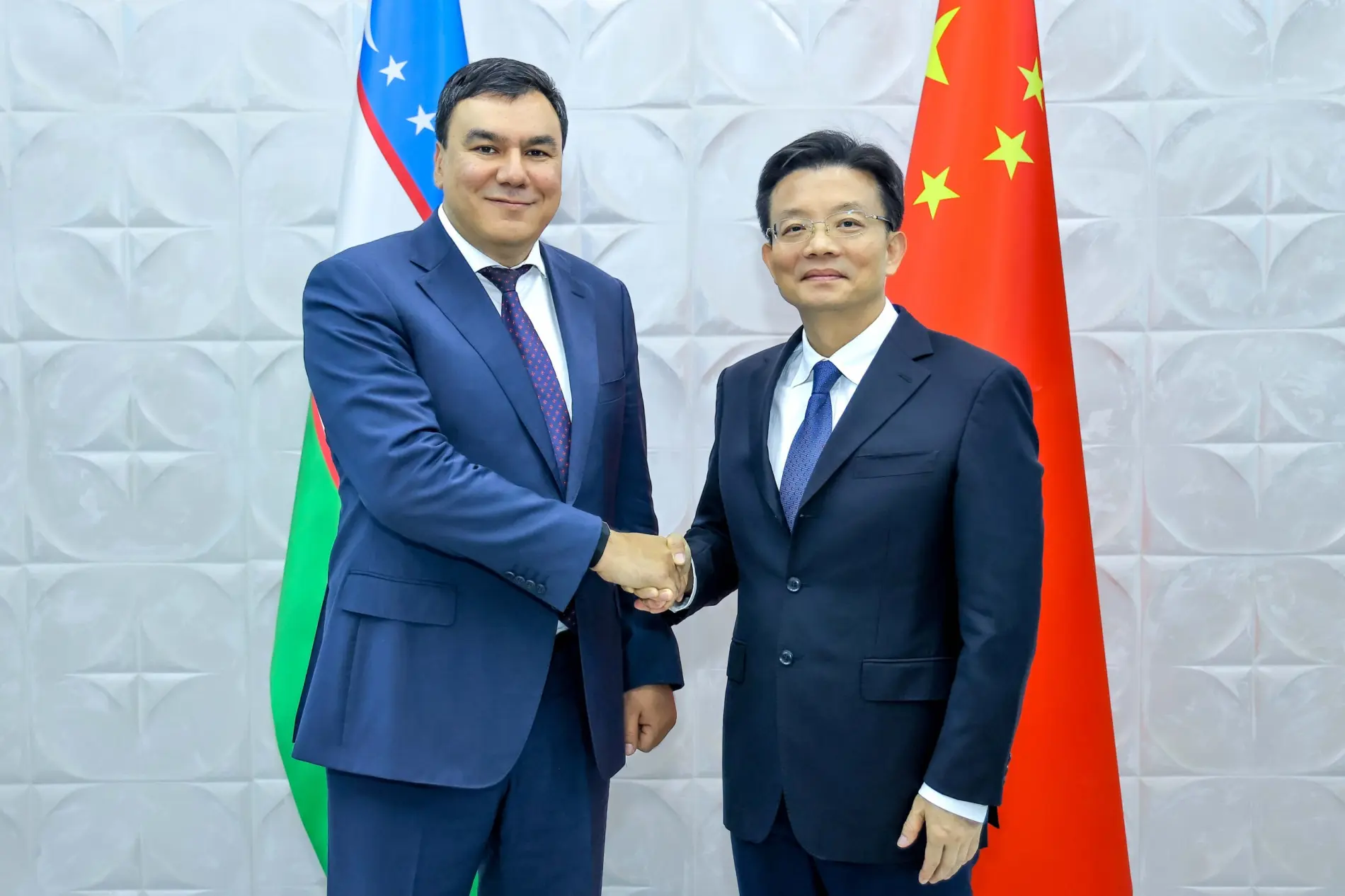
BAKU, Azerbaijan, July 22. Uzbekistan and China
have expanded cooperation on combating desertification and
restoring degraded ecosystems, signing a new agreement on
environmental technologies and sustainable land management during a
forum in Tashkent.
This was reflected in the statement by Uzbekistan’s National
Committee on Ecology and Climate Change.
The event, titled “Advanced Practices in Establishing an
Ecological Shelterbelt in Inner Mongolia,” was organized by the
Forestry Agency under Uzbekistan’s National Committee on Ecology
and Climate Change in cooperation with China’s National Forestry
and Grassland Administration.
The forum brought together Uzbek and Chinese government
officials, scientists, international organizations and
environmental experts to exchange experience on combating
desertification, restoring degraded land and promoting the
sustainable management of natural resources.
Among those attending were Aziz Abdukhakimov, adviser to the
Uzbek president on environmental issues and chairman of the
National Committee on Ecology and Climate Change, Erkin
Mukhitdinov, director of the Forestry Agency, and Shi Guanhui,
deputy secretary of the Communist Party Committee of China’s Inner
Mongolia Autonomous Region.
Participants discussed approaches to expanding forest cover,
restoring degraded ecosystems and introducing modern technologies
in forestry and grassland management, with particular emphasis on
scientific innovation and climate resilience.
A centerpiece of the event was an exhibition highlighting
China’s experience in combating desertification in the Inner
Mongolia Autonomous Region, including progress under the country’s
large-scale ecological shelterbelt program. Delegates also viewed
the documentary Green Silk Road: Rebirth in the Desert, which
showcases China’s Three-North Shelterbelt Forest Program and its
long-term efforts to restore arid landscapes through afforestation
and ecosystem rehabilitation.
Experts from both countries also exchanged experience on
forestry management, ecosystem restoration and the application of
advanced technologies for seedling production and sustainable
forest resource management.
During the forum, Wang Zhaosheng, director of the Forestry and
Grassland Administration of Inner Mongolia, presented China’s
experience in ecological restoration and sustainable forestry,
while Bakhtiyor Pulatov, rector of Green University, outlined
opportunities for expanding scientific cooperation, environmental
education and joint research initiatives between the two
countries.
“A key outcome of the event was the signing of a Cooperation
Agreement between M-Grass Ecology and Environment Group Co., Ltd.
and Green University. The agreement provides for the implementation
of joint projects on seed and seedling production, the restoration
of degraded grasslands, combating desertification and the
introduction of advanced environmental technologies,” the committee
said in the statement.
The agreement builds on earlier commitments reached during the
international China-Central Asia Cooperation on Combating
Desertification conference in Yinchuan and reflects growing
environmental cooperation between Uzbekistan and China. As
Uzbekistan intensifies efforts to expand forest cover and address
the effects of climate change, collaboration with China is expected
to support the adoption of advanced restoration technologies,
strengthen scientific partnerships, and accelerate land
rehabilitation projects across the region.


