


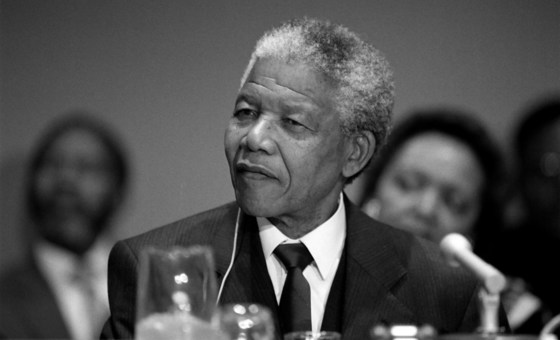
Diplomats stood alongside city officials and neighbourhood volunteers, dishing out plates rather than platitudes, in a small but pointed answer to a question the UN spent Monday asking in more formal terms: what does Mandela’s legacy actually demand of us now?
That question sat at the centre of the General Assembly’s commemoration of Nelson Mandela International Day, where the focus fell squarely on poverty and inequality – and on whether the world is living up to the example Mandela set.
Courtenay Rattray, Chef de Cabinet of the Secretary-General, addresses the General Assembly on the observance of the annual Nelson Mandela International Day.
‘The wrong choices’
Secretary-General António Guterres, speaking through his Chef de Cabinet, Courtenay Rattray, did not mince words.
Mandela understood that the world’s deepest problems come from human decisions – and can therefore be undone by different ones, Mr. Rattray said.
Right now, he warned, the world is doing the opposite: pouring resources into militaries while poverty and development needs go underfunded. “There is something deeply wrong when we spend more on the instruments of destruction and death than on the tools of development and peace,” he said.
South African journalist and broadcaster Redi Tlhabi, addresses the General Assembly on the observance of the annual Nelson Mandela International Day.
Beyond the myth
The sharpest words of the morning came from South African journalist Redi Tlhabi, the observance’s keynote speaker, who pushed back against the softened, reconciliatory image of Mandela that has settled into global memory.
She called him the “Inconvenient Mandela” – a man who stayed principled through imprisonment rather than negotiate his way out of it.
“Only free men can negotiate,” she quoted him telling his captors in 1985, when he was offered freedom in exchange for renouncing the struggle.
Reconciliation, she argued, was never where Mandela started. Justice was. “He never asked his oppressed to become comfortable with injustice. He asked the world to become uncomfortable with injustice,” she said.
Ms. Tlhabi turned that history into a direct challenge for today’s diplomats, pointing to the decades-long stalemate over reforming the UN Security Council – including the case for a permanent African seat – as proof that talk without risk changes little. “What are you prepared to risk for justice?” she asked the room.
General Assembly President Annalena Baerbock addresses the General Assembly on the observance of the annual Nelson Mandela International Day.
Remembrance into action
Annalena Baerbock, President of the General Assembly, opened proceedings by insisting that Mandela Day must mean more than a moment of reflection. The point, she said, is to honour his legacy “not only through remembrance but through action.”
Volunteers from the United Nations and the diplomatic community preparing and serving meals at Refettorio Harlem to mark Nelson Mandela International Day.
That is where Harlem comes back in. The Refettorio Harlem meal service was one of a series of volunteer projects the UN ran with city partners to mark the day, and it gave literal shape to Ms. Baerbock’s point.
Shaffiou Assoumanou, representing Mayor Mamdani’s office for International Affairs, put it plainly: “History won’t judge us by the words we take, but by the actions we take.”
It was a modest event by UN standards – no cameras in the General Assembly Hall, no resolutions attached. But it echoed the same argument running through the day’s speeches: that Mandela’s fight against poverty and exclusion was never only an institutional project.
It played out in neighbourhoods, in shared meals, in the everyday choice to show up. Sixty-seven minutes at a time.

