


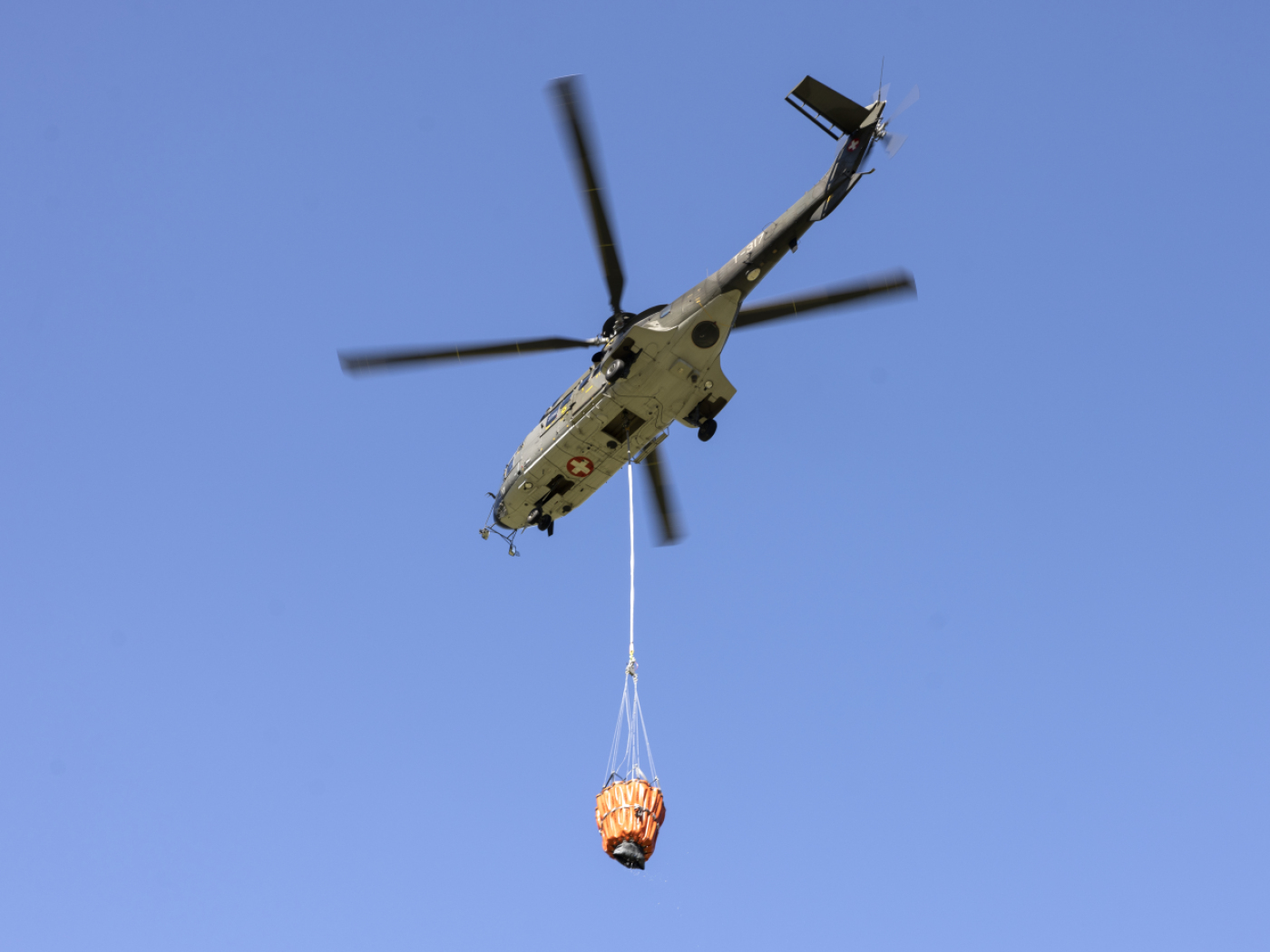
Helicopters must supply water to the St Gallen Alps
Keystone-SDA
Over the past few weeks, water has been transported by helicopter to the Alps in the Swiss canton of St Gallen.
However, according to a new motion tabled in the St Gallen cantonal council, it is unclear who is responsible and when the offers of assistance can be accepted.
The ongoing drought has led to water shortages in various regions of the canton of St Gallen.
+ Should Switzerland prepare for a severe drought this summer?
The Alps in the canton are particularly affected, as their water supply can only be guaranteed to a limited extent due to their location or a lack of infrastructure. “In some cases, water has to be transported to the Alps by helicopter,” read the parliamentary motion.
It is clear that responsibility for ensuring an adequate water supply lies, in principle, with the owners of the alpine pastures. The canton also supports investment in sustainable infrastructure. “Nevertheless, exceptional weather conditions can mean that additional help is required at short notice.”
Depending on the situation, such water transport operations are supported and co-funded by various bodies. The motion lists “municipal or regional crisis management teams, the army, the Coop Sponsorship Programme for Mountain Regions and Swiss Mountain Aid”.
More

More
If you can’t stand the heat … head up a mountain
Not a new issue
However, it appears unclear which body would take charge of coordination in a current emergency, what support options are available, and the criteria under which these might be accessed. “For the affected alpine farmers, this uncertainty is a burden in what is already a difficult situation.”
The issue had already been a concern for politicians following the last similar dry spell. In 2018, there was also a hot summer, and water had to be transported to various alpine pastures. In a report published in December 2018, the government referred to “twelve army helicopter flights to alpine pastures in the Schänis/Amden area”.
The issue was subsequently followed up. The Centre-GLP parliamentary group called on the government to produce a report setting out how the water supply could be secured in future extreme situations. A report of around 100 pages was published on this subject in March 2022.
Drinking water for cheese production
The report classifies the alpine pastures differently depending on whether cheese is produced there. The reason: cheese production requires water of drinking water quality. According to the report, the Alpine pastures in Obertoggenburg, Sarganserland, Werdenberg and the Lake Zurich–Linth region are already experiencing water shortages during dry years.
This situation is set to worsen by 2040. Longer dry spells are particularly problematic in the karst area around the Churfirsten, as rainwater drains away very quickly and the spring water supplies cannot provide enough water for livestock.
Less rain for the Lake Zurich-Linth region
Due to the topography, the Alps in the Lake Zurich–Linth region tend to receive less rainfall during dry summers than the Alps in the Sargans, Werdenberg and Obertoggenburg regions. Consequently, water scarcity issues are felt more acutely in the Lake Zurich–Linth region.
The government has announced measures, including improvements to the infrastructure. One solution is connection to the public water supply. Alpine farms, for which such a connection often involves considerable expense, are receiving support. The St Gallen Agricultural Centre has also drawn up a checklist entitled ‘Drought in the summer grazing area’.
The government will set out the current progress of these improvements in its response to the latest parliamentary motion. “Is there a central point of contact for affected alpine farmers?” is one of the questions raised. A round-table discussion involving all relevant stakeholders is also being proposed. In cases of force majeure, the two cantonal councillors are calling for “water deliveries to alpine pastures without access roads to be organised in an unbureaucratic and timely manner”.
+ How we produce English news
Translated from German, reviewed by an English Department journalist.


