


On October 6,1988, Chileans celebrated their victory in the referendum against Augusto Pinochet in Santiago.
Marco Ugarte / AFP
We asked our users whether they had cast their vote in what was arguably the most consequential referendum ever held under a dictatorship. A few got in touch – including a polling station worker.
Few referendums held under dictatorships have produced a result contrary to the wishes of those in power. One such example is the 1988 referendum in Chile, which marked the end of 15 years of military rule under Augusto Pinochet who seized power in a 1973 coup during the Cold War.
Backed by the armed forces and supported by the United States as a bulwark against communism, his regime became one of Latin America’s most prominent military dictatorships and was responsible for widespread human rights abuses. When voters rejected his bid for another eight years in office, they set Chile on the path back to democracy.
We asked our Spanish-speaking audience whether they had taken part in the vote. A few people responded. One person expressed pride that General Pinochet had accepted the result, as is customary in democracies but unusual under military rule.
Volunteering for the opposition at 16
Only Matilde Mercado Girard agreed to give an interview. The 53-year-old lawyer from Santiago, Chile’s capital, has a Swiss grandfather and is a reader of Swissinfo. She was not eligible to vote herself – she was only 16 at the time. However, she volunteered for the democratic opposition’s parallel vote-counting system.
This article arose from an interaction with the Swissinfo audience and examines the historic referendum from a Swiss perspective.
Augusto Pinochet and his junta ruled Chile following the military coup in 1973.
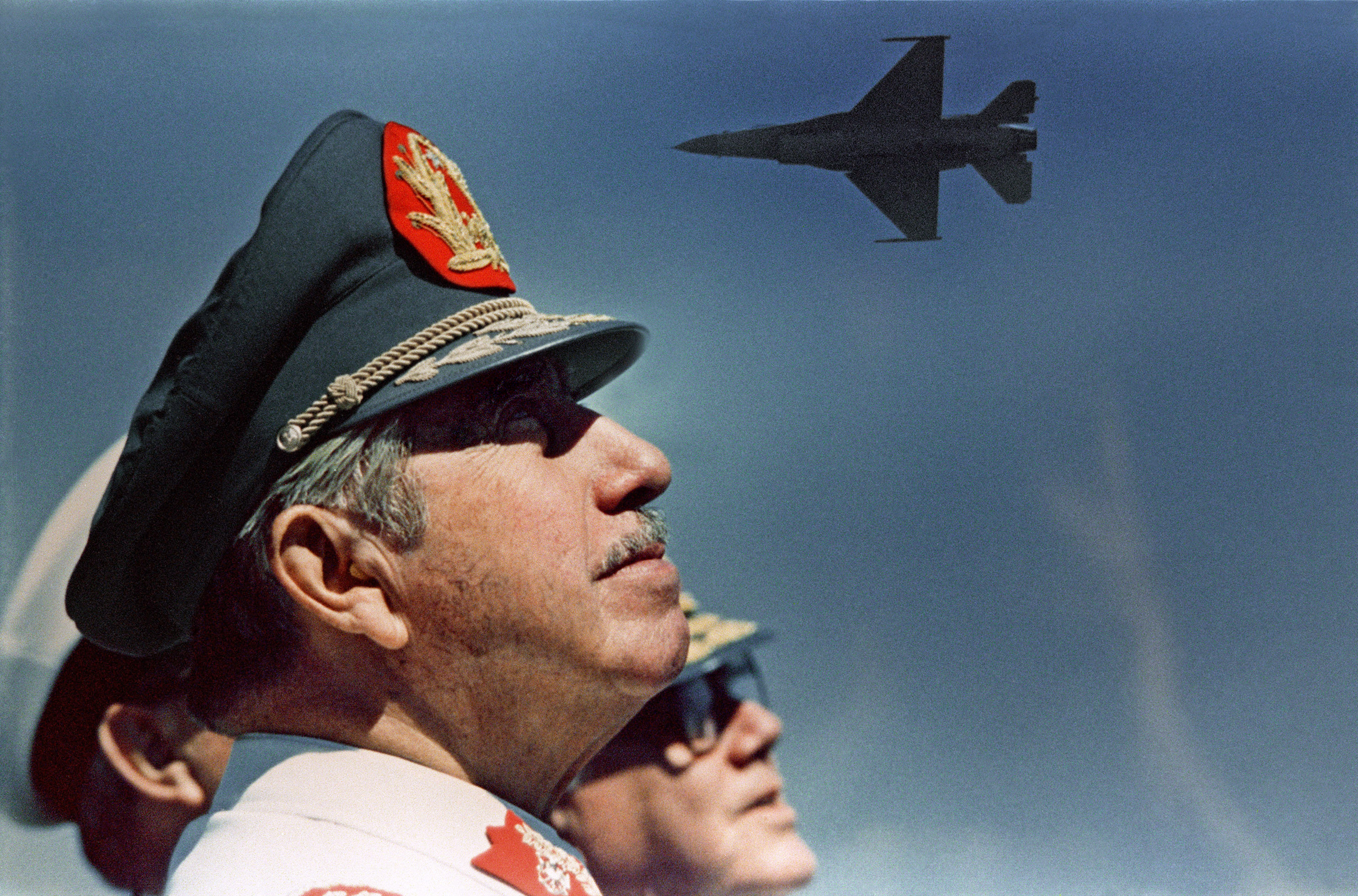
Chile’s dictator, Augusto Pinochet, watches F-16 jets near the El Bosque Air Force Headquarters in March 1988.
Marco Ugarte / AFP
According to Chile’s truth commissions, more than 3,000 people were killed or disappeared and more than 38,000 were recognised as victims of political imprisonment and torture during Pinochet’s rule.
Even before 1988, Pinochet – partly due to international pressure – relied on referendums to legitimise his rule. This included the 1980 plebiscite on a new constitution. This constitution stipulated that the dictatorship must be confirmed after eight years by a “yes” or “no” vote.
More

More
What it takes for a referendum to be fair
When dictators set an expiry date
The Swiss political scientist Robin Gut from the Centre for Democracy Aarau explains that the Chilean vote was neither a policy referendum nor an election in the usual sense.
The issue at stake was whether Pinochet should remain in power. However, he adds that the term is still appropriate, as it “simply has little to do with what we in Switzerland understand by a referendum”.
Gut describes the 1988 referendum in Chile as “highly significant” because it was one of the few occasions on which “an autocracy lost a referendum”. According to Gut, other examples include Uruguay in 1980, Poland in 1987 and Zimbabwe in 2000. While Chile, Uruguay and Poland experienced a surge in democratisation following the vote, this did not occur in Zimbabwe. Chile stands out because “the 1988 referendum was already laid down in the 1980 constitution”, says Gut. The dictatorship had “set itself an expiry date”.
According to political scientist Robin Gut, autocracies have learned from their mistakes. Among other things, they are now networking more extensively. Nevertheless, Gut believes there are still lessons that democracy activists today can learn from the events in Chile in 1988:
– The factor of perseverance: “Ten years before Chile’s eventual transition to democracy”, the Chilean opposition sent a delegate to learn from the success of the democracy movement in UruguayExternal link.
– Instead of resorting to boycotts too early, one should “challenge the regime, even if the rules of the game are unfair”.
– Convey positive, hopeful messages.
– Form a united political coalition that is already preparing for the period following regime change.
– If available, make systematic use of international support.
– Granting amnesties and exploiting divisions within the regime facilitates the handover of power. However, this requires “a painful balancing act between the victims’ sense of justice and the process of coming to terms with the past”, according to Gut.
– After the transition, as in Chile, one should treat “regime supporters with respect”.
It wasn’t supposed to be like this. “It was meant to be a move perfectly orchestrated by the dictatorship to ensure Pinochet could remain in power for another eight years,” recalls Mercado Girard. Many were afraid “that we would be duped again, just like in 1980,” she says.
The 1980 referendum was neither free nor fair. One of the many problems was that the Yes and No options were visually distinct on the ballot paper: the Yes vote was placed within the Chilean national emblem. In any case, there was no free campaign in the repressive state of emergency. In some municipalities and regions, the number of voters far exceeded the number of eligible citizens, as political scientist Claudio Fuentes Saavedra noted.External link
More
More
How do autocracies and dictatorships come to an end?
Politics returns to Chile
Despite these concerns, Mercado Girard recalls how, in the years leading up to the 1988 referendum, the political parties reorganised themselves after years underground “in order to peacefully oppose the dictatorship within this framework”. Chile gradually witnessed the return of politics. One could sense people’s fears beginning to fade.
Graffiti denigrated Pinochet as Pin8, a nickname that evoked Pinocchio and cast the dictator as a liar. Nass protests took place. “You got a sense of where people stood – because you’d bump into neighbours at the protests, for example,” she recalls. At school, hardly anyone had spoken out before. “But around 1988, we started to find out who we could confide in about our families and what had happened.” Mercado Girard had relatives who had been imprisoned or had emigrated.
Mercado Girard describes the No campaign, with its now famous song Chile, la alegría ya vieneExternal link, as incredibly upbeat. The aim, she explains, was to allay people’s fears and foster a sense of unity. “It showed that the police officer was just as much a Chilean as those demonstrating against the junta,” she recalls.
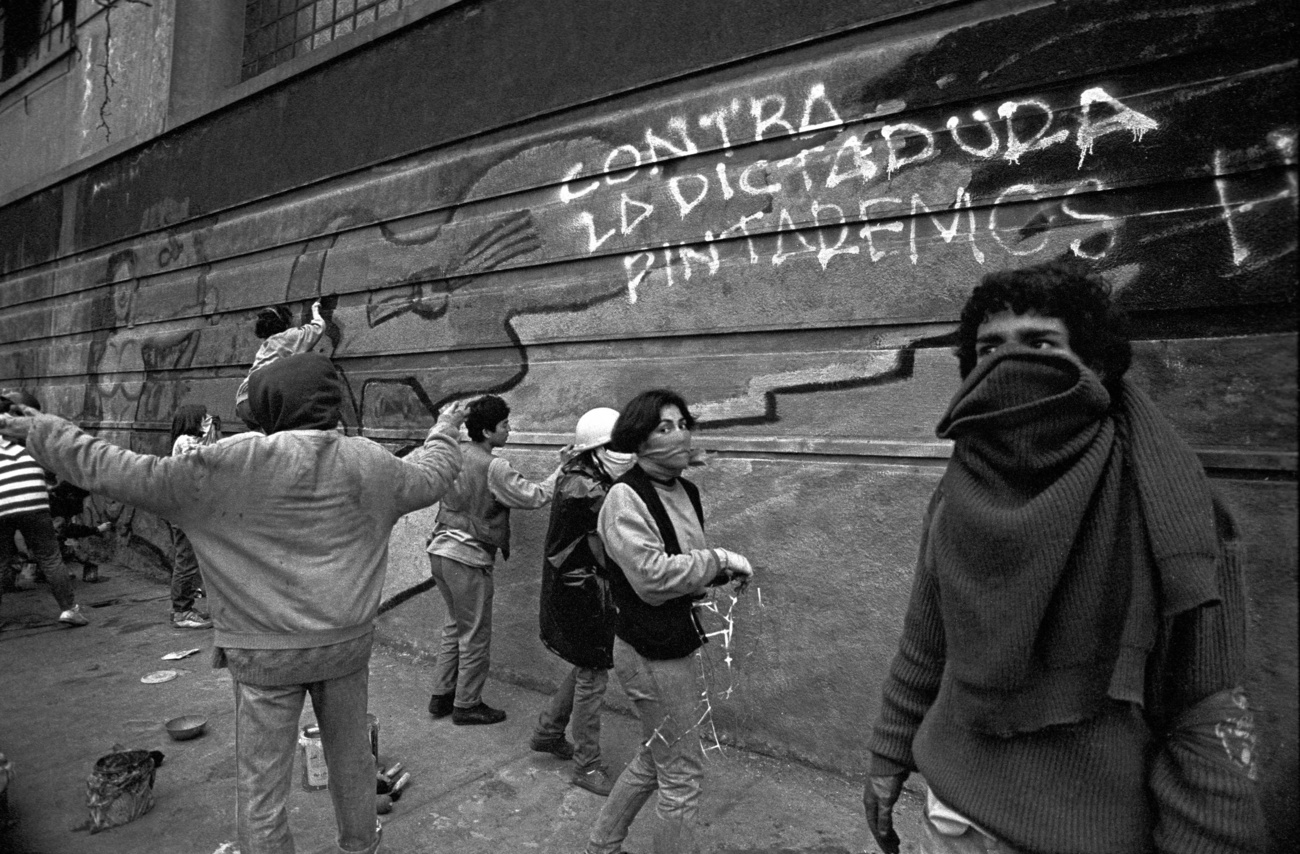
The communist ‘Ramona Parra Brigade’ sprayed graffiti shortly before the vote, on October 1, 1988: ‘We will paint against the dictatorship’, reads the inscription, translated from Spanish.
Jose Giribas / Keystone
All those who wanted to reclaim democracy had worked together. Unlike in 1980, the opposition was given a public platform. Nevertheless, the media largely sided with the dictatorship. “Television reports supporting the No campaign were deliberately broadcast late at night so that as few Chileans as possible would see them,” says Girard.
Unlike in 1980, there was a voter register, and the opposition was able to organise a parallel vote count. “The more people registered, the better our chances were,” recalls Mercado Girard, “because, relative to the total population, the proportion that Pinochet could manipulate became smaller.” She also distributed leaflets for the No camp calling for people to register.
According to Gut, the opposition’s parallel vote-counting system was crucial in preventing a falsified result. This was similar to what happened in Venezuela during the 2024 elections, where Nicolás Maduro’s regime nevertheless insisted on its victory. In Chile in 1988, Mercado Girard was one of many volunteers involved in this parallel system.
Polling day
She was a link in the information chain for the parallel vote count, responsible for passing on the latest tally. When she thinks back to election day, she thinks of climbing stairs. “We looked for information, got it, passed it on to the next person, who then ran out and came straight back in, and it went on like that until it was dark,” she says.
After the work came the joy. “We were ecstatic. It was incredible. Almost all the votes in our area went to the No camp,” she recalls.
Euphoric, she set off for home with a friend – and as they passed another polling station, they saw it was full of soldiers. That was the first blow. The second came when she got home. “The official news claimed that Pinochet wouldn’t lose, but would win,” says Mercado Girard. The television then even switched to a cartoon.
“The official result wasn’t announced until very late, and it was the same figure as that put forward by the No camp. It was around 2am on October 6,” recalls Mercado Girard.
Her cousin and his family had come round and shouted: “Let’s celebrate!” But she was too exhausted. The others went to Plaza Italia to celebrate.
The anxiety was justified. According to reports, it remained unclear well into the night whether Pinochet’s junta would accept the result. According to Gut, “dissidents within the regime” had made it impossible to falsify the results, alongside the parallel counting system.
“In the years that followed, the focus was on restoring democracy, establishing a genuine parliament and an independent judiciary,” says Mercado Girard.
She is reluctant to offer advice to those who today long for democracy while living under a dictatorship. But looking back, she believes one factor mattered more than any other: unity among those seeking democratic change.
“Essentially, it was all about information and organisation,” she says.
More
Edited by Mark Livingston. Adapted from German by Patrick Huwyler/ds


