


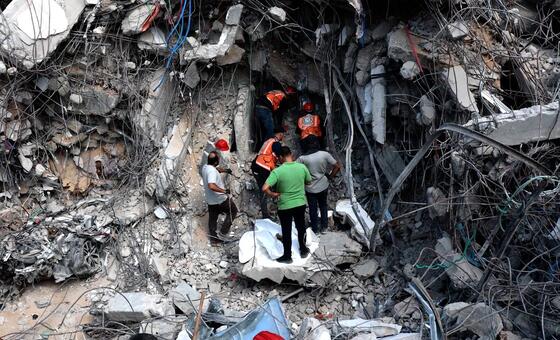
The passage of time and a severe shortage of heavy equipment have made the search and recovery operations increasingly difficult and complex, those working on this mission told UN News.
In one of Gaza City’s neighborhoods, a piece of heavy machinery continues to remove the rubble of a war-destroyed house.
Meanwhile, civil defence personnel and local teams continue digging and combing through debris for the remains of victims believed to still be buried under the rubble for more than two years.
“This building was believed to contain the remains of 44 victims,” said locally based team member Asaad Shreim. “So far, we have only been able to recover 13 of them while the residents and civil defence teams were able to recover the largest number during the first hours following the bombing.”
Waiting to find his family’s remains
Search and recovery operations are still being carried out with limited resources.
Ramez Nabhan lost his wife, children and several family members during the Israel-Hamas war.
The UN confirms that the removal of millions of tonnes of rubble is hampered by Israeli restrictions on the entry of heavy equipment as well as the risks posed by unexploded ordnance scattered among the rubble, which slows down the process of reaching and recovering the remains of victims.
While he watches the excavation work, Ramez Nabhan is waiting to find the remains of his family members who were killed in a bombing that targeted the building where they were staying in the early days of the war.
“I was a father of three children, and I had a wife, and I lost them all at the beginning of the war,” Mr. Nabhan said. “Several missiles fell on this building, and the residents and civil defence teams were able to recover some bodies, including my son, my uncle and his wife.”
Long delayed burials
Mr. Nabhan says that the lack of heavy equipment and fuel during the first months of the war prevented the timely recovery of many victims.
“There was no equipment to extract bodies, no fuel or necessary resources were available, and the conditions were not safe for rescue teams to operate,” he said. “We waited a long time and today, we face a new ordeal: recovering the remains and then burying them.”
During the search operations, local teams were able to recover a number of his family members, and their remains were placed in designated bags in preparation for identification and completion of burial procedures.
The remains of several members of Ramez Nabhan’s family, after local teams managed to recover them from beneath the rubble.
The wound reopens
For thousands of families in Gaza, the tragedy doesn’t end with the loss of loved ones, but extends to the long wait to recover and bury their remains. With each exhumation, the pain of loss is renewed, and the challenges of identifying the victims become ever more apparent.
“It is extremely difficult for the wound to reopen,” Mr. Nabhan said.
“We live between the pain of reliving the loss and the funeral rites. These are my children, and there are no words that can describe what I feel inside.”
Thousands remain missing
As time passes, identifying remains becomes increasingly complicated due to natural decomposition and the limited capabilities of forensic science and DNA testing, prolonging the suffering of families still waiting to learn the fate of their loved ones.
The war resulted in the deaths of more than 71,000 Palestinians and injuries to more than 171,000 others, according to the latest joint damage and needs assessment report issued by the UN and its partners in April 2026.
The UN indicates that thousands of people remain missing, and many are believed to still be buried under the rubble of destroyed buildings amid widespread destruction of infrastructure and residential areas throughout Gaza.
The search will continue for some time to come.


