


Ukrainian Sokol members march through Prague in July 1926.
Photo: Slavonic Library, National Library of the Czech Republic (Courtesy Image)
A museum in Prague that once held nearly a million artifacts relating to Ukraine’s drive for independence was shut down by Czechoslovakia’s communist rulers in 1948. The contents of the museum were scattered and largely lost, but RFE/RL has sourced remnants of the museum that survive in two Prague archives today.
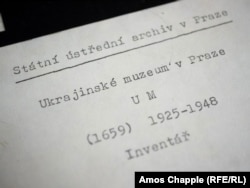
The cover of an inventory listing the contents of the Ukrainian museum in Prague seen in the Czech Republic’s National Archives.
The Museum of the Liberation Struggle of Ukraine was born of the exodus of Ukrainians into Czechoslovakia following the Bolshevik invasion of Ukraine in 1917-21. By the early 1920s, tens of thousands of Ukrainians and Russians fleeing the Bolshevik takeover sought refuge in Czechoslovakia.
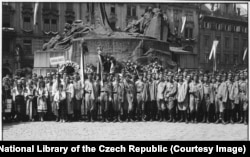
Ukrainians on Prague’s Old Town Square in the 1920s
The young nation of Czechoslovakia was chosen as a safe haven for many due to what Prague called the “Russian Aid Action.” The state initiative was launched in 1921 to financially support around 20,000 Russians, Ukrainians, and Belarusians fleeing the communist takeover of the former Russian empire.
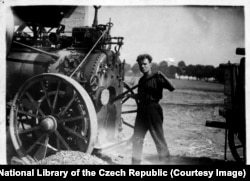
A Ukrainian man working in fields near the Czech town of Pecky in 1928
Olha Zubko, a Ukrainian historian who has written extensively about the 1920s exodus to Czechoslovakia, told RFE/RL that the aid initiative was an effort by Prague to foster future diplomatic ties.
“The Czechoslovak leadership hoped that the Ukrainian emigrants would be in exile only temporarily, and that upon their return home to [an independent] Ukraine, they would remember what had been done,” she said.
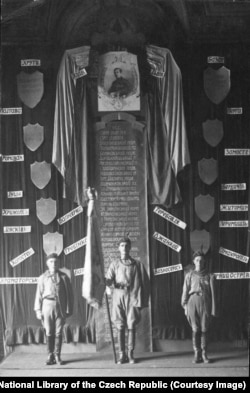
A guard of honor during the 10th anniversary ceremony of the Ukrainian People’s Army in the Czech town of Pardubice in May 1927
The Czechoslovak government actively encouraged the newly arrived exiles to set up their own cultural organizations.
For Ukrainians, whose fight for independence was crushed by Bolshevik forces in 1921, the need for a museum dedicated to Ukraine’s push for sovereignty was seen as a priority.
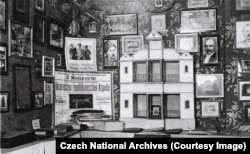
A photograph of a room in the Museum of the Liberation Struggle of Ukraine
In May 1925, the Museum of the Liberation Struggle of Ukraine was founded in Prague. Dmytro Antonovich, the Kyiv-born director of the museum called for donations of “everything” relating to Ukraine’s independence struggle. “What may seem completely unnecessary and unprofitable can sometimes be of great importance and value,” Antonovich said.
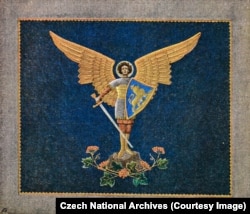
A flag of the Ukrainian Sich Riflemen from the Prague museum’s collection. The Ukrainian volunteer unit fought within the Austro-Hungarian Army in Word War I.
As well as donated artifacts, financial donations poured in from Ukrainians living in exile throughout the world. One letter was sent to the museum from an elderly Ukrainian living in a poorhouse in the United States who wrote that, “sometimes I help the undertaker carry out a dead man and he throws me a few cents for it. So I saved a dollar, which I send to the Museum of the Liberation Struggle of Ukraine in Prague.”
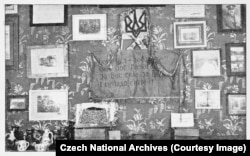
A wall within the Prague museum. A quote from Ukrainian poet Taras Shevchenko is on the banner in the center of the image: “Fight and you’ll be victorious, God is helping you! On your side is justice, glory, and our sacred freedom!”
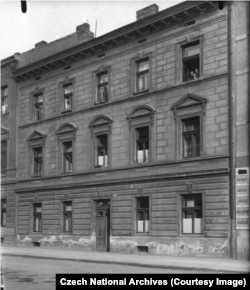
The museum changed locations several times before its founders purchased this building in the south of Prague.
Following the Nazi takeover of Czechoslovakia in World War II, occupying German authorities allowed the fiercely anti-Soviet museum to continue functioning, but financial support from Western countries was cut off.
By the 1940s, the museum reportedly held nearly a million documents, photographs, and artifacts relating to Ukrainian nationhood.
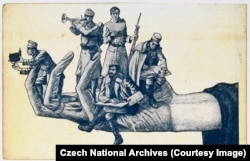
A 1916 illustration from the museum’s collection depicting Ukrainian Sich Riflemen
The beginning of the end for the museum came in February 1945 when it was severely damaged during an allied air raid that hit Prague. As Soviet forces neared Prague many Ukrainians linked to their homeland’s anti-Soviet independence movement fled westward.
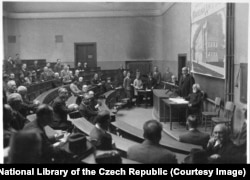
A meeting in Prague to mark the 10th anniversary of the Ukrainian museum in 1935
As the Soviets cemented their control of Central Europe, the “liberation” museum changed its name to the politically neutral-sounding “Ukrainian Museum.” But amid incursions into Czechoslovakia by the Ukrainian Insurgent Army in which dozens of civilians were killed, attitudes toward Ukrainian nationalism hardened in Czechoslovakia and calls grew to close the museum.
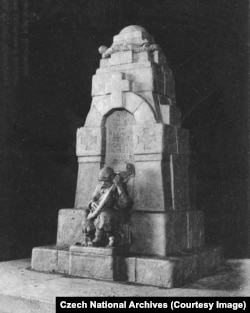
A model of a monument to Ukrainian soldiers who died — most from disease, in an internment camp in Czechoslovakia in the final months of World War I
In February 1948, Soviet-backed communists seized power in Czechoslovakia and the Ukrainian museum was shut down a month later, ostensibly due to its operation under Nazi rule in Prague.
The order for its closure described it as being “founded by a right-wing group of Ukrainian emigrants,” who collected “anti-Soviet political material under the guise of scientific work.”
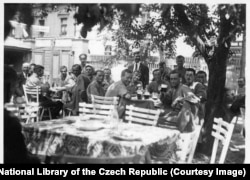
Ukrainians enjoy a beer in the Czech town of Pardubice in 1931.


