


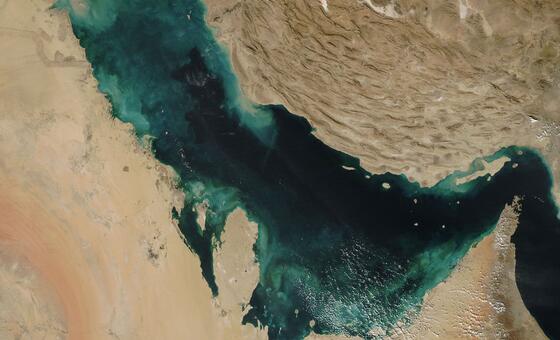
Echoing UN Secretary-General António Guterres’s alarm at the resumption of strikes and counterstrikes between the US and Iran, UN International Maritime Organization (IMO) Council Member States on Thursday condemned Iran for its “continued threats” and alleged attacks against multiple Gulf States and their territorial waters.
In a call to protect “vital shipping lanes”, several countries – including Bahrain, France, Germany and Saudi Arabia – underscored the impact on sea transport “particularly in and around the Strait of Hormuz”, a key global energy lifeline.
In a separate submission, Iran alleged “armed interference with Iranian commercial vessels” and “aggression carried out by the United States” and Israel.
The agency’s Secretary-General Arsenio Dominguez insisted that all transit through the Strait should be avoided “until the necessary safety conditions are in place” and noted that the evacuation of stranded seafarers would remain on hold for security reasons.
According to IMO data, 136 ships have been evacuated along with 2,900 seafarers to date.
Deadly toll
According to Iranian health authorities, 14 people have been killed in the last two days of hostile exchanges, while dozens more have been injured in strikes across five provinces.
Tuesday’s reported attacks in the Strait of Hormuz also caused a temporary spike in crude oil prices which recovered on Thursday to around $77 per barrel, still higher than pre-war levels.
The renewed hostilities came after three merchant ships were reportedly struck on Tuesday while transiting the Strait of Hormuz, despite a truce agreement signed by Iran and the US on 17 June.
Truce deal under pressure
That 14-point memorandum of understanding called for the “immediate and permanent termination of military operations on all fronts, including in Lebanon”.
It also specified 60 days of negotiations to achieve a “final deal” on issues including uranium enrichment by Iran, which also had to reaffirm that it does not intend to develop a nuclear weapon.
Other requirements listed in the memorandum’s text include the reopening of the Strait of Hormuz to all shipping and an easing of US and UN Security Council sanctions on the Middle East nation.
The waterway carries about one-fifth of global oil and gas supplies and before the war around 130 commercial ships passed through it each day.


