


On the same day that Russia pounded Kyiv for the third time in a week, Ukraine’s president was 1,200 kilometers away, pleading for permission to build the weapons that would stop, or at least blunt, Russia’s worst pounding.
Ukraine needs a lot of things these days, as it struggles to hold back Russia’s 52-month-old all-out invasion. What it needs most of all, however, is a way to shoot down the most destructive weaponry Russia is firing: ballistic missiles.
Until recently, the US-supplied Patriot air defense system was considered the only reliable way to intercept ballistic missiles. But Ukrainian stockpiles of the system’s interceptors are running low as US stockpiles have dwindled — the result of US forces in the Middle East defending against Iranian attacks.
Kyiv now wants to manufacture its own interceptors for the Patriot system. The problem? It needs the US to give it a license to do so.
On July 8, Volodymyr Zelenskyy got a thumbs-up.
“We’ll give them the right to make Patriots,” Trump said, sitting alongside Zelenskyy on the sidelines of a NATO summit in Turkey.
“We’re going to be giving a license to you to make Patriots,” he said. “This way you can’t complain we’re not giving them enough. I’ll say: ‘Well, make them yourself.’”
If Trump follows through on his pledge, the move will be a major boost for Zelenskyy, not to mention Ukraine’s struggling air defense systems.
Kyiv in particular has suffered a series of attacks involving waves of Russian drones, cruise, and ballistic missiles. The July 2 attack, which killed more than 30 people, was one of the deadliest since the start of the invasion in February 2022.
Ukraine’s air defenses have improved significantly over the course of the war; the air force, which is responsible for the defenses, has gotten adept at shooting down Russian drones, as well as cruise missiles. Ukraine’s defense industry has rushed to build new weapons systems, air defense or otherwise.
Since January, according to an estimate by the London-based Center for Information Resilience, 90 percent of Russian long-range drones — as opposed to shorter-range ones used heavily on the front lines — have been intercepted by Ukraine; 80 percent of the 722 cruise missiles fired at it have been intercepted.
Of the 522 Russian ballistic missiles fired this year, however, 70 percent got through.
Russia’s main ballistic missile is the ground-launched Iskander-M, which has a range of about 500 kilometers and can travel at speeds up to Mach 7 — reaching targets within minutes.
In the July 6 attack, none of the 23 Iskander-M missiles were downed by Kyiv’s defenses, according to the air force. Six hypersonic cruise missiles known as Tsirkon also hit their targets, again due to a lack of interceptors.
“To shoot down ballistic missiles, you need the assets to do so. We have enough systems, but what we need is a steady supply of missiles,” Colonel Yuriy Ihnat, an air force spokesman, said in televised remarks following the July 2 attack.
“Russia is exploiting the fact that Ukraine — and indeed the world — is facing a serious shortage of [Patriot] interceptor missiles,” he said. “That is why it is increasingly focusing on ballistic missile strikes.”
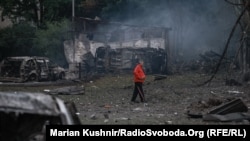
Russia hit the Ukrainian capital three times in a week, mostly recently on July 6.
‘Patriot Missiles Are Extremely Complex’
Built by the US defense giants Lockheed Martin and Raytheon, the actual Patriot battery system itself consists of the interceptor missiles, a launcher, a radar, a high-frequency antenna, a control station, and a power generator.
The system’s total cost is around $1.1 billion, according to the Center for Strategic and International Studies: $400 million for the launcher and other components; $690 million for the missiles.
Ukraine is believed to have at least seven Patriot systems in total: three supplied by the United States; three from Germany; and at least one from a group of European allies.
Not all of them are operational at the same time, however, mainly for maintenance reasons.
Ukraine also has a French-Italian air defense system known as the SAMP/T. The system works fine with cruise missiles or drones, but is less reliable against ballistic missiles, which fly higher and faster.
What Ukraine is running low on is the actual interceptors fired from a Patriot battery: PAC-2 and a newer model, PAC-3.
Ukrainian officials have been lobbying the US administration for months now. They’ve also sought to build support among European allies.
“Ukrainians are telling us they can develop an interceptor that is basically an equivalent to a PAC-2 in less than a year, and that they can produce them in big numbers,” a senior NATO diplomat told RFE/RL. “And if they’re able to do that, we applaud it.”
Experts doubt, however, whether Ukraine could in fact ramp up full production for the interceptors soon.
“I do not share the opinion that we in Ukraine could establish licensed production” of PAC-3 missiles, said Valeriy Romanenko, a former Ukrainian air defense officer who now teaches at Kyiv’s National Aviation University.
“Firstly, all our enterprises are under attack from Russian ballistic missiles, and we cannot currently protect them,” he said. “Secondly, we will have the same problems as the manufacturer; that is, a shortage of components.”
“Trump may have given his approval, but the plan is still unworkable,” said Jennifer Kavanagh, a senior fellow and director of military analysis at Defense Priorities, a US think tank. “Ukraine will still need to build production facilities that meet [export] requirements, overcome input part shortages, and pass through many layers of US legal hurdles.”
If Ukraine produces Patriot missiles it will be in small numbers and one or more years from now. This is not something that will help Ukraine in the near term,” she said.
There’s also the risk of classified technology making its way to adversaries, Kavanagh said.
“There are huge risks with giving this technology to Ukraine. It’s highly likely in my view that if the licenses were given to Ukraine the technology would end up in Russian and Chinese hands,” she said.

People take shelter inside an underground parking garage in Kyiv during Russian missile and drone strikes on July 6.
For Ukraine, a better strategy would be to acquire more long-range missiles to target Russian defense plants, Romanenko argued: like US-built Tomahawk missiles.
Last year, the US Defense Department gave approval for supplying Ukraine with Tomahawks, but the final decision has been held up at the White House.
“I am a supporter of active defense…. We need to strike at Russian missile manufacturers and missile divisions that launch these ballistics,” Romanenko said. “But for effective strikes at Russian military enterprises, we need powerful long-range missiles” — Tomahawks or air-launched cruise missiles.
The Ukrainian weapons company Fire Point — which has had success building long-range strike drones and the Flamingo cruise missile — has been developing a homegrown air defense system, to complement — or even replace — the Patriot.
Last month, the company announced a successful test of the system, called Freya. Analysts, however, warn it will be months before the company can field an operational battery.


