


Though the headline figures show a trebling under the current Socialist government, in reality the data is more nuanced and the Sánchez government’s high rate of citizenship concessions isn’t out of keeping with recent history.
The number of people gaining Spanish citizenship per year has trebled under Socialist Prime Minister Pedro Sánchez, new figures have revealed.
The full data, however, hides nuances about the granting of Spanish nationality over time and reveals that although record-breaking, the rate at which Spanish nationality is given out under this current Socialist (PSOE) government is not an historical anomaly.
According to a report by Spain’s national stats body, INE, during 2025, a total of 299,732 foreign nationals residing in Spain acquired Spanish nationality.
This figure represents an increase of 18.7 percent year-on-year and is “the highest on record”, the body states.
The figures provided by the INE relate to the most common route to obtaining nationality, which is available to those who can already prove a minimum period of residence in Spain – usually 10 years for most foreigners.
READ ALSO: Spain grants citizenship to 300,000 foreigners in one year
You have the right to apply for Spanish citizenship generally if you have 10 years of continuous legal residency in Spain or five years if you’re a refugee.
Those from Spanish or Portuguese-speaking Latin American countries, Andorra, Equatorial Guinea, the Philippines or Portugal, however, will only have to wait two years.
The breakdown of the INE nationality data shows that most common countries of origin for foreigners becoming Spanish by residency were Morocco (42,114), Colombia (37,712) and Venezuela (36,271).
Catalonia (70,933) and Madrid (69,566) were the regions with the highest number of residents acquiring Spanish nationality in this way.
Where the data has really grabbed attention in the Spanish media, however, is in the increase over the medium to long-term.
If we look at the year Sánchez came into power, 2018, and compare the number of citizenship concessions with the most recent data, 2025, we see a more than trebling of nationalities awarded annually.
In 2018 some 90,774 nationalities by residency were awarded, compared to almost 300,000 (299,732) in 2025.
However, some important nuance is needed here.
Though it’s true that concessions have trebled between 2018 and 2025, that doesn’t necessarily mean that the Sánchez government — portrayed by its opponents as radical leftists trying to socially engineer the census for electoral gain — is responsible for the change, or, indeed, that such high figures are historically incongruent with governments that came before it.
If we go further back in the data set, we see that annual concessions of 200,000 per year or more is not unusual.
In fact, in 2013 (225,793) and 2014 (205,880), Spain handed out more citizenships than that — under a centre-right Popular Party government fronted by former Prime Minister Mariano Rajoy.
As the graph shows, from 2017 (66,498) to 2019 (98,954) there was a severe drop off in the number of foreign residents granted Spanish citizenship.
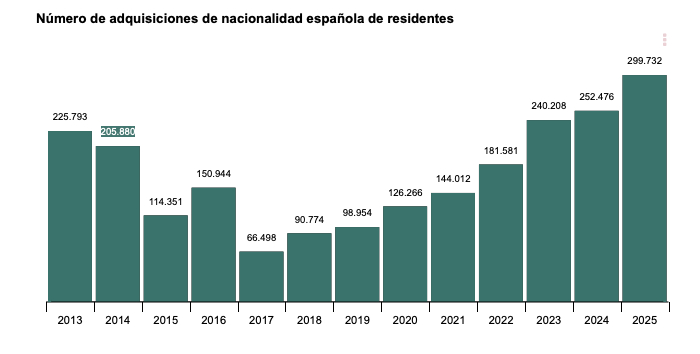
Photo: INE.
Furthermore, though reports in the PP-sympathetic Spanish press have framed the news as a direct tripling “under Sánchez”, while a politically convenient interpretation this is not analytically correct.
Not only are hundreds of thousands of new Spaniards a year nothing new and in keeping with previous rates, it’s important to note that INE statistics record the year in which nationality was acquired, not necessarily when the application was made.
This could mean, for example, that some of the thousands of foreigners who became legally Spanish under the Sánchez government actually applied and were approved under the Rajoy government.
Or, equally, that some of the more 200,000 who gained citizenship in the early years of the Rajoy government actually applied under the previous Socialist administration.
Similarly, annual totals can be affected by administrative speed, bureaucratic backlogs, changes in the law affecting eligibility, and events, such as the figures for 2020 and 2021 suggest.
Similarly, citizenship via long-term residency isn’t the only way to get Spanish nationality.
Under the Sánchez government, new routes have been opened to those eligible to become Spanish nationals but who reside abroad.
This is an option provided for under the Historical Memory Law, among various other ways.
In total, taking both procedures into account – those for residents and those for non-residents – the total number of new Spanish nationals recognised by the Sánchez government is estimated to amount to 1.8 million between 2018 and 2025.
READ ALSO: How to avoid 8 common mistakes when applying for Spanish citizenship

