


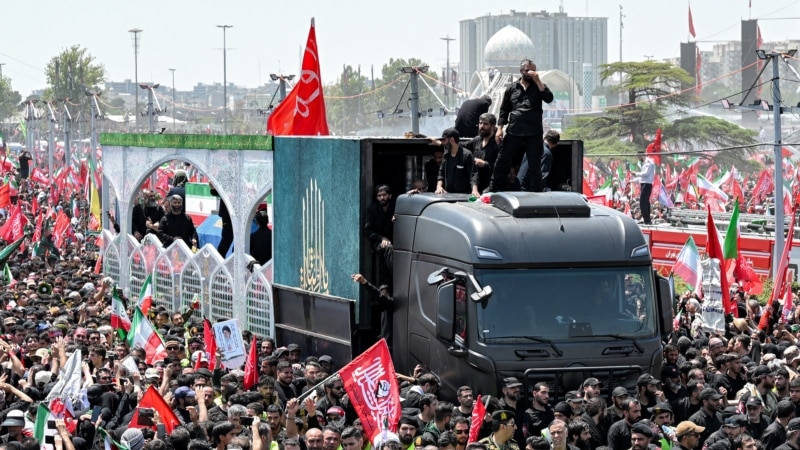
Iranian authorities imposed extensive security measures on July 6, including the closure of Tehran’s airspace, as public funeral ceremonies for late Supreme Leader Ayatollah Ali Khamenei moved from the capital to the holy city of Qom.
A procession across Tehran lasted some 12 hours before further ceremonies were to be held in Qom and Iraq’s Shi’ite holy cities, culminating in Khamenei’s burial in Mashhad on July 9. Temporary, localized flight restrictions will also be in place from July 7 until his burial two days later.
The body of the late supreme leader arrived in Qom late on July 6, according to state TV, which broadcast videos showing helicopters transporting his body landing in the city of 1.2 million people.
Earlier, with officials preparing for a turnout reminiscent of the 1989 funeral of Ayatollah Ruhollah Khomeini, state media showed large crowds accompanying Khamenei’s coffin through the capital after two days of lying in state at Tehran’s Grand Mosalla prayer complex.
The official IRNA news agency claimed several million people were taking part but did not give an exact number.
Organizers also appeared intent on avoiding a repeat of a deadly crush that marred Khomeini’s funeral, during which crowd surges killed more than 10 people and injured over 10,000.
Massive concrete barriers were erected around Khamenei’s coffin during the initial ceremonies, reflecting heightened concern over crowd control. The ceremonies appeared to proceed without major incidents.
The ceremonies are being presented by Iran’s leadership as a display of continuity and resilience following the five-week conflict with Israel and the United States that began with Khamenei’s killing during US-Israeli air strikes on February 28.
Officials have repeatedly portrayed the turnout as evidence of national unity despite the war, and the ceremonies come after massive anti-government protests earlier this year that ended in a brutal clampdown.
Attention has remained focused on Khamenei’s successor, his second son, Mojtaba Khamenei, who has still not appeared in public since being appointed supreme leader and is reported to have been wounded in the same strikes that killed his father.
No known audio or video recordings of him have been released in the intervening months, raising questions about his health and his ability to carry out his duties as supreme leader. Ali Khamenei’s three other sons, who had all remained out of public view since the outbreak of the war, have been attending funeral proceedings.
Also notable was the attendance of the Islamic Revolutionary Guards Corps (IRGC) commander-in-chief Ahmad Vahidi, who only reemerged publicly for the first time in months when paying his respects at Khamenei’s coffin on July 3.
He had kept a low profile since the conflict began amid concerns that senior Iranian commanders could be targeted for assassination. Esmail Qaani, the rarely seen head of the IRGC’s Quds Force, which oversees Iran’s foreign military and covert operations, also made an appearance on July 6.
President Masud Pezeshkian was also present. However, most of Iran’s surviving former presidents, several of whom had strained relations with Ali Khamenei, were not seen, although former President Mahmud Ahmadinejad was spotted attending the funeral procession with other mourners.
Delegations from Hamas and Hezbollah also attended, underlining Tehran’s long-standing ties with armed groups in the Middle East.
Hamas is designated as a terrorist organization by the United States and the European Union. Hezbollah is also designated as a terrorist organization by Washington, while its military wing is listed by the European Union.


