


In the years before Russia’s all-out war on Ukraine, Kostyantynivka was better known as a city of 66,000 with a thriving glassmaking industry, a strategic location at the crossroads of two major highways, and a busy railway junction.
These days, Kostyantynivka is a crater-pocked wasteland of smoldering rubble leveled by drones, artillery, and, in recent weeks, devastating Russian glide bombs.
Russian forces are hell-bent on capturing the city, an important part of what’s known as the “fortress belt” — a major line of Ukrainian defenses for the eastern region of Donetsk.
With small pockets of Russian troops reported in the city’s western, southern, and eastern districts, Kostyantynivka is in danger of falling entirely sometime before summer’s end, according to some analysts, open-source intelligence experts, and Ukrainian and Western observers.
In comments to reporters late on July 3, Kremlin spokesman Dmitry Peskov asserted that the city had been fully captured by Russian forces, though he provided no proof.
And in a separate, undated video released by the Kremlin, President Vladimir Putin was shown thanking Russian soldiers, and stating that Kostyantynivka’s capture was of “major strategic importance.”
Ukrainian President Volodymyr Zelenskyy dismissed the claims as ” just another Russian lie.”
Nonetheless, Ukraine’s struggle in Kostyantynivka stands in contrast to the success of its long-range drone campaign against Russian oil refineries, which has led to nationwide gasoline shortages and mounting headaches for the Kremlin.
It’s a grim reminder of the fight that outgunned and outmanned Ukrainian troops are still waging against a Russian Army willing to incur mindboggling losses.
“The situation around Kostyantynivka is developing into the most difficult scenario,” Deep State, an open-source research group with ties to Ukraine’s military, wrote last month. Russian forces have “literally reached the outskirts of the city from all sides and [are] exerting active pressure and seeping into the depths of the settlement.”
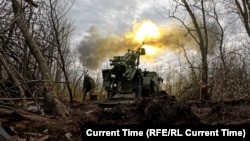
Ukrainian troops fire artillery at Russian positions near Pokrovsk.
“Based on how previous urban battles have shaped out, I would guess that the situation in Kostyantynivka is pretty bad for the” Ukrainians, said Finnish Lieutenant Colonel Juha Kukkola.
“The Russians have been able to disrupt the supply and rotation of troops the whole spring, wear out the Ukrainians with drones, glide bombs, and indirect fire, and finally penetrated in June,” said Kukkola, who teaches in the Russian Military and Security Research Group at the National Defense University in Helsinki. “That is usually the sign that a town will soon fall because it becomes hard to supply, command, and move the defending troops inside the town.”
“Kostyantynivka is a key point right now. [Russia] just sent another 11,000 soldiers just to advance into [the city],” said Serhiy Hrabskiy, a retired Ukrainian Army colonel and military analyst. “They desperately need it.”
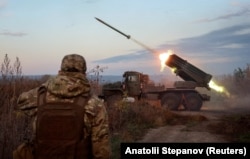
Ukrainian soldiers fire a BM-21 Grad multiple rocket launch system near the frontline town of Kostyantynivka.
Infiltration
Over late winter and the first months of spring, Ukrainian forces appeared to battle Russian troops to a near stalemate across much of the 1,100-kilometer front line. Russia managed to capture a tiny amount of territory — in contrast to previous months; some researchers concluded Ukraine had actually recaptured territory, a noteworthy feat more than four years into the war.
In Donetsk, a region whose complete capture President Vladimir Putin has prioritized, Russian troops advanced at one of the slowest rates recorded by any military in any war over the last century, according to the Washington-based Center for Strategic and International Studies.
In Kostyantynivka, Russian troops advanced on average just about 50 meters per day, CSIS said in a report published on July 1.
The entire Russian war effort since February 2022 has come at an astronomical cost: close to 500,000 Russian soldiers killed and twice that number wounded or missing, according to British intelligence.
Ukraine has suffered up to 150,000 war dead and as many as 475,000 wounded or missing, according to CSIS.
Ukraine’s yearslong effort to ramp up drone production, meanwhile, has had a major impact on the battlefield and farther afield. In the first months of 2026, Ukrainian officials claimed they were killing more Russian soldiers than could be replaced by recruitment inside Russia.
A “middle-strike” drone campaign targeting Russian fuel trucks supplying Crimea has led to a state of emergency on the annexed Black Sea peninsula, with rolling blackouts, widespread fuel shortages, and major disruptions to the tourist season.
Longer-range drones, meanwhile, have hit Russian targets hundreds of kilometers away from the Ukrainian border. That includes oil export terminals on the Baltic and Black seas and refineries and military industrial plants in central Russia and Siberia.
The campaign has worked: Nearly all of Russia’s 83 regions are now imposing fuel restrictions or reporting gasoline shortages, which appears to have rattled the Kremlin ahead of parliamentary elections this fall.
But in the trenches and blasted-out streets of places like Kostyantynivka or Huliapolye — another city where there’s been an uptick in Russian operations — Ukrainian troops are still straining to hold back Russian advances.
“There is no building which has not been hit by Russian air strikes,” said Ivan Stupak, a Ukrainian military analyst and former intelligence officer who predicted the city would be mostly under Russian control by summer’s end.
“Slowly but surely Russian forces penetrated the city. Infiltration. One by one. Not as big assault groups, small groups. One, maximum two members of assault teams infiltrating,” he said. “They hold onto a partly destroyed apartment building, an old factory, and just wait for comrades.”
Stupak said he spoke the other day to a soldier fighting in Kostyantynivka.
“He admitted, you know, that ‘the city is sliding out of our hands in a way faster than we ever considered,'” he said.
“As Kostyantynivka is clearly a center of effort for the Russians, it is only a question of time as to when it will fall,” Kukkola said. “Based on previous cases, I would at this point give Kostyantynivka defenders maximum a month, maybe only a week or two.”
Responding to the Russian claims about Kostyantynivka, Zelenskyy offered a characteristically wry proposal: if the city was indeed under Russian control, Putin should then meet him there for peace talks.
“But the fact is, he won’t cross the front line — reality is very different from Putin’s words.” he wrote in a social media post.
‘A Gray Zone For A Very Long Time’
In an interview with the TV channel TSN, Ukraine’s top military commander, General Oleksandr Syrskiy, said Russian forces were preparing for a possible new offensive in the north — from the Russian border region of Bryansk — with the goal of “stretching the front and depriving us of reserves.”
Whether Kostyantynivka’s fall becomes an inflection point, a tactical defeat for Ukraine, is an open question.
About 30 kilometers to the north is Kramatorsk, one of two cities, along with Slovyansk, that comprise the heart of the “fortress belt” or agglomeration of defenses for Ukraine. Another smaller settlement, Druzhkivka, sits on the H-20 highway between Kramatorsk and Kostyantynivka.
“Kostyantynivka is the ‘gate’ for opening the Slovyansk-Kramatorsk agglomeration,” Deep State wrote in its analysis. “When Kostyantynivka falls — and it is a matter of time — Druzhkivka will be next, which currently plays an extremely important logistical role, and after it, Kramatorsk.”
Hrabskiy predicted Ukrainian troops would try to bog down Russian forces in Kostyantynivka and try to kill as many troops as possible.
“It will be a gray zone for a very long time,” he said.


