• Login
Friday, July 3, 2026
Geneva Times
  • Home
  • Editorial
  • Switzerland
  • Europe
  • International
  • UN
  • Business
  • Sports
  • More
    • Article
    • Tamil
No Result
View All Result
  • Home
  • Editorial
  • Switzerland
  • Europe
  • International
  • UN
  • Business
  • Sports
  • More
    • Article
    • Tamil
No Result
View All Result
Geneva Times
No Result
View All Result
  • Home
  • Editorial
  • Switzerland
  • Europe
  • International
  • UN
  • Business
  • Sports
  • More
Home Switzerland

Leaf ‘scorching’ likely to increase due to global warming

GenevaTimes by GenevaTimes
July 2, 2026
in Switzerland
Reading Time: 8 mins read
0
Leaf ‘scorching’ likely to increase due to global warming
0
SHARES
0
VIEWS
Share on FacebookShare on Twitter


Researchers warn against misinterpreting brown leaves in the forest

Researchers warn against misinterpreting brown leaves in the forest


Keystone-SDA

Climate models may overestimate the resilience of forests, if they fail to distinguish controlled leaf senescence from damage caused by heat and drought, say Swiss scientists.


Generated with artificial intelligence.


This content was published on


July 2, 2026 – 14:27

Researchers at the Swiss Federal Institute for Forest, Snow and Landscape Research (WSL) have issued a warning about this in a commentary published in the specialist journal Nature Climate Change. What looks similar from a distance can have very different consequences for the tree, the WSL said on Thursday.

In the case of controlled leaf senescence, the tree sheds its leaves in an orderly manner, reabsorbing valuable nutrients in the process. In contrast, when leaves are ‘scorched’ by heat and drought, the leaf tissue is irreversibly damaged. The tree then loses nutrients before it can store them.

The difference is significant

From space, both processes appear similar: the forest turns increasingly brown. Biologically, however, the difference is significant. If heat damage is interpreted as controlled leaf senescence, the resilience of forests to climate extremes could be overestimated.

More
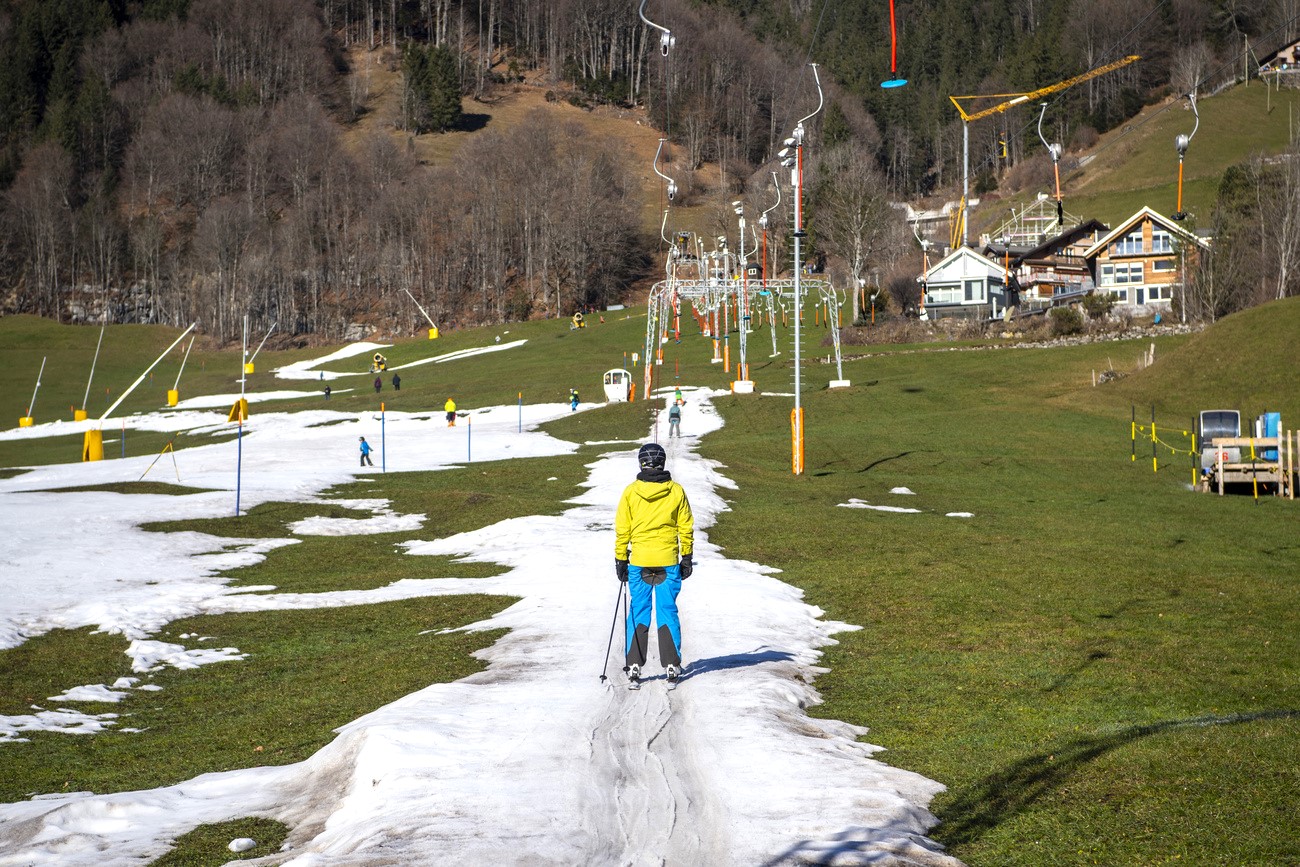
skiers using a ski lift on a strip of snow on green fields.

More


Climate adaptation

Five numbers show how the climate is changing in Switzerland


This content was published on


May 7, 2026


Switzerland ranks among the countries most affected by climate change. We break down the impacts using five key figures.


Read more: Five numbers show how the climate is changing in Switzerland


According to the WSL, the summer heatwave of 2018 demonstrated just how deceptive first impressions can be. At that time, beech trees in the Schaffhausen area already had brown crowns by mid-August. The following year, many of them failed to sprout properly – an indication that they had in fact been damaged.

With global warming, such cases are likely to become more frequent. The researchers are therefore calling for controlled experiments to determine more precisely the thresholds between adapted leaf ageing and irreversible damage.

Translated from German/sub-editing gw

Articles in this story

Read More

Previous Post

Former Olympian indicted on felony charge over alleged Reflecting Pool vandalism

Next Post

Argentina-Cape Verde Is The Most College Football-Esque Matchup Of The World Cup

Next Post
Argentina-Cape Verde Is The Most College Football-Esque Matchup Of The World Cup

Argentina-Cape Verde Is The Most College Football-Esque Matchup Of The World Cup

ADVERTISEMENT
Facebook Twitter Instagram Youtube LinkedIn

Explore the Geneva Times

  • About us
  • Contact us

Contact us:

editor@thegenevatimes.ch

Visit us

© 2023 -2024 Geneva Times| Desgined & Developed by Immanuel Kolwin

Welcome Back!

Login to your account below

Forgotten Password?

Retrieve your password

Please enter your username or email address to reset your password.

Log In
No Result
View All Result
  • Home
  • Editorial
  • Switzerland
  • Europe
  • International
  • UN
  • Business
  • Sports
  • More
    • Article
    • Tamil

© 2023 -2024 Geneva Times| Desgined & Developed by Immanuel Kolwin