


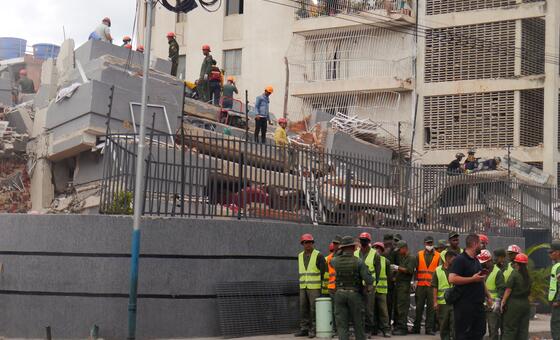
The miraculous story of the three-year-old’s rescue in the worst-hit northern region came as tens of thousands of people remained without adequate shelter, after the 7.2 and 7.5 magnitude quakes struck less than a minute apart, on 24 June.
“As the death toll rises, needs are skyrocketing,” the UN refugee agency (UNHCR) said in an online alert on Tuesday. According to the authorities, nearly 2,000 deaths have been confirmed and more than 6,400 people have been rescued so far.
UN quake response includes:
- UNICEF: flown in enough supplies for 100,000 people for three months
- UNHCR: providing shelter, warns many basic needs are increasing.
- OCHA: coordinating dozens of international rescue teams still at work.
- UNDAC: assessing urgent needs across worst-hit communities.
Multiple UN agencies and partners remain on the ground in the hardest-hit areas working alongside local authorities and aid partners to help families access shelter, healthcare, protection and other essential services.
“Every life matters,” the UN aid coordination office, OCHA, insisted on Wednesday, as national and international search and rescue teams remained on the ground in La Guaira.
Also helping to assess needs, UN Disaster Assessment Coordination (UNDAC) teams are continuing their work to know “where and for whom humanitarian assistance is needed”, said UNDAC public information officer Veronique Durroux.
In total, some 1,000 buildings, including hospitals, have been damaged or completely destroyed, along with more than 400 schools and water systems.
In response to the emergency, an initial 47-tonne shipment of humanitarian supplies from the UN Children’s Fund, UNICEF, arrived in Venezuela on Tuesday.
Those supplies are in addition to a regional shipment from Panama that arrived on 28 June. Combined, they will support more than 100,000 children and families over three months.
Urgent funding call
“UNICEF is on the ground and working around the clock to reach as many children and families as possible,” said UNICEF’s Gabriel Vockel, speaking in La Guaira. “The first flights with water, medicine and many other supplies have reached the country and we are grateful for the solidarity. And we ask for donations to UNICEF because with more funds, we can save more lives, reach more children, and reach as many families as possible.”
The shipment – facilitated by the European Union via the UNICEF logistics hub in Copenhagen – includes emergency health kits for urgent medical care, supplies for safe births, newborn care, disease prevention and treatment.
Water purification and storage supplies have also been delivered, along with tents for child-friendly spaces and wheelchairs. Other recreational and early childhood development supplies that have been sent are designed to help children regain a sense of normalcy and continue learning.
“Families across the affected states are in urgent need of safe water, as well as access to health care,” said UNICEF Regional Director for Latin America and the Caribbean, Roberto Benes. “Many are sleeping outside, afraid of more aftershocks. These supplies will help us reach children and families with what they need most right now…But the needs on the ground are far greater than what’s arrived.”
Kids impacted in six states
The agency estimates that some 680,000 children need humanitarian assistance across the six states affected by the earthquakes – the most significant seismic event to strike Venezuela in more than a century.
“Communities remain at risk from continuing aftershocks, which have numbered more than 600 since the initial quakes,” UNICEF noted.
UNICEF estimates that $52 million is required to respond to the earthquake emergency, as part of its wider 2026 Humanitarian Action for Children appeal for Venezuela, which stands at US$137.6 million and was, prior to the earthquakes, only 35 per cent funded.


