


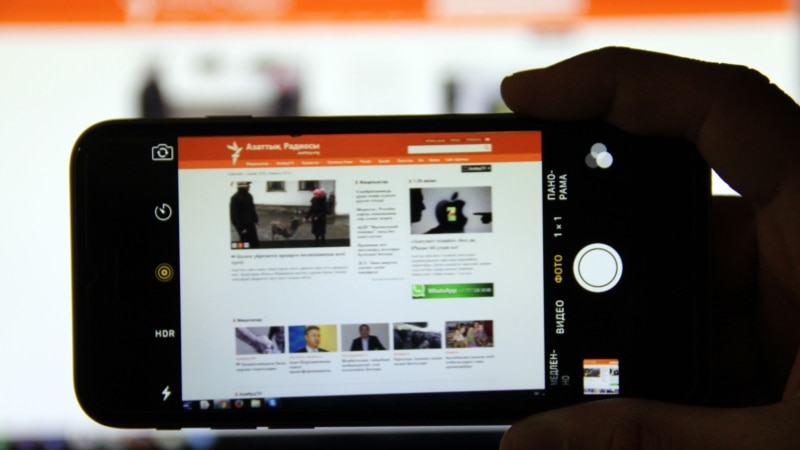
“Unable to access the site.”
In recent weeks, this is the message that appears on the screens of Kazakh users when they try to access the websites of the Kazakh and Central Asian Russian-language services of Radio Free Europe/Radio Liberty.
The Kazakh government says it has nothing to do with the denial of service, which started on May 18, the day Radio Azattyq — the local Kazakh service of RFE/RL — published an investigation pointing out links between family members of President Qasym-Zhomart Toqaev and VD Stroy-Engineering, a private company that receives large state contracts.
On June 3, Kazakhstan’s Culture and Information Ministry and the Artificial Intelligence and Digital Development Ministry, issued a joint response to a request from RFE/RL stating that they had not taken any measures against Radio Azattyq and Azattyq Asia.
The Open Observatory of Network Interference (OONI), however, said its analysis shows a “persistent anomaly” for the domains of azattyq.org and azattyqasia.org that cannot be attributed to technical failure. The Rome-based OONI is a nonprofit global community that tracks Internet censorship around the world.
“Based on the data collected, we can say that there are definitely signs consistent with a deliberate blocking scheme, which can be seen from OONI measurements,” according to OONI Executive and Technical Director Arturo Filasto.
An RFE/RL engineer who has been trying to solve the weekslong issue said it is “almost impossible to establish the identity of the organizer of such an attack, since they are usually carried out using a large number of compromised devices.”
The most common type of blocking recorded by OONI is the disconnection of the browser to the site before the page is opened.
Filasto said the blocking appears to be done through Deep Packet Inspection (DPI) technology. To the user, it looks like a simple connection error without any explanation, as if the site just doesn’t work.
Simultaneously with the attacks on the RFE/RL websites, attempts were made to delete content on its social media pages. Following complaints of “copyright infringement” filed from fake accounts, Meta removed Azattyq and Azattyq Asia posts about VD Stroy-Engineering. Google removed articles from global search results for similar complaints.
Such practices of unofficial, or so-called hidden blocking, are widespread, especially when it comes to restricting access to content for political reasons, Filasto added.
The Radio Azattyq investigation showed that the founders and managers of VD Stroy-Engineering included people associated with the sister and nephews of the Kazakh president.
For example, Bagdat Omirzhanova was a co-founder from 2020 to 2023. Now she heads companies that were previously owned by Karlyga Izbastina, Toqaev’s sister. Rustam Karagoishin, the former director of VD Stroy-Engineering, worked for more than 10 years in the quasi-public sector with Kanysh Izbastin, Toqaev’s nephew.
While the investigation pointed out the previous ties, it did not claim that the former founders are currently associated with the construction company.
Radio Azattyq attempted to contact Izbastiny, Omirzhanova, and Karagoishin, but the requests went unanswered.
Two days after the release of the investigation, Azamat Usimbekov, the current founder of VD Stroy-Engineering, said in a video interview with the Kazakh publication Ulysmedia that he was not familiar with the previous founders of the company or the president’s relatives and had never met Toqaev in person.
It’s not the first time RFE sites in Kazakhstan have been seemingly targeted.
In April 2023, OONI investigated reports that the same RFE/RL sites in Kazakhstan were “throttled” in the country in the months leading up to snap elections in November 2022.
International human rights groups also have noted that Kazakhstan frequently blocks or restricts access to social media. In its 2025 annual report on the level of Internet freedom around the world, Freedom House defined Kazakhstan as a “not free” country.
The current blocking of RFE/RL sites also affected another online publication, Fergana.media, that reprinted the investigation into VD Story-Engineering.
According to Daniil Kislov, editor-in-chief of Fergana, Meta deleted his personal posts about the Azattyq investigation and blocked the possibility of monetization of his pages.
“I published several posts dedicated to the investigation of Azattyq Asia about the business of the entourage and relatives of Toqaev,” he said. He then received messages “from Meta that some user from an absolutely fictitious xbm9888@aol.com address calling himself Azattyk Asia claimed the rights to my posts, which Meta immediately blocked, and even deprived me of the opportunity to monetize my feed.”
After winning the November 2023 snap election, Toqaev signed into law a controversial and opaquely worded bill that allows the authorities to shut down social media and messaging platforms with the aim of protecting users from cyberbullying.
Internet experts and activists criticized the legislation, saying it would give the authorities tighter control over social networks and messaging.
Rights activists have accused the Kazakh authorities of purposely using “unclear language” in legislation to crack down on dissent.
Diana Okremova, head of the Legal Media Center in Astana, notes that political content and materials critical of the authorities are increasingly under attack.
“This is becoming commonplace. And you can never predict why your account may be blocked, what will be considered some kind of dangerous information,” Okremova said.


