


Children playing at home in the ‘Bratstva i Jedinstva’ (Brotherhood and Unity) housing complex, Sarajevo, June 1993.
Thomas Kern

Bad news from home, Zenica, January 1993.
Thomas Kern

View from an empty room at the Holiday Inn towards one of the two Unis Towers and the city centre and Old Town. Sarajevo, May 1993.
Thomas Kern

A convoy leaves Sarajevo. Evacuation of Jewish citizens from the city. Sarajevo, May 1993.
Thomas Kern

Emergency in the surgical ward of Kosevo Hospital. Sarajevo, December 1992.
Thomas Kern

Prayer at the Begova-Dzamija Mosque in the historic centre. Sarajevo, December 1992.
Thomas Kern

Left: A young soldier from a Bosnian Croat unit in Bosanski Brod, September 1992. Right: A man at the entrance to the emergency department of Kosevo Hospital after bringing two wounded people there. Sarajevo, May 1993.
Thomas Kern

Collecting water in the city centre on a sunny spring day. The ‘Skloniste’ sign points towards a public shelter. Sarajevo, June 1993.
Thomas Kern

A street scene in the Kosevo district. Sarajevo, January 1993.
Thomas Kern

Ward rounds by ward doctors in the basement of Kosevo Hospital. Sarajevo, May 1993.
Thomas Kern

Waiting in the mortuary at Kosevo Hospital. Sarajevo, January 1993.
Thomas Kern

Newly enlisted recruits of the Bosnian Army during drill. Sarajevo, June 1994.
Thomas Kern

Golo Brdo (Bare Hill) on the Žuč ridge was one of the most important and fiercely contested front lines during the Siege of Sarajevo. December 1992.
Thomas Kern

A man stands in the doorway of his house near the old bus station. Sarajevo, December 1992.
Thomas Kern

Left: A sleeping UN soldier and transport aircraft on the tarmac at Zagreb Airport, August 1992. Right: Vladimir Gluvacevic, who is blind, at home in Sarajevo, April 1994.
Thomas Kern

Playing on a wasteland on the outskirts of Zenica, January 1993.
Thomas Kern

Visiting a flat shortly after an artillery attack, Bosanski Brod, October 1992.
Thomas Kern

A man with a pile of firewood and a coffin at the entrance to the Lav cemetery in the Kosevo district. Sarajevo, December 1992.
Thomas Kern
Swissinfo photographer Thomas Kern witnessed the wars in Croatia and Bosnia and, for several months, the siege of Sarajevo. A personal retrospective.
I didn’t visit the Holiday Inn very often. In fact, I had originally intended not to go to Sarajevo at all. The city had been under siege by Serbian forces since April 1992. My impression was that there were already enough photographers there. I didn’t want to become part of that crowd at the Holiday Inn, the only hotel in the besieged city.
In early 1992, I was taking photographs for a Swiss newspaper at a refugee shelter in Davos. It was there that I first met refugees from a country that was falling apart: Yugoslavia. The impressions left by those encounters stayed with me. The Vukovar massacre was already known. For the first time, I became aware of a war in Europe, almost on our doorstep.

A double-page spread from the photographer’s diary featuring a pasted-in self-portrait – complete with camera, helmet and protective vest. September 1992.
Thomas Kern
Back then, I shared a Saab with a friend, but it gradually became more my car than his – and in August 1992 I drove it to Croatia. In Zagreb, I was able to stay with people working for the UN.
From there, I moved closer to the front line. I crossed the River Drina several times to Bosanski Brod, where Croatian and Bosnian units were fighting Serbian forces. I tried to keep track of events using various maps – that was essential for assessing where the risks lay. After a while, however, I realised I wasn’t finding what really interested me there.
I didn’t see myself as a war photographer. Rather, my aim was to show what war did to people and what it meant for those living through it. Many conversations with Ervin, an experienced Slovenian journalist from Mladina, led me to realise that, if I wanted to see that for myself, I would have to go to Sarajevo after all.
Serbian troops and militias occupied the suburbs and hills surrounding the city for 1,425 days between 1992 and 1996. It was the longest siege of the 20th century. Between 350,000 and 450,000 people remained in the city. While some fled, new refugees from eastern Bosnia arrived in besieged Sarajevo. An airlift via the airport and a tunnel provided the most basic supplies.
More than 300 shells struck the city every day, while Serbian snipers kept residents in their sights.
According to estimates, the gunfire and shelling killed more than 11,000 inhabitants.
An Italian prosecutor’s office is investigating suspicionsExternal link that wealthy western Europeans may also have been involved in the killings.
Sarajevo as a symbol of the multi-ethnic state
In Croatia, I mainly met Croatians. Although they held different views, they nevertheless shared a similar perspective.
In Sarajevo, things were different. In the disintegrating Yugoslavia, the city symbolised the multi-ethnic state. Bosniaks, Serbs, Croats, Jews and Roma lived together there. The people I met knew that this coexistence was at stake. I could sense how torn they were.
My photographs were later published alongside a text by the Croatian-Bosnian writer Miljenko Jergović. His words captured my impressions better than any caption could:
“The tall poplars, acacias and ash trees cast their shadows over the venerable Gothic architecture of Austro-Hungarian marble. The crumbling stone, long since eroded by acid rain and communism, is falling apart. Gravestones bearing eternal memories are toppling over, never to be raised again, never to exist. People want to keep warm, and they keep no record of the dead. They lie cold, somewhere deep down, beneath all this horror, far removed from that incorrigible need of the living to maintain their body temperature at a comfortable 36.8°C.”
Heating by making holes in a gas pipe
It was freezing. There was no central heating. You either lit a fire with wood or heated with gas. In practice, this meant making holes in a gas pipe and holding a flame to it. As I was staying with a host family in Sarajevo, I experienced everyday life first-hand. I learnt how to find wood and joined others fetching water. In doing so, I got to know the city.
Gradually, I expanded the area I knew. I spent hours walking around taking photographs. I went wherever it was possible and relatively safe from Serbian snipers. A Bosnian newspaper, Oslobođenje, was still being published in the city. Its reporting, together with conversations with my hosts, helped me find my bearings.
I was staying with Medina, whom I had met through Ervin. She was also a journalist and wrote for Mladina. Living with her were her sister Jasna and her children, as well as Ismira and Sead, who worked for the Bosnian Army press office.
>>The following photographs are taken from Thomas Kern’s private archive. They were not intended for publication at the time.

A small celebration at home to take our minds off the hardships of daily life. With a bottle of sparkling wine and a cake from the Holiday Inn. Together with Jasna (holding the bottle), her two daughters and a friend, her sister Medina, Ismira and Sead, who was working at the time for the press office of the newly formed Bosnian Army in Sarajevo. Sarajevo, December 1992.
Thomas Kern

With Sead, queuing to fetch water for our household of seven. One of the best-known places to fetch drinking water was the Sarajevska Pivara – a well-known local brewery in the city centre, about a 15-minute walk from where we lived. Sarajevo, May 1993.
Thomas Kern

A passer-by took a photo of my Swiss photographer friend Tomas Muscionico (left) and me, just behind the Holiday Inn hotel in the Ciglane district. Sarajevo, December 1992.
Thomas Kern

Out and about in central Bosnia with Medina and Ervin. Breakfast at the Hotel International in Zenica. The well-known hotel belonged to the state-owned steelworks and was closed for good shortly afterwards. Zenica, May 1993.
Thomas Kern

Sead was lucky enough to find some timber in a back yard and chopped it up on the balcony into firewood that would fit in the small makeshift stove. The heating in most apartment blocks was off, and the winters in Sarajevo were bitterly cold. Keeping warm and securing a supply of drinking water – for cooking as well as personal hygiene – kept everyone on their toes. Sarajevo, June 1993.
Thomas Kern

Photographers Paul Lowe, Roger Hutchings of Network Photographers and Gilles Peress of Magnum at the start of a joint trip through Herzegovina to Mostar and back to Sarajevo. Sarajevo, June 1993.
Thomas Kern

In the middle on the sofa is Elma Abadzcic, with whom I had often worked; in the foreground on the phone is her mother (local calls were always possible, even when the power supply was cut off); in the background is photographer Paul Lowe, who later married Elma’s sister and lived in Sarajevo after the war. Sarajevo, May 1993.
Thomas Kern

That was Zenit Đozić from ‘Toplista Nadrealista’ (‘The Surrealist Hit Parade’), a group of artists from various fields. During the siege, they produced a satirical radio review of the past week. In the radio studio, where on the way there from the city one was completely exposed to Sniper Alley, I spent two or three nights with them. Sarajevo, May 1993.
Thomas Kern

The Slovenian journalist Ervin Hladnik-Milharcic from Mladina and the London-based photographer Judah Passow in Travnik, in central Bosnia. Travnik, May 1993.
Thomas Kern
Off to the Holiday Inn for the birthday cake
There wasn’t much of a normal daily life left in Sarajevo even during that first winter of the siege. But people carried on: celebrating New Year’s Eve, children’s birthday parties, and a bar was open about every two weeks. I couldn’t exactly splash the cash back then, but as an international journalist I still had more at my disposal than most. So, for example, I was able to contribute a cake for Medina’s niece’s party. I went to the Holiday Inn to buy this cake.
During that time, I was completely on my own. I didn’t want to be a war photographer, but of course I was part of that reality. I was constantly dealing with other journalists and was also dependent on them.

Title of the DU issue, Issue No. 5, May 1993.
Thomas Kern
There were hardly any phones for international calls. You could use a satellite phone in the TV studio building for 20 marks a minute. At one point, I rang my editor-in-chief on it and said: “I’m in the right place now. I’m working every day. Things are going well, but I can’t get home to watch the films. You’ll just have to wait.”
My work was first published in May 1993 in the magazine DU under the title “The Balkans: A European Disaster”. Because that is exactly what the war was: it was European. It was completely different from Iraq, where I had been before. I felt and knew that this war had more to do with me.
Switzerland: close and connected
In Croatia and Bosnia, I saw women walking past with plastic bags from the Swiss department store Manor – a sight just like home. And if I got into the car and drove for 16 hours, I could actually be sitting in Café Sprüngli in Zurich again the next morning. In Sarajevo, I met young people from the arts and intellectual scene whom I could just as easily have met in Switzerland.
Once or twice I actually met people who went off to war in Croatia for the weekend and then drove back to Switzerland to work. To this day, whenever I hear men my age speaking Serbo-Croatian in everyday life, I wonder what on earth were they doing 30 years ago.

December 26, 1992: Sarajevo had been cut off from the outside world for months. It was cold outside, and ordinary citizens who had previously gone unnoticed were shouting and fighting over firewood to keep their homes warm with stoves cobbled together from scrap metal. Suad and Snezana, however, were happy; the harshness of everyday life did not touch them on this day: it was a wedding – their wedding! The fact that Suad’s father was Muslim and Snezana’s family were of Croatian origin did not bother anyone here. Suad and “Snezu” had known each other for several years. Why did they choose to get married then, in the midst of a war, in a besieged city, in such difficult times? They were not the only ones to tie the knot in Novi Grad’s makeshift administrative building that day. While they exchanged vows inside, in the semi-darkness of an indistinct room, beneath the five lilies of the Bosnian coat of arms, another couple was already waiting outside. In times like these, people drew closer together; they needed warmth.
Thomas Kern

That was Suad’s father. He, too, lived in a prefabricated block of flats in Novi Grad, between the city centre and the airport. Whenever Suad spent his days at the front, he would look through these plastic binoculars towards the hill where his son was on duty, even though he could hardly see anything with them. Perhaps it reassured him, perhaps it made him feel more connected to his son, as if he could watch over him and protect him that way.
Thomas Kern
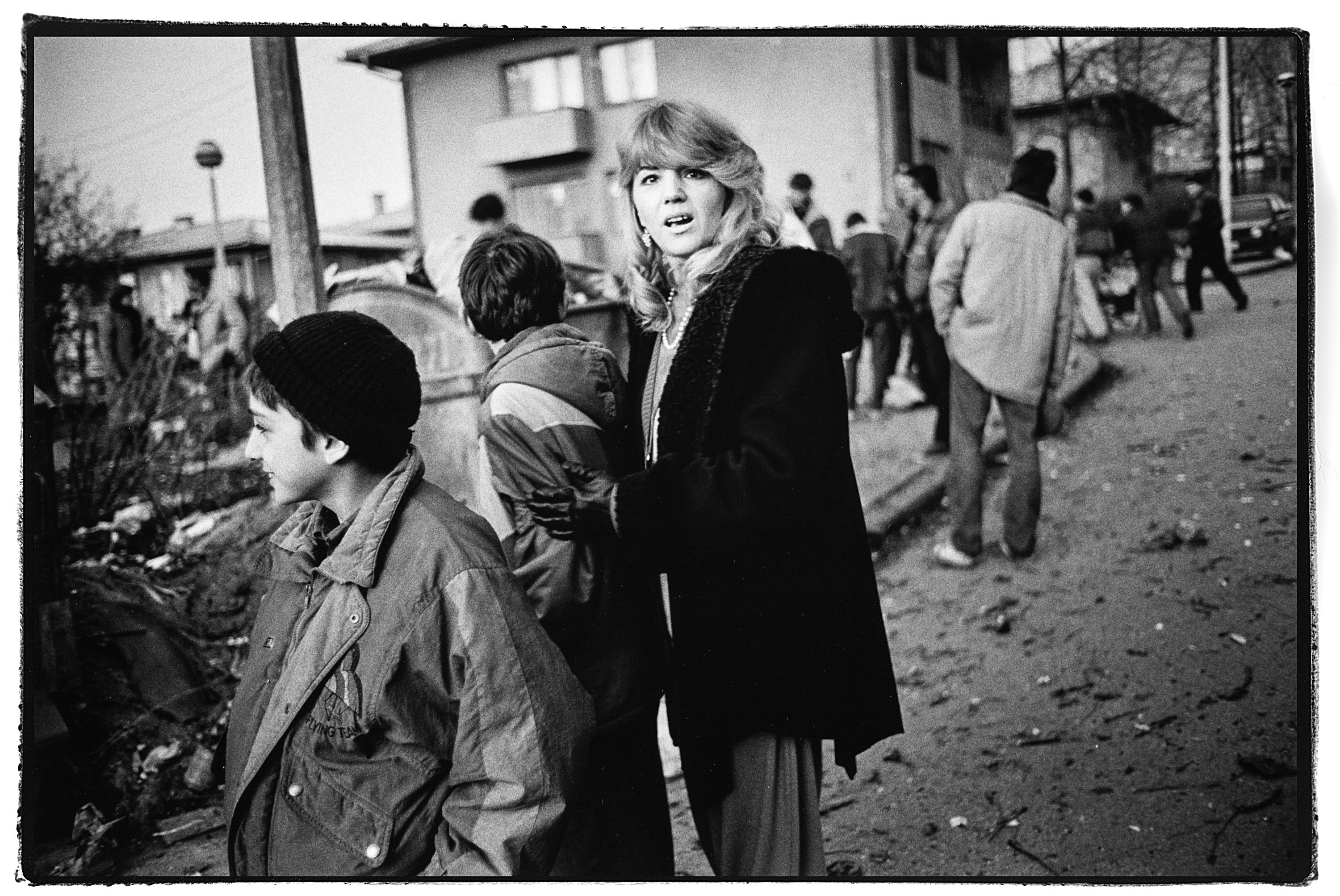
In the magazine’s layout, we had published a whole series on wood gathering and heating across a double-page spread. When I look at this picture today – the woman’s leather gloves, the expression on her face, her make-up, her blow-dried hair, and the way she wants to shield her son from what is happening around them – I imagine that her life had probably not prepared her for this situation.
Thomas Kern

Thirteen-year-old Kenan Herenda was probably Sarajevo’s most avid collector of shrapnel, unexploded ordnance, bombs and other projectiles. Kenan lived in Dobrinja 2, right on the front line. He had been collecting these items since the war began, and whenever there was shelling, he was the first to run to the remains of the incoming shells to secure the largest pieces of shrapnel. Sarajevo, January 1994.
Thomas Kern
When I look back on that time, I realise how much better off I was than the people who lived there, who couldn’t simply leave the besieged city as I did. I know a few reporters from that period who went into therapy afterwards, and I’m glad that I never felt traumatised in that way. Perhaps that was also because I was really able to capture what mattered to me in the images.
But the experience leaves its mark. Back in Switzerland, I found it difficult at the time to talk about what I’d been through. The best friend of my partner at the time had experienced similar situations while working for the Red Cross. That was good. We were able to share our experiences.
Edited by David Eugster. Adapted from German by Patrick Huwyler/ts


