

If you have been looking for a ‘cool’ apartment in Switzerland, you may want to opt for ones with a ‘Minergie’ label. But can they really keep the heat out?
Simply put, Minergie is an official label for sustainable construction — that is, buildings that use less energy than conventional ones.
This means not only lower energy consumption, but also cleaner indoor air and automatic temperature control.
Born in 1998
While it may sound like a very new concept, it is not.
In fact, it dates…to the previous century, to 1998 to be precise.
That is when a group of people in Switzerland, concerned with protecting the environment from greenhouse emissions, launched the concept of energy-efficient living spaces.
The idea, and part of the financing for the scheme, was picked up by the government, at both the federal and cantonal level.
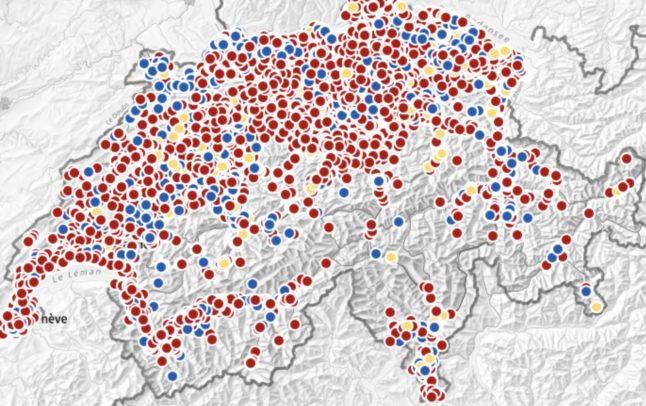
To date, more than 50,000 buildings in Switzerland — both new and renovated — carry the Swiss quality Minergie label.
This government map shows where they are located:
Do they really keep the heat out?
Are these dwellings cool in the summer or is this claim full of…hit air?
Minergie houses are generally designed with thermal insulation and an automatic ventilation system for good air circulation.
They don’t use gas or oil, saving both energy and cost of it by relying on heat pumps and solar energy instead.
As a result, Minergie apartments stay comfortably warm in the winter and comfortably cool in the summer — which is a definite plus as air conditioners are notoriously difficult to install in Switzerland.
READ MORE: In Switzerland it’s easier to get a work permit than an air conditioning permit
Another difference between a conventional and a Minergie home is that in the latter you don’t have to open the windows to ventilate, as fresh air circulates automatically.
This doesn’t mean that you can’t open the windows if you want to; just that you needn’t do it to let fresh air in.
What do people living in Minergie housing think?
The feedback is mixed.
“Our Minergie house is great! It has way better insulation than an average house which makes it pleasantly cool in the summer and low energy to heat up in winter,” one Reddit user said.
“There are thermostats in each room and the ventilation system also works great.”
Many other tenants and homeowners do swear by the efficacy of the Minergie system.
But some report minuses as well.
‘The ventilation system doesn’t help with a heatwave’
“I’m writing from a “comfortably cool” Minergie apartment where I have 27 degrees right now with AC turned on. It is indeed a bonus that you don’t have to ventilate, but the ventilation system doesn’t help with a heatwave if it lasts more than 3-4 days,” one of our readers, Kate, said.
“After this time, the apartment becomes really warm. When a heatwave is over, it takes another 3-4 days to properly cool down the apartment, meaning trying to ventilate it 24/7. Otherwise you get 26-27 degrees inside again as soon as you close the windows, even if it’s below 20 outside. The building is built for retaining heat during the winter I guess, and it retains it well during the summer too. All Minergie systems in the building are functioning well, it’s just impossible for the apartment to not get too warm after some time if the building is located in a huge city with lots of concrete.”
Another person’s complaint relates to the fully automated system. “We couldn’t regulate anything in our rental apartment, because it was all done centrally,” a tenant said.
In a forum on this subject on Reddit, one tenant mentioned that their Minergie apartment “had a really bad smell, like something decomposed …and it always feels ‘windy inside” — both complaints suggesting that perhaps the ventilation system was faulty.
Someone else said that “our ventilation system causes a pressure difference from indoors to the place in front of the flats, so it’s hard to open the doors if the ventilation is on high.”
As another tenant pointed out, the Minergie system as a whole is very good, but it doesn’t rule out problems in some dwellings.


