

“Central Asia in Transformation: A New Role for Regional Cooperation and Global Engagement”
Geneva Centre for Security Policy (GCSP), Brunner Library 22 June 2026 Organised by the Bulan Institute and the Geneva School of Diplomacy and International Relations
GENEVA · GCSP · 22 JUNE 2026
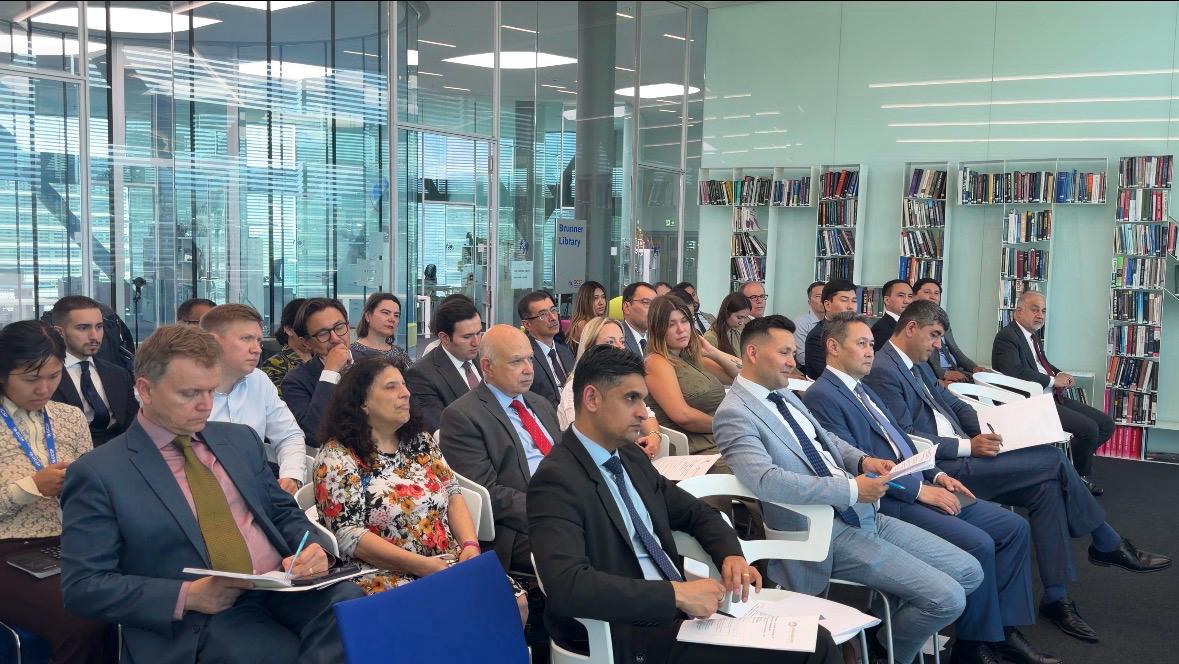
A roundtable at the GCSP brought together the ambassadors of all five Central Asian states — with Kazakhstan at the centre of a wide-ranging debate on reform, regional integration, and the shifting geometry of multilateral order.
Geneva has long served as a barometer of international priorities. On 22 June 2026, the Brunner Library of the Geneva Centre for Security Policy filled with ambassadors, diplomats, academics, and experts for a conversation that felt, by any measure, timely.
The roundtable — “Central Asia in Transformation: A New Role for Regional Cooperation and Global Engagement” — was convened by the Bulan Institute and the Geneva School of Diplomacy and International Relations. It brought together the ambassadors of Kazakhstan, Kyrgyzstan, Tajikistan, and Uzbekistan, alongside senior analysts, former UN officials, and representatives of Geneva’s wider diplomatic community. What follows draws on the proceedings.
The timing was not incidental. One day earlier, negotiations between the United States and Iran had convened at Bürgenstock. Two weeks prior, Kyrgyzstan had been elected to the UN Security Council against a heavily favoured rival candidate backed by Washington. Central Asia, a region that spent much of the post-Soviet era viewed through the lens of great-power competition, was making its presence felt on the international stage in ways that were increasingly its own.
Kazakhstan at the Centre
The most substantial portion of the morning’s discussion was devoted to Kazakhstan — a reflection both of the country’s weight in the region and of the significance of the reforms currently underway.
In March 2026, Kazakhstan held a nationwide constitutional referendum that produced the most comprehensive revision of the country’s legal and institutional framework since independence. The result — supported by nearly 90 percent of participating voters — introduces changes that are structural rather than cosmetic.
The previous bicameral parliament, comprising a 98-seat Majilis and a 50-seat Senate, has been replaced by a single 145-seat Kurultai elected through proportional party representation on a five-year term. The office of Vice President has been restored to strengthen executive continuity and provide a clear mechanism of political succession. A new People’s Council — the Halyk Kenesi — has been established as a consultative institution with the right of legislative initiative, creating a formal channel for civil society engagement in policymaking. The abolition of the death penalty, previously enacted by decree, has been constitutionally entrenched. Digital rights and personal data protections have been strengthened.
“Modern economies are built not only on natural resources, infrastructure, or geography. They are built on institutions.”
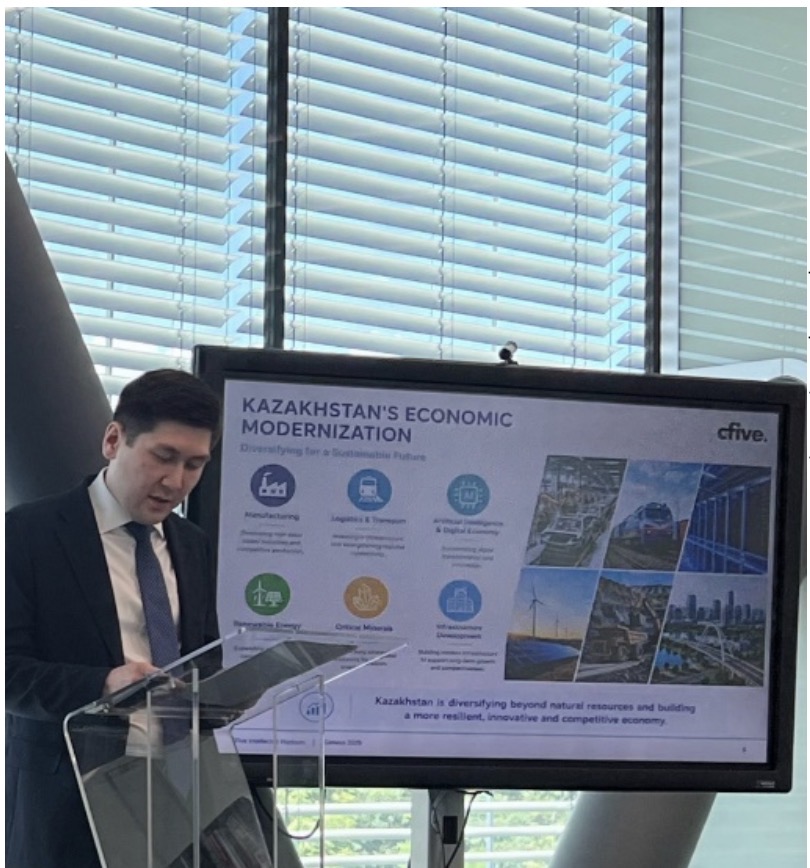
The observation came from Sapargali Shalgimbaev, President of the CFive Intellectual Platform, who delivered the session’s keynote analytical address. The point was addressed as much to investors and business leaders as to policymakers. Constitutional reform, he argued, is not a political event in isolation — it carries direct economic implications. The quality of governance, the predictability of policy, the protection of property rights, and, above all, the level of trust that institutions generate are increasingly decisive factors in attracting capital, talent, and technology.
The Kazakhstani ambassador K.Sarzhanov elaborated on the architecture of the changes: the essence of the reform is a transition from a highly centralised presidential system toward a more balanced model grounded in three principles — stronger institutions, the rule of law, and expanded citizen participation. The new constitution entered into force on 1 July 2026, with parliamentary elections to follow.
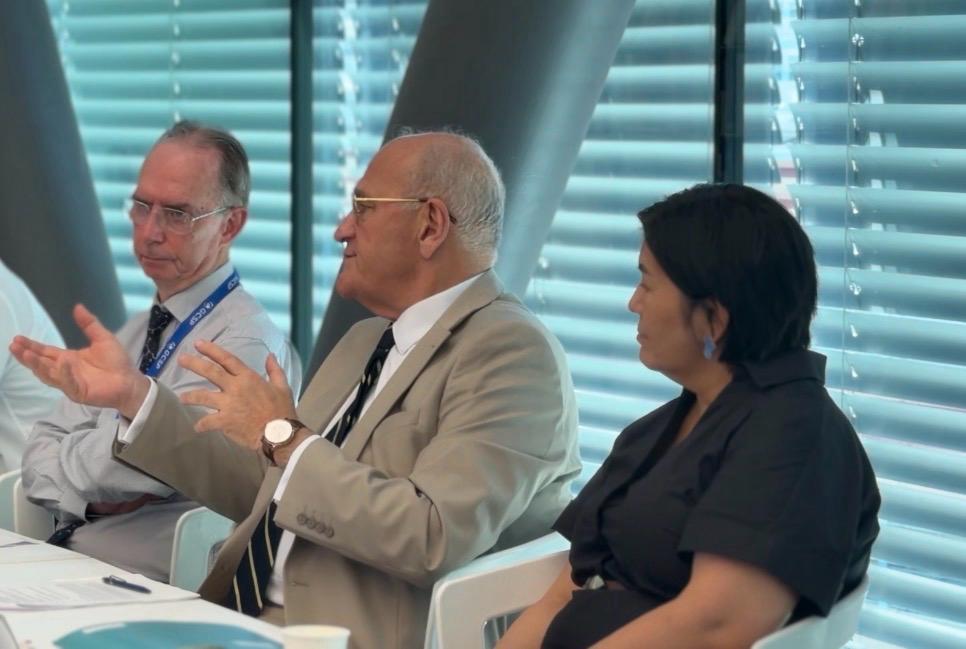
David Chikvaidze — five times Chief of Staff to the Director-General of the UN in Geneva, and a veteran of negotiations on North Korea, Western Sahara, and the Iranian nuclear file — offered a characteristically direct assessment. The reforms in Kazakhstan, he said, are “root and branch” — genuine transformation rather than surface adjustment. Those present, he suggested, were “witnessing the creation of modern states in Central Asia” — a process of historical weight that should be understood as such. President Tokayev’s agenda, in his reading, is aimed at making Kazakhstan a state of law and order, and that ambition is being replicated, in varying forms, across the region.
Shalgimbaev was careful to qualify the optimism. “The most important test still lies ahead.” The success of institutional reform cannot be measured in months; it must be assessed over years. Will governance become more transparent? Will public accountability improve? Will citizens and businesses develop greater confidence in state institutions? These are questions that sustained political commitment, not announcements alone, will answer.
A Region Finding Its Weight
Kazakhstan’s reforms do not exist in isolation. They are part of a broader transformation that is reshaping Central Asia as a whole — and it was this wider picture that occupied much of the afternoon’s discussion.
The region today is home to more than 80 million people and generates a combined GDP exceeding 500 billion dollars. Kazakhstan accounts for roughly 60 percent of that output and attracts the majority of foreign direct investment entering the region. The European Union remains the dominant source of FDI, accounting for more than 40 percent of the total. But the region’s external partnerships are diversifying at speed: trade with China has grown from 18 billion dollars in 2020 to more than 100 billion dollars in 2025; trade with Turkey exceeds 15 billion dollars; announced investment projects from Gulf states surpass 100 billion dollars.
Shalgimbaev drew a deliberate historical parallel. Kazakhstan and Uzbekistan, he argued, are playing a role in Central Asian integration comparable to that performed by France and Germany in the early stages of European integration — the principal engines of a process that benefits all participants. Two emerging strategic concepts — “Invest in Central Asia” and “Made in Central Asia” — are being developed as complementary pillars: the first to present the region as an integrated investment platform rather than five separate markets; the second to build a regional production identity capable of entering global value chains.
The Trans-Caspian International Transport Route — the Middle Corridor — has become the most visible symbol of this ambition. The International Transport Forum projects that freight demand in Central Asia will increase by more than 160 percent by 2050. Investment in rail modernisation, logistics infrastructure, and digital border management could reduce access costs to global markets by 25 to 30 percent. For the ambassadors present, the corridor represents something beyond transportation: it is an assertion of strategic agency, a claim to shape Eurasian connectivity rather than merely to serve as a transit space.
“For the first time since independence, the countries of Central Asia are moving beyond geography toward genuine regional partnership.”
The establishment of a UN Regional Centre for Sustainable Development Goals for Central Asia and Afghanistan in Kazakhstan was cited as a further marker of this shift — reflecting growing international recognition that the region’s development agenda merits dedicated institutional support.
The Security Council and the Politics of Solidarity
On 7 June 2026, Kyrgyzstan was elected as a non-permanent member of the UN Security Council — only the second Central Asian state to hold the seat, and the third member of what has become a C6 grouping that includes Azerbaijan. The vote was close and contested. The United States backed the Philippines and campaigned hard in the final week. The outcome was achieved through consolidated effort across all five Central Asian states and Azerbaijan, working diplomatic networks that smaller missions could not have activated alone.
“All the odds were against us,” the Kyrgyz ambassador acknowledged. The result was made possible by the fact that Central Asian foreign policy has, in his assessment, become genuinely unified: positions on human rights, security, and disarmament move as a bloc. When one country advances an initiative, the others stand behind it. The Security Council seat, as he framed it, belongs to the region as a whole.
Strategic priorities for the term will be coordinated through the C6 mechanism and discussed at an informal summit of Central Asian leaders and Azerbaijan at Issyk-Kul in late July. The pace of geopolitical change, the Kyrgyz ambassador noted, is such that priorities agreed in Tashkent in November already require revision. In a phrase that resonated in the room: “Anything I say now would be yesterday’s newspaper.”
But the vote also revealed fault lines with Europe. The EU did not provide consolidated support for the Kyrgyz candidacy — a point raised with visible frustration. More sharply, Kyrgyzstan’s inclusion in an EU sanctions package targeting Russia was described as unexplained and selective: several Central and Eastern European states maintain significantly deeper economic ties with Moscow without facing comparable measures. The logic of the decision, the ambassador said, remains unclear, and is actively being raised with European counterparts.
“The EU strategy on Central Asia has not been updated since 2019. That is a different era.”
The assessment of the EU’s strategic tempo was blunt and went unanswered by any participant. Seven years without a revised strategy is, in the Kyrgyz ambassador’s words, “an eternity.” The EU Special Representative’s indication that a review might take two more years after Samarkand was characterised as a “typically bureaucratic approach” — incompatible with the speed at which the region, and the world, is changing. The contrast drawn was explicit: “Our Chinese partners are very agile. They do not think in terms of seven years.”
Multilateralism, Disarmament, and the Wider Picture
Chikvaidze’s contribution ranged beyond Central Asia. His diagnosis of the international system was unflinching: the return of war as a tool of statecraft has nearly sidelined the universal multilateral mechanisms built over eighty years. More than fifty armed conflicts are currently active. The dysfunction is not institutional in origin — it reflects the choices of member states, above all the three most powerful, whose increasingly fractured bilateral relationships produce cascading effects across the system.
Against this backdrop, Central Asia represents an exception — and he used the plural deliberately. The C5, now C6, are among the most responsible and constructive middle powers on the post-bipolar international scene. Their multi-vector foreign policy is not a hedge but a strategic asset, and an example that others would do well to study. “While the most powerful countries pursue wars of choice,” he concluded, “it increasingly falls to the middle powers to take on the responsibility of reapplying the diplomatic toolkit.”
The session’s moderator Marc Finaud, a former French diplomat and associate fellow at the GCSP, reminded participants that Central Asia holds a distinction often overlooked in international discourse: it is the only populated region in the world with a treaty-based nuclear-weapons-free zone, established under the Semipalatinsk Treaty. Kazakhstan’s additional leadership — as a former victim of Soviet nuclear testing, as a signatory of the Treaty on the Prohibition of Nuclear Weapons, and as a proponent of an international trust fund for victims of nuclear use and testing — was cited as deserving wider recognition and support.
What the Room Heard
The roundtable did not resolve the tensions it surfaced. That was not its purpose. What it did — in a city accustomed to diplomatic circumspection — was give voice to a set of observations that the region’s representatives clearly felt needed to be said more plainly than protocol usually permits.
Kazakhstan is engaged in a reform process of genuine ambition. The institutional changes being introduced are substantive, their success is not guaranteed, and their ultimate test will come in implementation over years rather than months. But the direction is set, the political commitment is visible, and the international community’s attention — from Geneva’s diplomatic corps to its research institutions — is, belatedly, matching the scale of what is happening.
Central Asia is no longer a region defined primarily by what surrounds it. It is a region with its own integration logic, its own investment narrative, its own diplomatic solidarity, and its own voice in multilateral forums. That voice was audible on 22 June in Geneva — measured, substantive, and on occasion pointed.
For those who govern Geneva’s many international institutions, for the investors and business leaders who use the city as a base, and for the diplomats who navigate its corridors daily, the message from the Brunner Library was straightforward: Central Asia is worth watching — and worth engaging, on its own terms.
The roundtable “Central Asia in Transformation” was convened by the Bulan Institute and the Geneva School of Diplomacy and International Relations, hosted at the GCSP Brunner Library, Geneva, 22 June 2026.

