


When the following social media post hit people’s timelines at 5:29 p.m. on April 5, the night before Michigan would appear in the national championship game against UConn, anxious Wolverines fans exhaled:
“Sources:” ESPN college sports insider Pete Thamel wrote, “Dusty May has informed Michigan officials that he’s not pursuing any college basketball jobs. … May had been an initial target at North Carolina, but that never materialized because of Michigan advancing in the NCAA Tournament.”
By then, rumors and speculation surrounding May’s potential candidacy at North Carolina, considered by many to be the most enticing job in college basketball, were running rampant following the Tar Heels’ dismissal of head coach Hubert Davis.
In just two seasons at Michigan, where May inherited a mucky mess from predecessor Juwan Howard, he’d lifted the Wolverines to incredible heights: twenty-seven victories and a trip to the Sweet 16 in his debut campaign, followed by a Big Ten regular-season title and a national championship while setting a school record with 37 wins in Year 2.
May accomplished all of this while embracing NIL, the transfer portal, analytics and NBA-style roster construction, a formula that only enhanced his standing across the sport. He was, at 49 years old, seen by many as the ideal modern coach, someone capable of sustaining Michigan’s success to a dynastical degree.
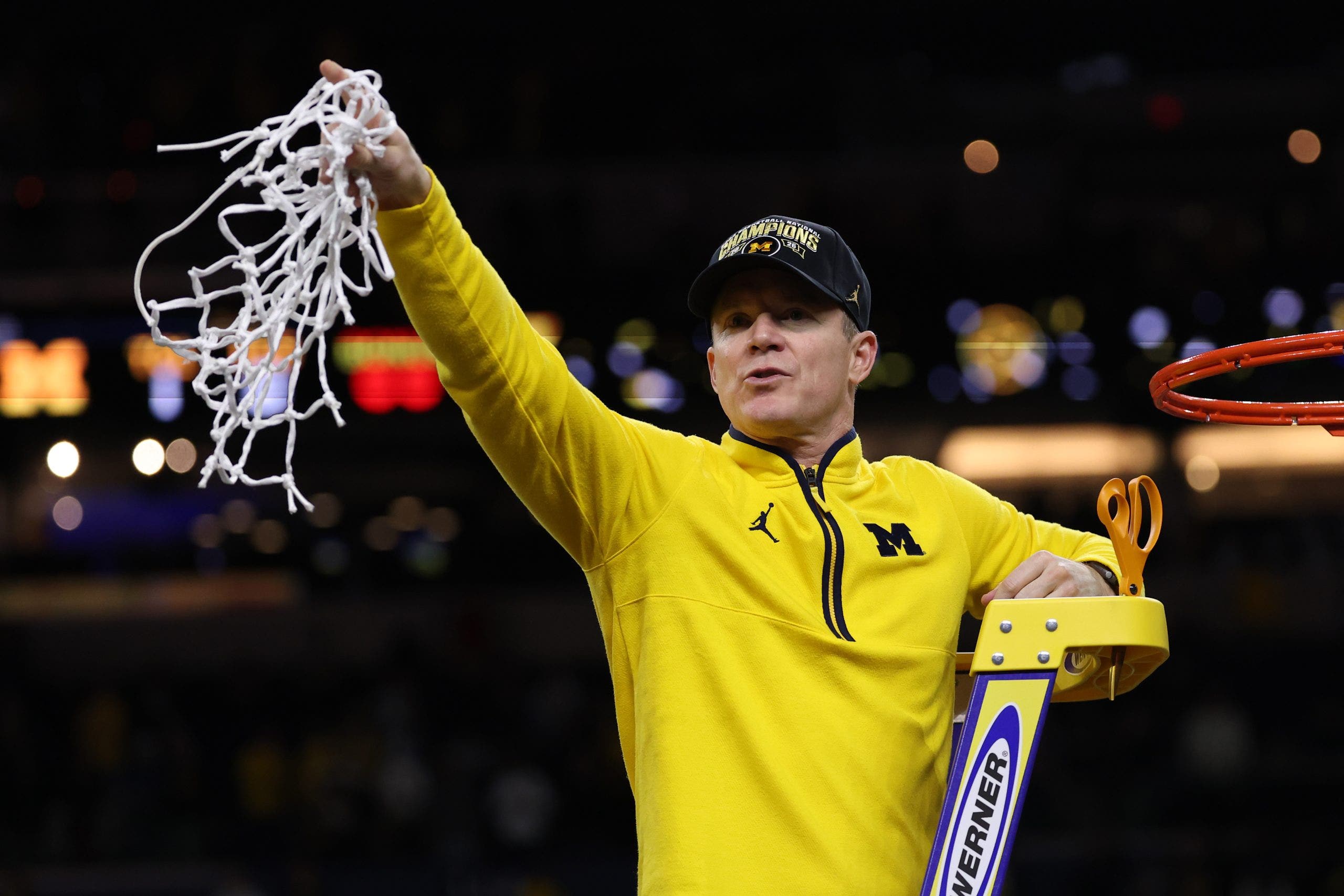
Michigan head coach Dusty May led the Wolverines to a 64-13 record in two seasons. (Photo by Michael Reaves/Getty Images)
A week later, during the Wolverines’ banner-raising ceremony at Crisler Center, athletic director Warde Manuel told The Athletic he believed May will “be the leader of this basketball team for many years to come.” Manuel added the two sides had agreed on a contract extension designed to keep May at Michigan for the foreseeable future, though nothing had been officially signed. Still, the forcefulness of Manuel’s comments — he said the contract would be on May’s desk by the following weekend — quelled some of the lingering concerns.
But on Monday morning came the stunning news that May was finalizing a deal to become head coach of the Dallas Mavericks, leaving one of the most coveted jobs in college basketball at an unusual time in the calendar for a chance to compete at the sport’s highest level.
Rather than pursuing a second consecutive national championship at Michigan, May will take over a rebuilding franchise that bid farewell to All-NBA guard Luka Dončić partway through the 2025 season and has since replaced him with former Duke star Cooper Flagg — the No. 1 overall pick last summer and the league’s reigning Rookie of the Year. The Mavericks also have two more first-round selections in this week’s NBA Draft, one of which falls in the top 10.
May’s replacement, at least temporarily, will be current Michigan assistant Mike Boynton Jr., according to additional reporting from ESPN. Boynton was the Wolverines’ defensive coordinator the last two years and was previously the head coach at Oklahoma State from 2017-24, guiding the Cowboys to one NCAA Tournament appearance and two trips to the NIT. He’s expected to be named interim coach for the upcoming season in an effort to preserve a roster that includes the nation’s No. 4 high school recruiting class and the No. 12 transfer haul.
Michigan’s players will be given a 15-day window to enter the transfer portal that begins five days after May’s replacement is hired or publicly announced.
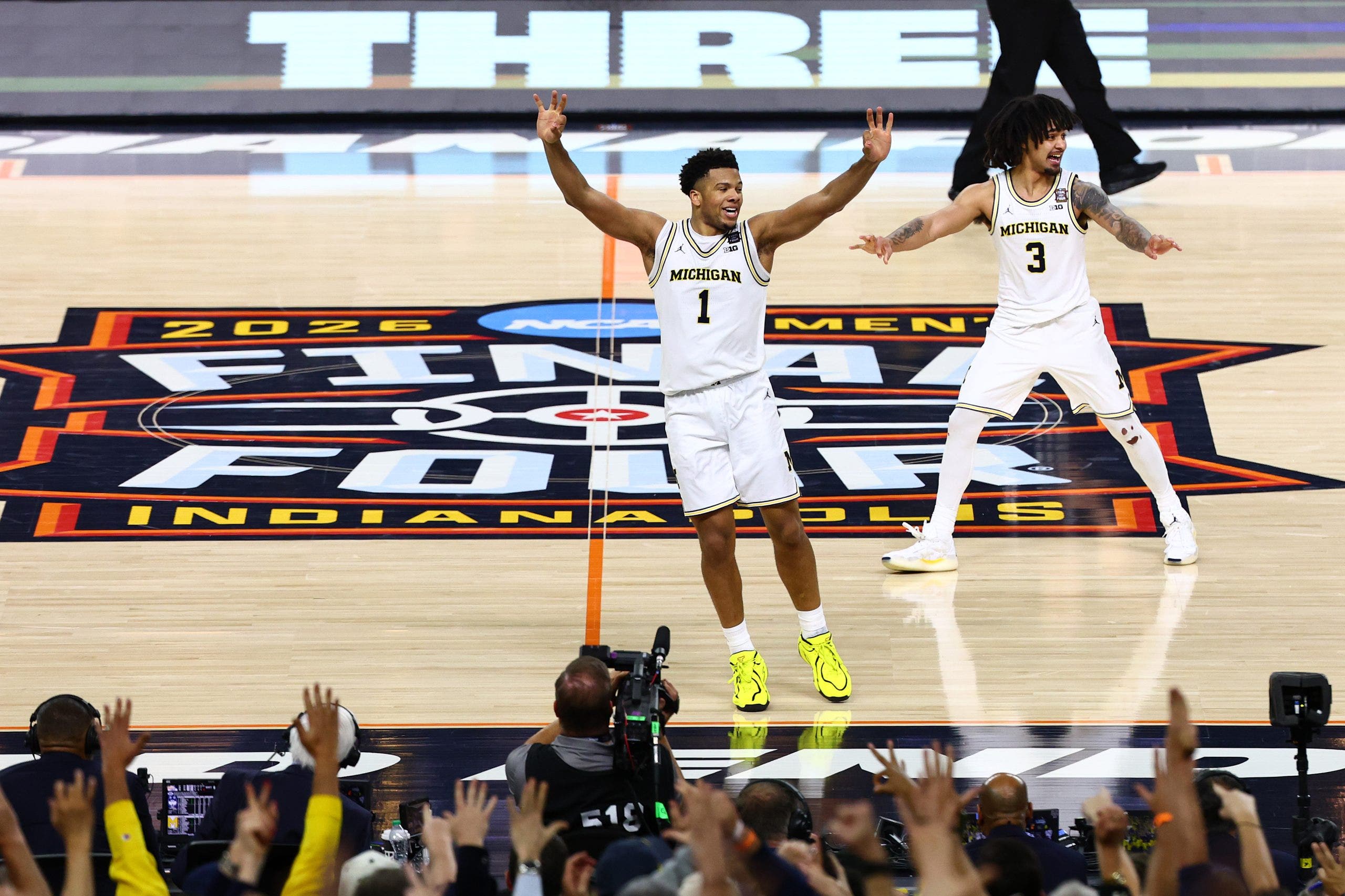
Trey McKenney and Elliot Cadeau are expected to form one of the top backcourts in college basketball next season. (Photo by Tanner Pearson/NCAA Photos via Getty Images)
For such a jaw-dropping move to take place during the third week of June, by which time most programs have already begun their summer workouts, is merely the latest reminder that stability in collegiate athletics no longer exists — even after winning a national championship. Instead, May becomes the first college coach to leave for an equivalent role in the NBA since former Michigan head coach John Beilein was hired by the Cleveland Cavaliers in 2019. He’s also the first coach to walk away after cutting down the nets since Larry Brown departed Kansas in 1988 for a return to the pros.
Perhaps the warning signs were there all along. Or at least since Thamel’s carefully worded message entered the discourse in early April, the one specifying that May wouldn’t pursue other college basketball jobs but made no mention of how he’d respond to interest from the NBA. Such a unique syntactical choice — coupled with the fact that May’s contract extension remains unsigned — feels like a set of clues that were largely overlooked amid the good vibes and wishful thinking sparked by Michigan’s first national championship in nearly 40 years. It’s easy to understand why fans would have trouble picturing someone like May walking away from a program that is so well-positioned for lasting success in the modern era.
But with the modernization of collegiate athletics has come a tediousness in the coaching profession that never used to exist. There’s a constant turning of the hamster wheel in an industry where nothing about the system can sustain. Rosters are churning like never before. Player compensation soars on an annual basis. Whichever rules actually remain are difficult to understand and even harder to enforce. Imagine telling Dean Smith or Mike Krzyzewski that they’d be learning the names of local judges.
Who can really blame May for bailing on the blur?
And yet, somewhat paradoxically, the aggressiveness of Michigan’s transformation under May means the infrastructure is there for the Wolverines to remain among college basketball’s elite. He radicalized everything from practice habits and player acquisition to fundraising and on-court philosophy, all of which could be largely maintained with Boynton in charge.
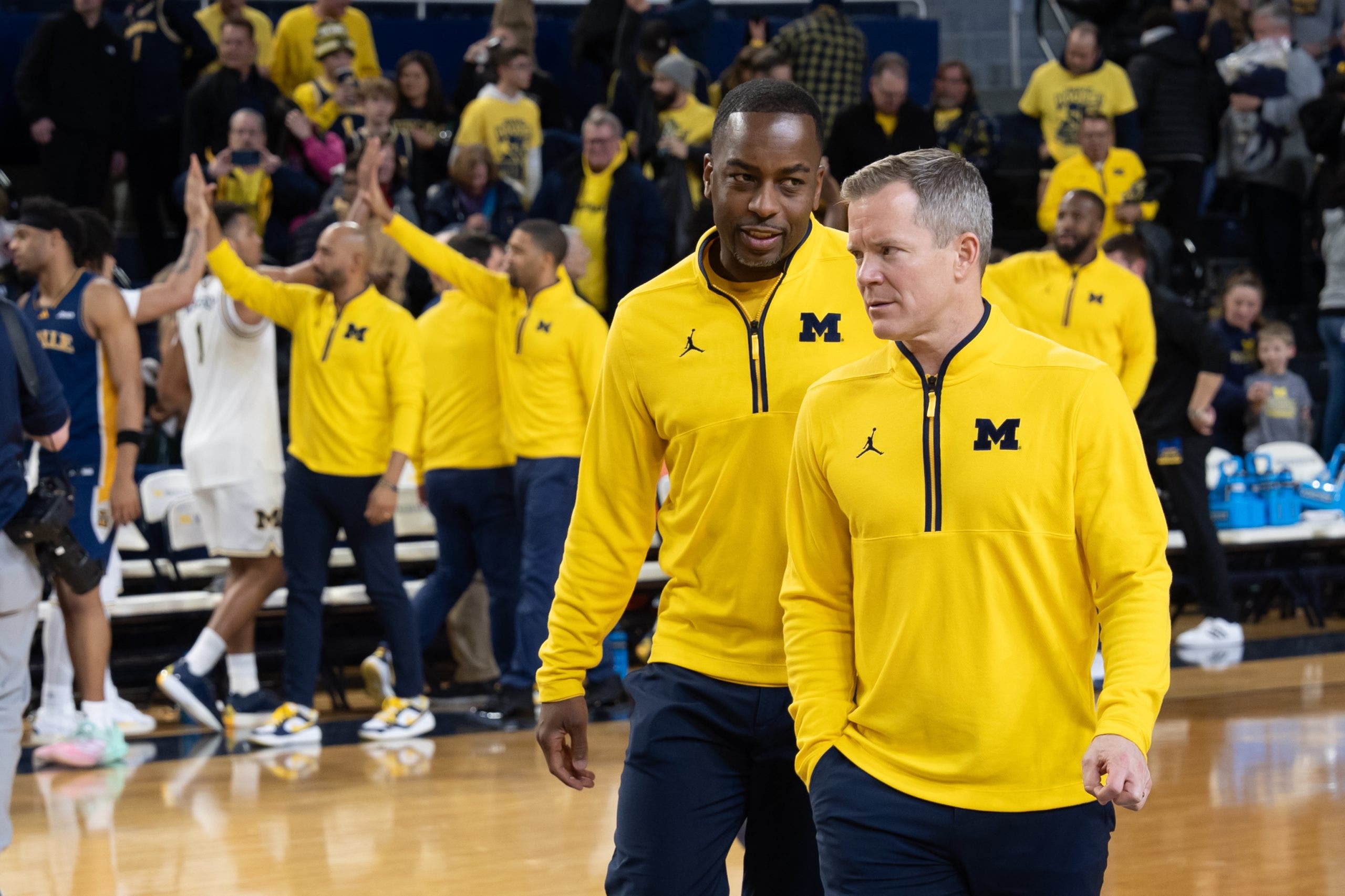
Michigan will reportedly name Mike Boynton the program’s interim coach for the upcoming season following Dusty May’s departure for the Dallas Mavericks. (Photo by Jaime Crawford/Getty Images)
Not only are the Wolverines loaded with talent for the 2026-27 campaign — pending the success of Boynton’s retention efforts — but there are only a handful of teams around the country that can match Michigan’s financial commitment year over year. An assembly line of high-level transfers-turned-pros from the last two seasons is all the proof recruits should need.
Which is why, even after Monday’s shocking news, Michigan’s reputation should continue to swell in the coming days when three of May’s former players are drafted: Yaxel Lendeborg, Aday Mara and Morez Johnson Jr., all of whom are projected first-round picks. Together, they entrusted May with their development and won a national championship because of it, dominating the sport on both ends of the floor. There’s little question that they’d vouch for the quality of program he’s leaving behind.
With or without May, the Wolverines have pieces in place that suggest they’ll be fine. And that’s a credit to everything he built across two seasons Michigan fans will never forget.


