


In this week’s Inside Spain, we look at how a group of teachers has set up a temperature-monitoring platform which exposes how many Spanish school buildings remain ill-equipped for early heatwaves, and the impact on teachers and pupils.
Children at a primary school near Barcelona splash water on each other in the late morning heat as classrooms become increasingly unbearable in one of Europe’s fastest-warming countries.
Inside, temperatures climb past 29C (84F) on a June day just before the end of the school year, a sensor installed in a classroom shows.
It was installed as part of a grassroots monitoring project called “Aules que cremen” — Catalan for “Burning classrooms” — that tracks heat conditions across schools in the northeastern region of Catalonia.
Teachers say the heat is no longer an occasional discomfort but a growing barrier to learning.
“We’re having a lot of heat, and it affects everything in our daily life with the children,” Marta Abril, a teacher at the Patufet Sant Jordi public school in L’Hospitalet de Llobregat near Barcelona, told AFP.
The school, with around 450 pupils in primary education, relies on ceiling fans funded years ago by parents’ associations.
But staff say they are no longer enough as hot periods at the start and end of the academic year grow longer and more intense.
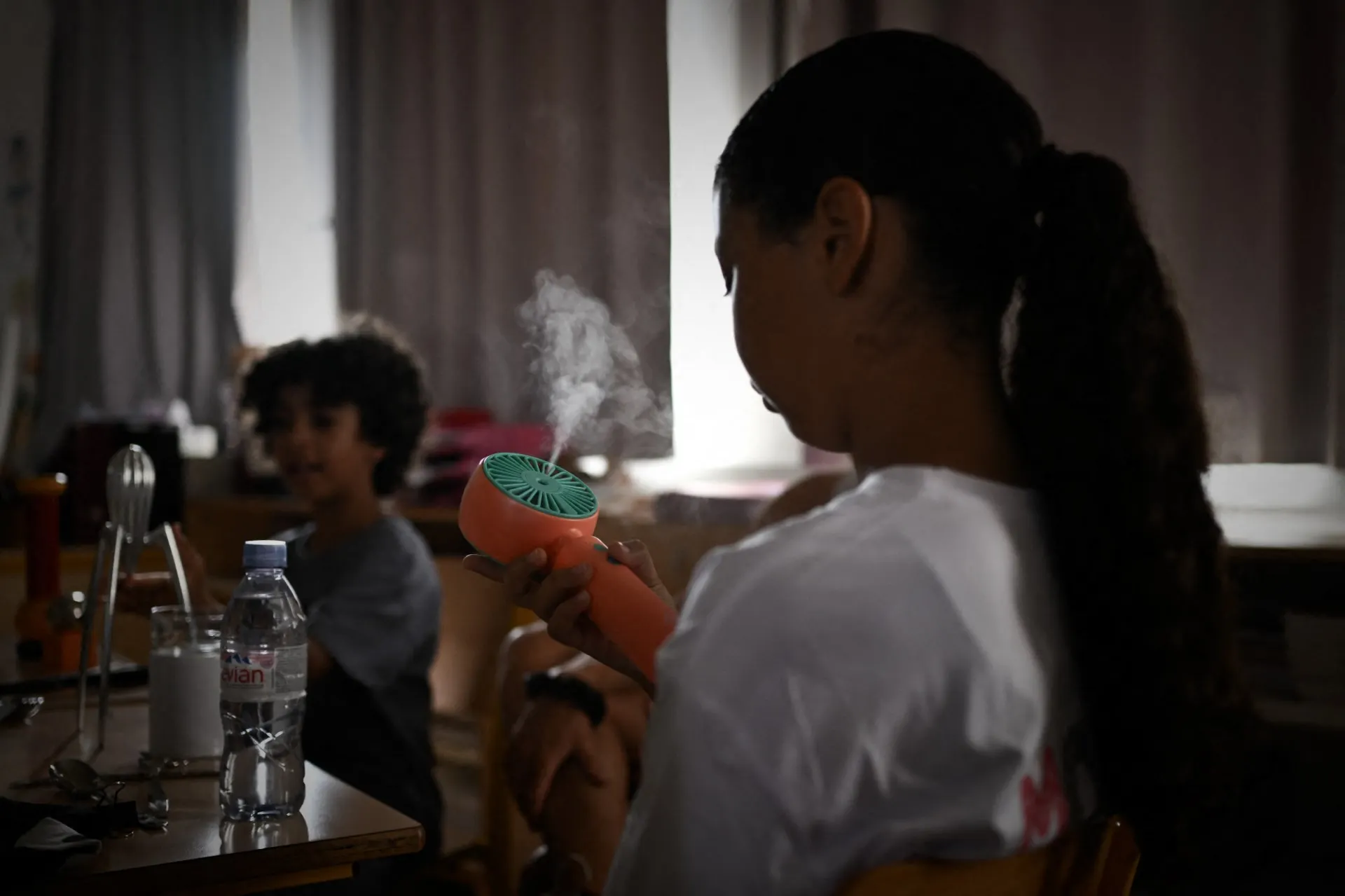
Students regularly complain of headaches after recess due to the heat, said Abril.
“So you have to remind them to wet their heads before playing, to wet their heads again during recess, and to wet their heads once more before coming up to the classroom.”
Created by teachers, the project has installed low-cost sensors in nearly 300 schools across Catalonia, creating a live map of classroom temperatures organisers say underscores how many school buildings remain ill-equipped for rising heat.
“There is labour legislation that sets healthy conditions for adult workers, but there is no law regulating conditions for children,” said Pau Sánchez, a secondary school technology teacher who helped launch the project.
The system, built using simple materials available in school technology workshops, feeds data into an online platform that has become a reference point for teacher complaints about overheating classrooms.
“We already knew the evidence, but now it is written down,” said Octavi Enrech, a developer who co-created the platform with Sánchez, adding it is “unthinkable” that there are classrooms with temperatures of 35C.
Spain is considered a frontline region for climate change, experiencing increasingly long heatwaves that sometimes start before summer, along with more frequent episodes of intense rainfall.
The last four years have been the country’s warmest since records began in 1961, according to national weather agency Aemet.
“We are in what is sometimes called a ‘hot spot’, a region especially sensitive to warming,” said Javier Martín Vide, emeritus professor of physical geography at the University of Barcelona.
Nearly half the school buildings in Catalonia were built before 2000 and have “significant deficits” in energy efficiency and thermal comfort, according to a study by Catalan education policy group Equitat.org.
Elsewhere in Spain, parents in Madrid have filed complaints with the national ombudsman over the lack of air conditioning in schools, while teacher unions in Valencia have complained about baking classrooms.
Local and regional governments have announced investment plans to adapt schools to rising temperatures.
Among the most ambitious initiatives is a programme in Barcelona, where 54 schools have been fitted with air conditioning, with work underway in 30 more.
City authorities plan to invest around €100 million ($116 million), funded through a tourist tax, to equip all of Barcelona’s roughly 140 primary schools, as well as 30 other education centres, by 2030.
In Andalusia, the southern region that frequently endures some of Spain’s most intense summer heat, around one-third of schools have air conditioning, according to daily newspaper El País.
The authorities “will likely react sharply and quickly” when a child suffers heatstroke, said Martín Vide.
“We are already on the brink of it happening,” he added.


