


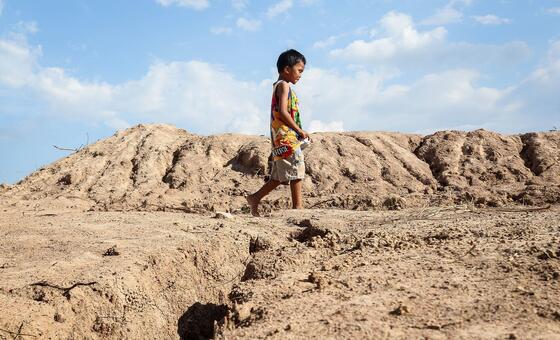
About 1.1 billion children now face at least three overlapping climate hazards, threatening their health, education and survival, according to the Children’s Climate Risk Report 2026.
“The lives of children continue to be upended by the impact of heatwaves, wildfires, droughts and floods,” said UNICEF Executive Director Catherine Russell. “Half of the world’s children are now living with at least three overlapping climate threats shaping their daily lives.”
Overlapping threats
For the first time, the report revealed exactly where and how intense, multiple and overlapping climate threats are affecting children and the essential social services they rely on and how governments can take concrete actions to respond.
Almost every child in the world faces at least one climate hazard while more than four million could face as many as six overlapping threats, warned the report, which used the latest available data to map children’s exposure to the eight most frequent climate threats, including coastal floods, droughts, extreme heat, fires, heatwaves, riverine floods and sand, dust and tropical storms.
More than 296 million children are living in areas exposed to all three conditions, according to the findings. The second most common combination – drought, extreme heat and tropical storms – leaves more than 115 million children worldwide exposed to these overlapping threats.
Children play football in southern Bangladesh in an area devastated by cyclones. (file)
Air pollution affects nearly every child globally
In addition to the eight most frequent climate hazards, the report analysed children’s exposure to air pollution and malaria, which are two risks highly sensitive to the effects of climate change.
Data showed that air pollution affects nearly every child globally, while one billion children are exposed to malaria, adding another layer of danger for children already facing multiple climate hazards.
Without urgent efforts to reduce greenhouse gas emissions, climate hazards will grow more frequent and severe, placing even greater strain on government budgets and systems while threatening children’s wellbeing, the report warned.
Challenges and solutions
One of the hardest hit regions is the Sahel in Africa, where more than four million children face the triple threat of heatwaves, extreme heat and sand and dust storms.
Meanwhile children in countries across Asia, including Bangladesh, Myanmar and Pakistan, are exposed to more climate hazards at once and at a higher intensity than anywhere else in the world.
High-income countries are not immune. In Italy, more than six million children are exposed to prolonged heatwaves and drought, the data showed. Yet, the country illustrated how investment in climate change adaptation can mitigate some of the risks children face while highlighting the need for further action as the climate crisis intensifies.
Triple threats call for triple action
To protect children’s rights from climate threats and adapt to growing environmental changes, UNICEF is calling on governments, businesses and relevant actors to:
- Reduce emissions and take ambitious action to fulfil existing international commitments, grounded in the best available science
- Protect children through inclusive climate adaptation, disaster risk reduction and responses to loss and damage that prioritise the resilience of social services, ensuring that children and child-critical services are included in national adaptation plans and sector strategies, disaster risk governance, preparedness and response plans
- Empower children and young people to meaningfully participate in climate action by investing in climate education, knowledge and skills, and by strengthening the capacity of decision makers and experts to respect children’s rights to be heard, freedom of expression and participation in decisions that affect their lives.
“This analysis can help governments and decision makers plan better and invest more effectively in resilient services,” UNICEF’s chief said.
“When we strengthen health and education systems and improve infrastructure with children in mind, we protect them from today’s climate threats and help secure their future.”


