


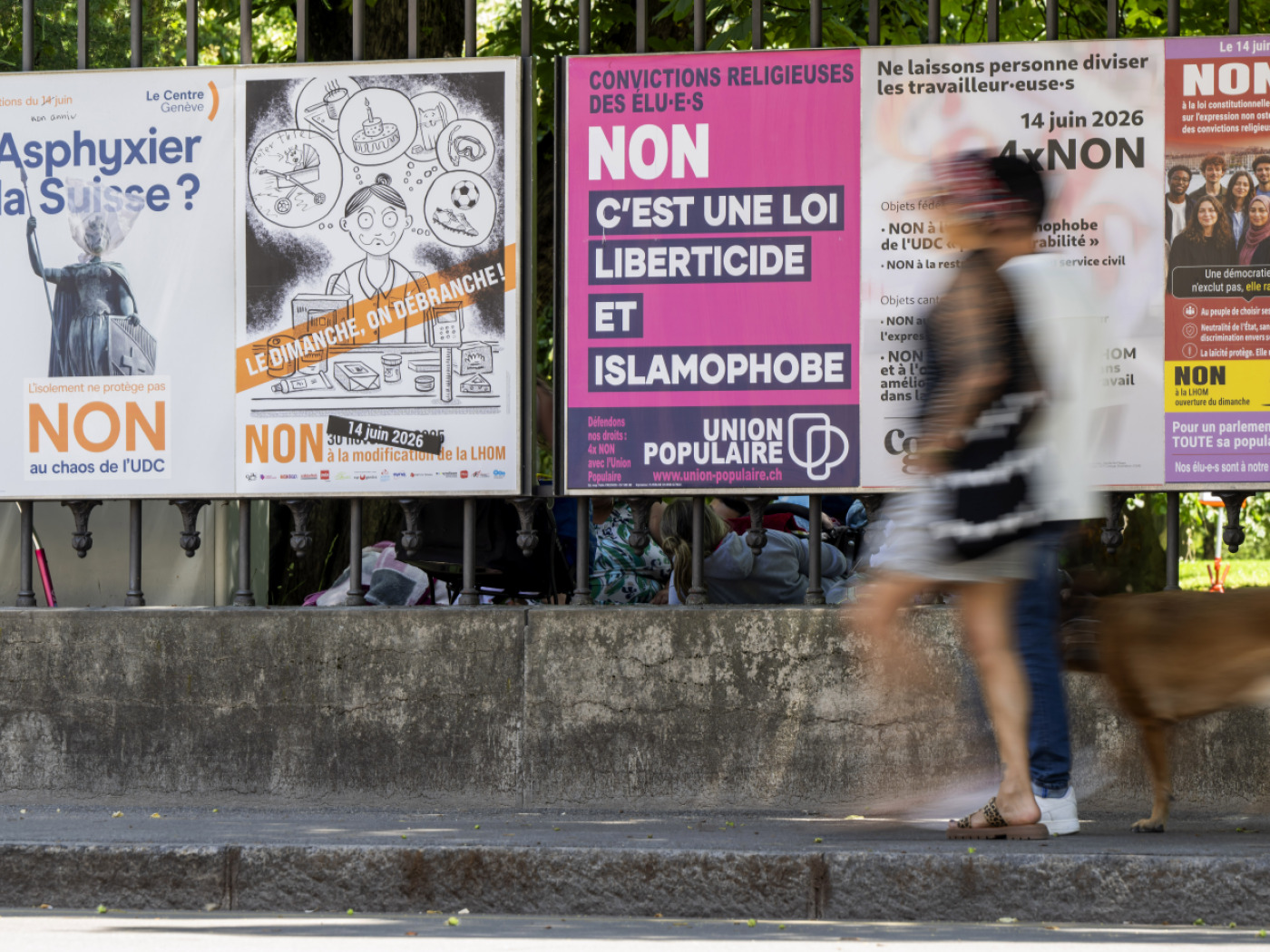
The proposal was introduced by right-leaning parties in the Geneva cantonal parliament.
Keystone-SDA
Geneva has banned cantonal and municipal lawmakers from wearing visible religious symbols during parliamentary sessions. On Sunday, voters approved a constitutional amendment to this effect by a narrow majority.
+Get the most important news from Switzerland in your inbox
The ban on religious symbols was approved by 51.37% of voters, with a turnout of 51.47%.
However, the debate is not over, as appeals have already been lodged against this provision.
The proposal, put forward by right-leaning parties including the Swiss People’s Party, the centre-right Radical-Liberals and the Centre in the name of secularism, was subject to a mandatory referendum.
Parties on the left, along with Libertés et justice sociale (LJS), opposed the ban, arguing it infringed on fundamental freedoms. According to these opponents, members of parliament are not state officials, but representatives elected by the people. Parliament must therefore reflect the diversity of opinions, including religious ones.
More
More
Why Switzerland is losing its religion
“This law claims to strengthen democracy, but actually weakens it by exploiting secularism to restrict access to elected office,” the Green Party said in a statement on Sunday. The Social Democrats believe that the ban “risks excluding certain citizens from political representation on the basis of their religious beliefs”.
The left also saw it as a new Islamophobic attack. The ban covers all religious symbols (headscarves, kippahs or crosses) without targeting any particular religion. Feminist and anti-racism groups, however, denounced the systematic harassment of Muslim women.
First introduced in 2019 as part of the law on secularism following a referendum, this ban was subsequently overturned by the courts. The judges had ruled that lawmakers were not meant to represent the state, but society and its pluralism.
Against the advice of the government, the cantonal parliament reintroduced the ban at the end of 2025 by a narrow majority. For the People’s Party, the Radical-Liberals, the Centre and the Movement Citoyen Genevois, elected representatives embody the public interest. They must not act as spokespeople for communities, and must therefore show a certain restraint in expressing their religious convictions.
Appeals lodged
Opponents of the ban also pointed out that no concrete problems had been observed within the cantonal parliament on the subject of religious symbols. In municipal deliberative bodies, the issue arose on only one occasion. The Green Party representative who sat wearing a veil eventually resigned from her party and relinquished her seat due to her views on same-sex marriage.
More

More
Survey: more Swiss reject organised religion
It will now be up to the courts to rule on the matter, as appeals had already been lodged against this law prior to the vote. Members of the executive at cantonal and municipal levels, as well as magistrates of the judiciary and the Court of Auditors, are already required to observe strict religious neutrality in the performance of their duties.
Translated from French with AI/gw
We select the most relevant news for an international audience and use automatic translation tools to translate them into English. A journalist then reviews the translation for clarity and accuracy before publication.
Providing you with automatically translated news gives us the time to write more in-depth articles. The news stories we select have been written and carefully fact-checked by an external editorial team from news agencies such as Bloomberg or Keystone.
If you have any questions about how we work, write to us at english@swissinfo.ch.


