


When a new Russian-language school opened its doors in Tajikistan’s southern city of Bokhtar in 2022, thousands of locals flocked to enroll.
Named after the 18th-century Russian scientist Mikhail Lomonosov, it was one of five Russia-funded schools that popped up across the impoverished Central Asia country that year.
Part of a $150 million Russian state project, the gated school in Bokhtar stands out among other buildings in the area. A modern three-story structure, the school has round-the-clock uniformed security guards and tall flagpoles flying Russian and Tajik colors.
Moscow’s funding of schools in Tajikistan and across Central Asia is widely seen as an effort to maintain its longstanding influence in a region where China has made inroads and Western interest has intensified.
Among the over 1,000 students enrolled at the Russian-language school in Bokhtar is the eldest daughter of Mukhtor, a local construction worker. The 42-year-old, who also hopes to enroll his son, said he is not focused on politics.
“What matters to me is my children’s future,” Mukhtor, who requested that only his first name be used, told RFE/RL. “This school opens doors to universities in Russia and possibly to better jobs there.”
The five Russian-language schools opened in Tajikistan in 2022 educate a total of around 6,000 students. The schools follow Russian educational standards and teach primarily in Russian. The curriculum as well as the schools’ ceremonies and symbols emphasize Russia’s language and culture.
‘Secure Long-Term Influence’
Moscow is spending hundreds of millions of dollars to expand Russian-language education across Central Asia, building new schools, funding universities, and opening cultural centers in a region where its dominance is no longer assured.
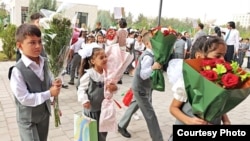
The Russian-funded school in Bokhtar draws thousands of applicants, parents say.
The investments come as Central Asian governments promote their own national languages and younger generations increasingly turn to English or Chinese as a second language.
Yet demand for Russian-language education remains strong, driven by labor migration and access to universities in Russia. The Russian language is still widely used in government and business across the region.
“By building new Russian schools in Central Asia, Moscow is targeting the next generation to secure long-term influence,” a political analyst based in Tajikistan, an autocratic country where dissent is not tolerated, told RFE/RL on condition of anonymity.
Unlike older generations, young Central Asians have no personal memory of the Soviet era and are increasingly exposed to Western and Chinese influence, the expert added.
Customized For Each Country
Russia is funding dozens of educational projects across Central Asia.
Among the most high-profile is a planned $200 million campus for the Kyrgyz Russian Slavic University in Bishkek. Partly funded by Moscow, the institution already plays a major role in Kyrgyzstan’s higher-education system.
Russia has also pledged to build several new Russian-language secondary schools across Kyrgyzstan.
In Kazakhstan, where the Russian language retains official status alongside Kazakh, Moscow’s approach has focused more on higher education and professional training.
Russian President Vladimir Putin revealed during a visit to the country on May 28 that some 60,000 Kazakh students are studying at universities in Russia. He also said eight of Russia’s leading higher education institutions operate campuses in Kazakhstan.
In Uzbekistan, Russian-language education remains popular in higher education and technical fields despite government efforts to make Uzbek the main language of instruction. Russian universities operate campuses in the country, and bilateral agreements support student exchanges and professional training.
In Turkmenistan, where foreign educational initiatives are tightly regulated, Russian-language instruction persists under state oversight. Turkmen students continue to pursue higher education in Russia through intergovernmental arrangements, keeping educational links intact despite broader restrictions.
Across Central Asia, Moscow has also expanded elite and informal education initiatives aimed at younger professionals, analysts, and future policymakers.
One example is an initiative called School On Central Asia organized by the Aleksandr Gorchakov Public Diplomacy Fund, a Russian think tank that brings together young specialists from Russia and Central Asian countries for lectures and discussions on regional affairs.
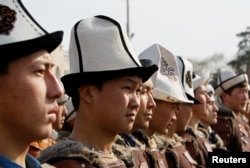
Central Asian governments continue to promote their own national languages and identities.
Language Politics
Russia’s investments in education in the region come as Central Asian governments are looking to promote their own national languages and identities. That process began after the collapse of the Soviet Union in 1991 and has accelerated in recent years.
Language and identity policies in the region, where many countries have ethnic Russian minorities, have periodically courted controversy and triggered sharp reactions from Russian politicians.
When Kyrgyzstan discussed changing Soviet-era names of Bishkek’s districts, Russian lawmakers and commentators accused the authorities of erasing shared history and discriminating against Russian speakers.
Russian officials have also reacted angrily to debates in Kyrgyzstan over reducing the role of the Russian language in public life, despite its status as an official language.


