


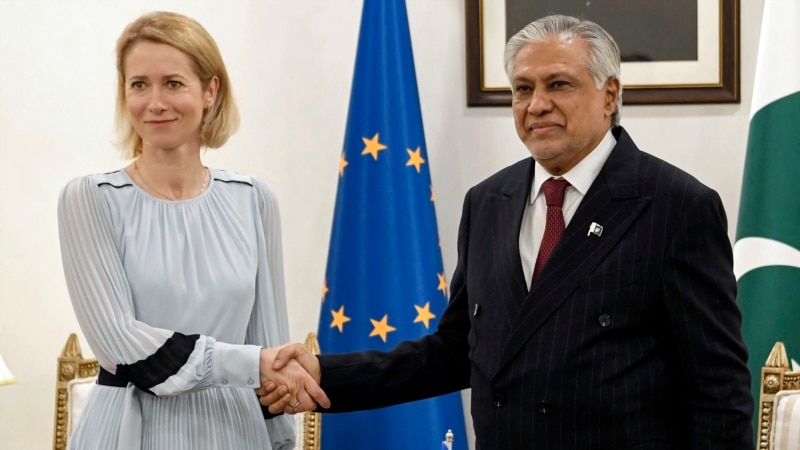
Any temporary peace agreement between the United States and Iran must be followed by deeper talks about Tehran’s nuclear stockpiles, missiles, and other critical issues, European Union foreign policy chief Kaja Kallas said.
Speaking at a news conference in Islamabad on June 1, Kallas, the EU high representative for foreign affairs and security policy, said she sees a “tenuous diplomatic opening” to extend the current temporary cease-fire and reopen the Strait of Hormuz despite an exchange of attacks overnight by both Iran and the United States.
“Any temporary understanding between the US and Iran must be followed by deeper talks about Tehran’s nuclear stockpile and other critical issues,” the bloc’s top diplomat told a joint news conference with Pakistani Deputy Prime Minister and Foreign Minister Ishaq Dar.
Kallas praised Pakistan’s role as a mediator in the Gulf crisis and expressed the EU’s readiness to contribute to the peaceful resolution of the US-Iran dispute mentioning the group’s “economic leverage, hard-won nuclear expertise, longstanding relationships with partners across the Gulf, and direct engagement with Iran itself.”
“I see a concrete role for the EU in helping to make any eventual agreement durable — whether through maritime operations or economic incentives that support long-term stability,” she said suggesting “strict conditions” for a “calibrated path towards sanctions relief” for Iran.
The US and Israel launched air strikes against Iran on February 28 following their continued disagreement over issues relating to Iran’s nuclear capability. Pakistan has been mediating between the United States and Iran to achieve a permanent cease-fire after a fragile cease-fire was reached on April 8.
A draft agreement, mediated by Pakistan, has been going forth and back between the two sides with US President Donald Trump stating on May 31 that the focus is on Iran’s nuclear capability. In a social media post, Trump said his deal “states, very clearly, that Iran will not have a nuclear weapon.”
During the war, Tehran and Washington have taken measures to effectively close the Strait of Hormuz, a narrow but strategically vital maritime passage through which nearly 20 percent of the world’s oil supply is transported from the Gulf to international markets.
The disruption has triggered a sharp surge in global oil prices, raise concerns about inflation, supply chain disruptions, and broader economic instability worldwide.
Pakistan-EU Partnership
Kallas said her first-ever trip to Islamabad “underscores the sustained momentum of high-level political exchanges between Pakistan and the EU and reflects a shared commitment to further strengthening the Pakistan-EU partnership.”
Referring to Pakistan’s recent border clashes with the Taliban regime in neighboring Afghanistan, she said the fighting had “grave humanitarian consequences” and risks fueling further “instability and radicalization.”
She said “Pakistan has a right to defend itself and its people in line with international law. But dialogue, not air strikes, are the best off-ramp in this situation.”
Once allies for decades, bloody border clashes erupted between Pakistan and the Taliban in October last year causing scores of military and civilian casualties and displacing civilian population on either side of the border.
Pakistan accuses the Taliban of sheltering the Pakistani Taliban on its soil, from which they have carried out attacks inside Pakistan. The Afghanistan Taliban, however, say they would not allow any one to use the Afghan soil against any other country.
Pakistan carried out air strikes inside Afghanistan last year by targeting several cities, including the capital Kabul. The Afghan Taliban retaliated with mortar and artillery shelling on Pakistan’s border posts along the British-era 2600-kilometer Durand Line.


