


Tehran has accused the United States of making “contradictory demands” in peace negotiations as a fragile cease-fire hangs in the balance amid a fresh round of attacks in their conflict.
The US military said it had conducted another round of “self-defense” strikes against Iranian sites on June 1, while Iran retaliated with missile and drone attacks on US Persian Gulf ally Kuwait.
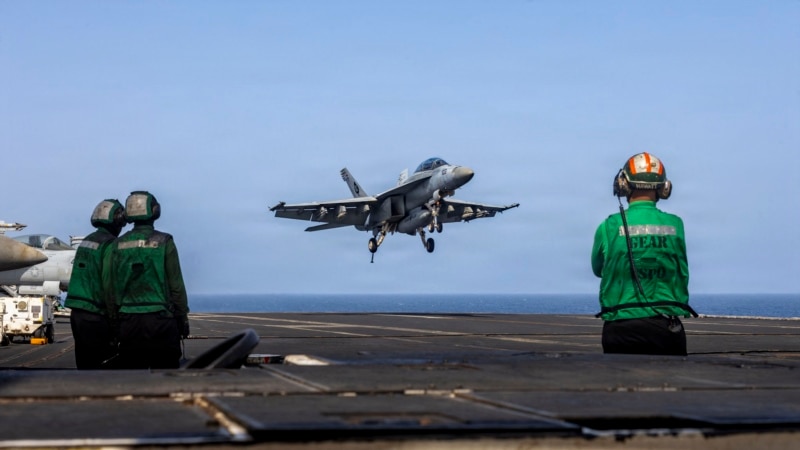
In a statement, US Central Command (CENTCOM) said it had “conducted self-defense strikes on Iranian radar and command and control sites for drones in Goruk, Iran, and Qeshm Island this weekend.”
Iran’s Islamic Revolutionary Guards Corps (IRGC) said US forces had attacked a telecommunications tower on Sirik Island, compelling Iran to “target the air base from which the attack was launched,” an implicit reference to Kuwait.
The exchange marks at least the third publicly announced US “self-defense” strike against Iranian targets since a cease-fire took effect in early April to pause 40 days of fighting.
US forces conducted strikes on May 7 after attacks involving Iranian missiles, drones, and small boats targeting US naval vessels, and carried out additional strikes on May 25 and May 27-28 against missile sites, mine-laying boats, and other military targets that Washington said threatened US forces and commercial shipping in the Strait of Hormuz.
Despite the exchange of fire, the April 8 cease-fire appears to be holding though Tehran has accused Washington of breaching the truce.
During his weekly press briefing on June 1, Iranian Foreign Ministry spokesman Esmail Baqaei said the United States “is also violating the cease-fire, including this morning.”
He added that Tehran will “take whatever measures we deem necessary to defend Iran’s national security.”
Baqaei said communications with the United States were continuing “under extreme skepticism and pessimism” as the “other party is constantly changing its views and putting forward new or contradictory demands.”
Latest Draft Of Agreement
The latest draft of an emerging agreement, first reported by Axios on May 30, would extend the cease-fire by 60 days, call for the reopening of the Strait of Hormuz, and establish a framework for renewed nuclear negotiations. The deal would also potentially allow Iran to access billions of dollars in frozen assets through sanctions relief if diplomatic progress continues.
But US media reported on May 31 that President Donald Trump has requested changes to the proposed agreement with Iran. The revisions reportedly concern the status of the Strait of Hormuz and the disposal of Iran’s highly enriched uranium stockpile.
In a social media post early on June 1, Trump said “Iran really wants to make a deal, and it will be a good one for the U.S.A. and those that are with us.” He did not elaborate.
In his news conference, Baqaei said that a cease-fire in Lebanon “is an essential condition for any deal” with the United States, as Israel expands its offensive its says targets members of Hezbollah, an organization designed by Washington as a terror group, inside Lebanon.
Mohammad Baqer Qalibaf, Iran’s parliament speaker and lead nuclear negotiator, reiterated Tehran’s position in a post on X, charging that the US naval blockade of Iranian ports and Israel’s “escalation of war crimes in Lebanon” constitute “US noncompliance with the cease-fire.”


