


The world soccer governing body, FIFA, reportedly plans to again prohibit fans from displaying Iran’s pre-revolutionary flag at the 2026 World Cup, renewing a controversy that shadowed the tournament in Qatar four years ago and drawing immediate backlash from the Iranian diaspora and opposition figures.
The ban was reported by The Athletic on May 19 after FIFA pointed to its stadium code of conduct, which bars “banners, flags, apparel, and other paraphernalia that are of a political, offensive, and/or discriminatory nature” from venues. Unlike in Qatar, where enforcement was inconsistent, the 2026 ban is expected to be applied as a blanket policy.
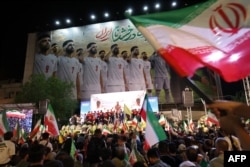
The report said the Iranian soccer federation had submitted a list of demands to FIFA related to the team’s participation, including “respect for the Iranian flag,” and FIFA described recent talks with Iranian football officials as “excellent” and “constructive.”
Iranian-born Belgian MP Darya Safai, who has campaigned for years for Iranian women’s right to enter sports stadiums, told RFE/RL Radio Farda the ban would not stop diaspora fans. “If you insist, if you sit on your seat and take it up, they cannot do anything. I have always said: This is my real flag, this is my seat, and I will sit here.”
She drew a direct comparison between the Islamic republic’s official flag and Soviet-era iconography. “The flag of the Islamic republic is an ideological flag, comparable to the hammer and sickle of communism. It is not the real flag of the Iranian people.”
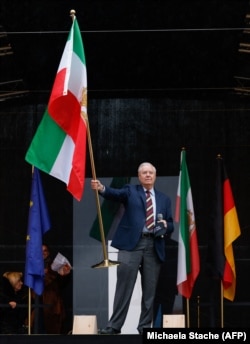
The flag at issue features the lion and sun emblem carried on Iran’s tricolor for decades. The lion and sun motif has roots in Persian heraldry as far back as the 12th century, predating any modern monarchy, and became Iran’s official national emblem after the Constitutional Revolution of 1906–1907. In 1980, the newly installed Islamic republic replaced it with a new emblem, turning both symbols into potent political markers.
The replacement emblem is a stylized composite designed to simultaneously resemble a tulip, a sword, and the word “Allah” in Arabic script, while the flag’s borders carry the phrase “Allahu Akbar” repeated 22 times, referencing the date of the revolution in the Iranian calendar.
Since then, a symbol that had represented Persian national identity across centuries and dynasties has been claimed most visibly by the monarchist movement, though Iranians across the opposition spectrum have also raised it as a broader symbol of resistance to the Islamic republic.
Iran faces New Zealand, Belgium, and Egypt in Group G. The tournament opens on June 11.


