


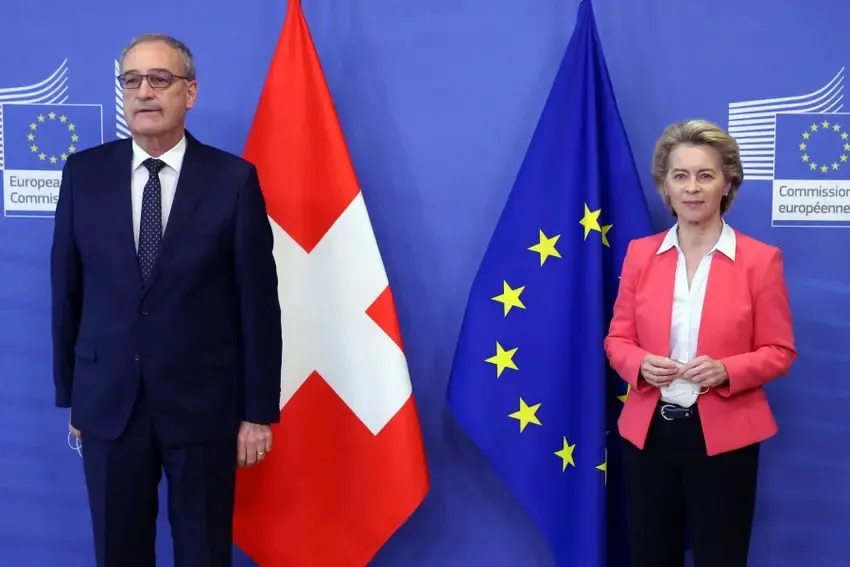
The Swiss government and many economists believe the new package of agreements between Bern and Brussels – the so called ‘Bilaterals III’ – is crucial to Switzerland’s prosperity. But one expert thinks otherwise.
The new agreements were concluded in December 2024 after years of negotiations, and signed by both sides in March 2026.
Bilaterals III cover a wide spectrum of topics, such as electricity supply, food safety, air and land transport, as well as healthcare.
They also ensure Switzerland’s participation in EU programmes: research, innovation, education, youth, sport, culture, and other areas.
Last but not least, Bilaterals III also address the Free Movement of Persons – that is, issues related to immigration.
According to the Federal Office of Foreign Affairs, the agreements “are of benefit to Switzerland by securing and expanding access to the EU single market, providing legal certainty for exporters, and enabling participation in vital research programs.”
READ MORE: How will Switzerland benefit from new pact with the European Union?
‘Giving up autonomy’
Some experts, however, argue that further ties with the European Union would be detrimental to Switzerland.
In an interview with The Local, Swiss historian Markus Somm said he is against the agreements because “we would be giving up part of our political autonomy and weakening our institutions.”
Somm, who is the author of a book titled ‘Why Switzerland Became Rich: Facts and Myths of an Economic Miracle’, argues that “Switzerland’s prosperity does not depend on bilateral agreements with the EU. The country was already economically strong before them, so I am questioning whether market access really depends on such agreements.”
“Switzerland’s trade has become more globally diversified, reducing its reliance on the European partners, so close institutional ties to the EU are not essential for the country’ success,” he adds.
Another downside to consider: A ‘threat to democracy’
According to Somm, Bilaterals III “would require Switzerland to adopt EU laws without having a say in making them, which would result in weakening national sovereignty and direct democracy. This would undermine Switzerland’s political independence.”
An interesting fact about Somm is that he had morphed from a radical left-wing youth to being a member of the centre-right Liberal-Radical Party (FDP) today.
“Throughout my life, I’ve simply come to understand that the solutions proposed by the left, despite their good intentions, don’t achieve the desired results and don’t generate prosperity,” he explained in an interview with Swiss media.
“They invariably lead to a reduction of freedoms. And I firmly believe that individual freedom, the ability to shape one’s own life, is a fundamental value. That’s why I changed my political orientation,” he said
Do supporters of closer ties with the EU agree with these arguments?
Regarding the claim that Switzerland’s independence would be weakened, and that it would be obligated to adopt EU’s laws, this standpoint “is vastly exaggerated,” Francesco Maiani, professor of European Law at the University of Lausanne and expert in EU Migration Law and Policies, told The Local in an previous interview.
“Wide-ranging areas will be untouched by the agreements – such as State authorities and political rights, general administrative law, and civil law outside of limited points,” he said.
Also, “even for matters covered by the agreements (most of which are already part of the existing treaties, and therefore already subject to rules derived from EU Law), Switzerland will still have the ultimate right to decide whether it wants to take on new EU law.”
And referring to another point brought up by Somm – that Bilaterals III are a threat to Swiss democracy – Maiani stressed that “the new agreements in no way restrict the scope of direct democracy –issues will still be voted on, even if they run counter the the EU treaties,” he said.
What is the next step?
MPs in both chambers – the National Council and the Council of States – will debate this matter during future sessions.
However, a unilateral approval is highly unlikely: though most parties support the effort to strengthen Switzerland’s relations with the EU, one – the Swiss People’s Party (SVP) – does not, and its interference could derail the legislative proceedings.
The agreements’ fate will be ultimately sealed by Swiss voters.
Under the country’s direct-democracy system, the government must seek voters’ approval before introducing new laws, and Bilaterals III are no exception.
READ MORE: What happens next with the landmark Swiss-EU agreements?


