


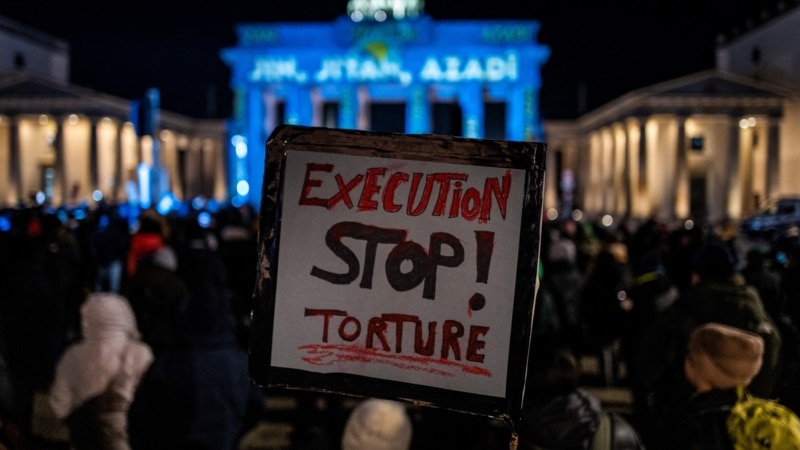
Iran executed two men on May 13 as the accelerated campaign of political hangings since the start of the war with the United States and Israel shows no signs of abating.
Ehsan Afrashteh, a cybersecurity and network specialist, was hanged on charges of espionage for Israel, Tehran’s archfoe, early in the day.
By late evening, Mohammad Abbasi, who took part in mass protests in January, was executed at Ghezel Hesar Prison on charges of killing a security officer in Malard, a town near Tehran.
Abbasi’s family was summoned to prison for what they were told would be a visit, only to be turned away at the gate, according to the US-based rights group HRANA. They later learned of his execution by phone.
In a statement on May 14, the Mujahedin-e Khalq Organization (MEK), an exiled Iranian opposition group that for years was considered a terrorist organization by the United States and Britain, claimed Abbasi as a member.
The Iranian judiciary’s Mizan news agency, which did not link Abbasi to the MEK, framed his hanging as “qisas,” an Islamic concept that refers to a retributive execution carried out at the request of the victim’s family.
The Islamic republic had published footage of his trial, in which he was accused of killing a member of the security forces during the peak of the mass protests on January 8-9.
Weeks of nationwide demonstrations against Iran’s clerical rulers erupted in late December. The authorities responded with an unprecedented crackdown, killing several thousand protesters.
In Afrashteh’s case, two sources who spoke to RFE/RL’s Radio Farda said he was approached by a foreign intelligence service while visiting Turkey. He informed Iran’s Intelligence Ministry before he returned home only to be arrested at Imam Khomeini International Airport the moment he landed and transferred to prison, the sources said.
HRANA had previously reported that Afrashteh’s confessions during detention were “fabricated,” he had rejected the charges, and his family’s assets had been seized and relatives placed under surveillance.
Rights groups and sources close to the family say Afrashteh’s case illustrates the Islamic republic’s use of forced confessions and wartime courts to eliminate perceived security threats.
‘Political Purge’
The executions are the latest in an intensifying campaign of hangings since March 18 — weeks after the United States and Israel launched a bombing campaign of Iran.
There have been at least 29 confirmed political executions since then. They fall under three broad categories: protesters who took part in the mass demonstrations in January and charged with moharebeh, or “enmity against God”; members or alleged members of the MEK convicted of armed rebellion; and those convicted of spying for the CIA or Mossad, the Israeli intelligence agency.
Rights organizations have condemned the trials of those executed. The Oslo-based Center for Human Rights in Iran in April said many of the trials were marked by “torture, forced confessions, and the complete absence of due process.”
Iran Human Rights Monitor, a foreign-based group that documents human rights abuses, characterized the pace of executions as “a political purge” exploiting wartime conditions.
“The regime’s priority is not external war, but internal suppression,” it said in an April statement, noting the number of political executions in the first six weeks of the war already exceeded the total for all of 2025.
Last month, UN Human Rights Chief Volker Turk called on Iran to “establish a moratorium on the use of capital punishment” and release prisoners “arbitrarily detained.”
“I am appalled that — on top of the already severe impacts of the conflict — the rights of the Iranian people continue to be stripped from them by the authorities, in harsh and brutal ways,” he said.
Iran is one of the world’s biggest executioners, hanging hundreds of people per year, many for drug-related offenses and homicide.


