


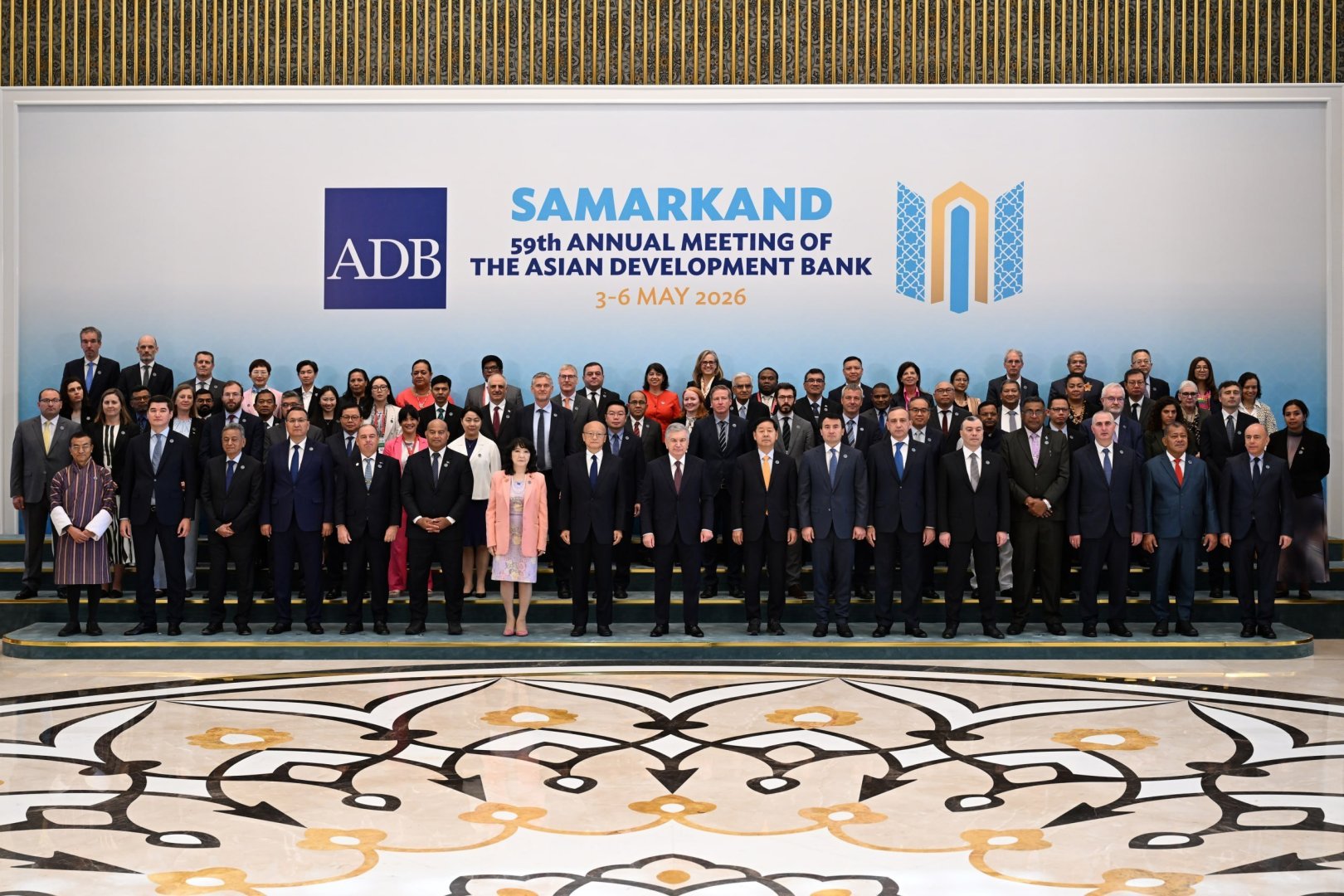
BAKU, Azerbaijan, May 9. Samarkand has emerged
as a platform through which Uzbekistan is translating its domestic
reforms into regional initiatives.
At the 59th Annual Meeting of the Board of Governors of the
Asian Development Bank (ADB) in Samarkand, Uzbekistan presented a
package of initiatives supported by a new partnership program with
the bank through 2030, valued at $12.5 billion. The forum, held
from May 3–6 under the theme “Crossroads of Progress,” has convened
over 3,000 participants representing more than 60 countries.
The agenda emphasizes connectivity, data, and resource
mobilization. ADB President Masato Kanda highlighted the
acceleration of cross-border integration in energy, digital
technologies, and trade as a top priority. By hosting the meeting
for the second time since 2010, Uzbekistan is consolidating its
position as a regional hub.
The economic foundation underpinning these achievements is
reflected in concrete data. Since 2016, Uzbekistan has attracted
approximately $150 billion in foreign investment, its GDP has
expanded from $50 billion to $147 billion, and exports have
tripled. Investments of around $35 billion have been directed to
the energy sector, raising electricity production to 87 billion
kWh, a 1.5-fold increase. The poverty rate has declined from nearly
35% to 5.8%, while incomes have risen for 8.5 million citizens. In
the first quarter of 2026, the economy recorded growth of 8.7%.
President Shavkat Mirziyoyev highlighted the rapid pace of
change. “In a historically short period, we have navigated a
complex path of development together with our hardworking and
creative people,” he stated.
He also underscored improvements in the business environment,
noting that Uzbekistan climbed 14 positions in the Index of
Economic Freedom, entering the category of “moderately free”
economies for the first time.
A central focus of the address was the regionalization of
reforms through tangible initiatives. The Central Asia Tourism Ring
project aims to establish a unified regional tourism space. Over
the past decade, the number of foreign visitors to Uzbekistan has
increased sixfold, reaching 12 million, with plans to extend this
growth across the region.
The Digital Customs and Logistics Alliance initiative seeks to
reduce trade barriers in response to rising logistics costs, as
freight expenses across Central Asian countries have increased by
up to 30% and delivery times have lengthened by several weeks. The
China-Kyrgyzstan-Uzbekistan railway is anticipated to reduce
delivery times to 10 days, with an annual capacity of up to 15
million tons.
In the digital economy domain, Uzbekistan has proposed the
establishment of an artificial intelligence scaling program under
the Asian Development Bank, including the creation of a regional AI
hub in Tashkent. Concurrently, the country is joining the
Asia-Pacific Digital Highway initiative, which has a projected
budget of $20 billion through 2035.
On the climate agenda, the Central Asia Green Belt project is
being actively advanced. The national program “Yashyl Makon”
envisages the planting of 200 million trees and shrubs annually and
has already resulted in the creation of 2 million hectares of
forest plantations on the dry bed of the Aral Sea. The overarching
goal is to increase regional green coverage to 30% by 2030.
The investment component encompasses the planned listing of 30%
of shares in the National Investment Fund, which consolidates
assets from 13 strategic enterprises, alongside participation in
the Asian Development Bank’s critical minerals program, comprising
more than 70 projects valued at $1.6 billion.
Uzbekistan’s total cooperation portfolio with the ADB already
exceeds $16 billion. President Shavkat Mirziyoyev emphasized that
the proposals presented at the Samarkand platform are intended to
translate into practical projects and mutually beneficial
agreements.
Uzbekistan’s initiatives are expected to reduce logistics costs,
accelerate trade, expand tourism flows, and attract private
investment through public-private partnership mechanisms, while
simultaneously advancing the green and digital agendas.
Under an optimistic scenario, the implementation of the
Samarkand proposals could enable Uzbekistan to achieve
upper-middle-income status. In the event of geopolitical
instability, additional measures to diversify the economy may be
necessary to avoid over-dependence on the commodity sector.
Ultimately, the Samarkand platform confirms that Uzbekistan is
increasingly promoting initiatives to significantly contribute to
the region’s economic connectivity.


