


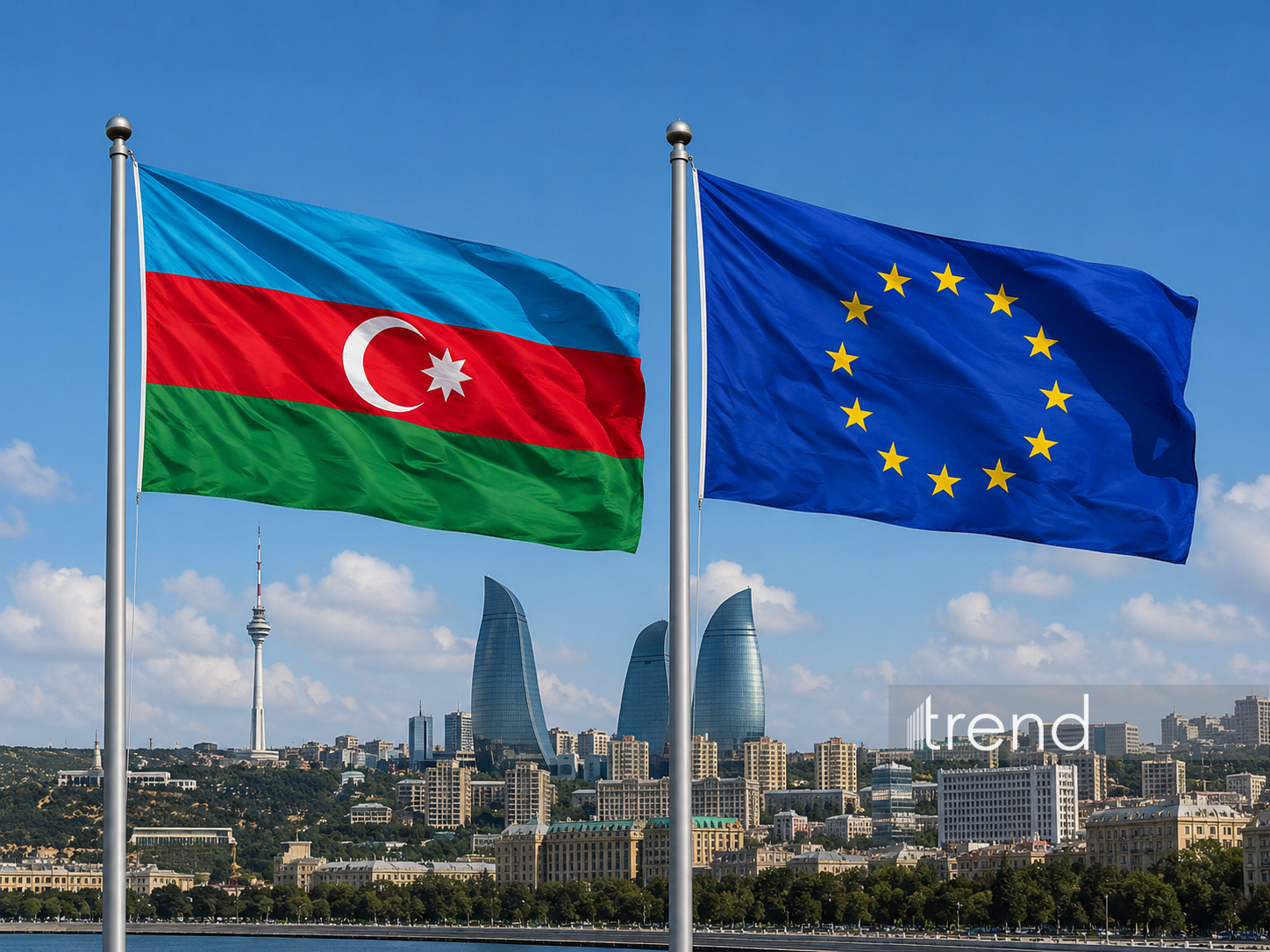
BAKU, Azerbaijan, May 6. The relations between
Azerbaijan and the European Union (EU) are developing dynamically,
based on mutual trust, pragmatic cooperation, and long-term
strategic interests against the backdrop of modern geopolitical
realities.
Kaja Kallas’ visit: next milestone of continuous
dialogue
The visit of one of the high-level representatives of the EU,
Kaja Kallas, to Azerbaijan is considered an important event
confirming that bilateral relations continue on a stable and upward
path. It’s particularly noteworthy that this visit took place
immediately after the European Political Community Summit in
Armenia. This sequence clearly shows that relations with Baku are
one of the priority directions.
Kallas’ previous visits to Azerbaijan and meetings with
President of the Republic of Azerbaijan Ilham Aliyev at various
international platforms also prove that this dialogue is systematic
and continuous. These contacts are not accidental, but rather are
part of a strategic line formed between the parties.
Political relations: cooperation strengthened by
strategic documents
Currently, the basis of Azerbaijan-EU relations is political
dialogue. The adopted joint documents play a special role in
deepening this dialogue. These documents demonstrate that the
partnership has already gone beyond the framework of purely
cooperation and has acquired a strategic nature.
The agreements reached between President Ilham Aliyev and the
leadership of the European Union demonstrate that relations are
developing institutionally and systematically. This is one of the
main indicators of the parties’ trust in each other in the long
term.
Main dialogue mechanisms: the structural basis of
cooperation
Three main mechanisms operate to organize bilateral relations
more effectively. These include the transport cooperation platform,
the energy security dialogue, and the security-related interaction
mechanism.
This structure allows for a systematic expansion of cooperation
and ensures that relations between the parties are not limited to
political statements.
Transport and connectivity: Azerbaijan’s strategic
geography
Azerbaijan’s geographical location makes it one of the main hubs
connecting Europe and Asia. Projects connecting the Caspian and
Black Sea basins, as well as initiatives such as TRIPP, serve to
expand logistics and transport opportunities in the region.
In addition, initiatives put forward to open communications in
the region are also welcomed by the EU. This approach shows that
Azerbaijan is an important partner in terms of not only energy, but
also transport security.
Energy factor: Azerbaijan’s role in European
security
Azerbaijan has an important position in Europe’s energy supply,
and this fact has been repeatedly emphasized by European officials.
Kallas also emphasized in her speeches that Azerbaijan is an
important partner for the EU.
Currently, Azerbaijani gas is already supplied to 10 European
countries. The recent inclusion of Austria and Germany in this list
indicates the expansion of the geography of cooperation. Against
the background of the processes taking place in the Caspian region,
the importance of this partnership is increasing, and Azerbaijan is
strengthening its position as a reliable energy supplier.
Peace initiatives: the main guarantor of stability in
the region
Azerbaijan plays a leading role in advancing the peace agenda in
the region. The steps taken and initiatives put forward in this
direction are also positively received at the international
level.
President Ilham Aliyev’s speech at the European Political
Community summit is of particular importance in this regard and is
already considered a historic event. The fact that this approach is
also supported by the EU shows that Azerbaijan’s constructive
position is accepted.
Political pressures and reality: different approaches
within Europe
Although some groups operating in the European Parliament have
attempted to negatively influence Azerbaijan-EU relations, these
initiatives have not yielded any real results.
On the contrary, cooperation between the main executive bodies
of the EU, especially the European Commission, and Azerbaijan has
become closer and more sustainable. This shows that pragmatic
cooperation is the main factor determining the direction of
relations.
Regional economic cooperation: new opportunities and
prospects
The gradual formation of economic relations between Azerbaijan
and Armenia creates new realities in the region. This process,
based on mutual interests, serves to strengthen stability and
increase economic activity.
Azerbaijan also acts as an important partner for the countries
of the region in the energy sector. Especially against the
background of the complex situation in the Middle East, there was a
possibility that Armenia would face an energy shortage. However,
thanks to the opportunities provided by Azerbaijan, this risk was
eliminated, and as a result, energy prices in Armenia were kept at
a stable level.
Future built on trust and pragmatism
In general, relations between the EU and Azerbaijan are
multifaceted and stable. Kallas’ visit to Azerbaijan demonstrates
that this cooperation is not only continuing, but also entering a
new phase.
The current dynamics show that the relations formed between the
parties aren’t accidental, but are based on specific strategic
interests and mutual trust. This gives reason to say that
cooperation will expand further in the future and will remain one
of the main pillars of stability and development in the region.


