


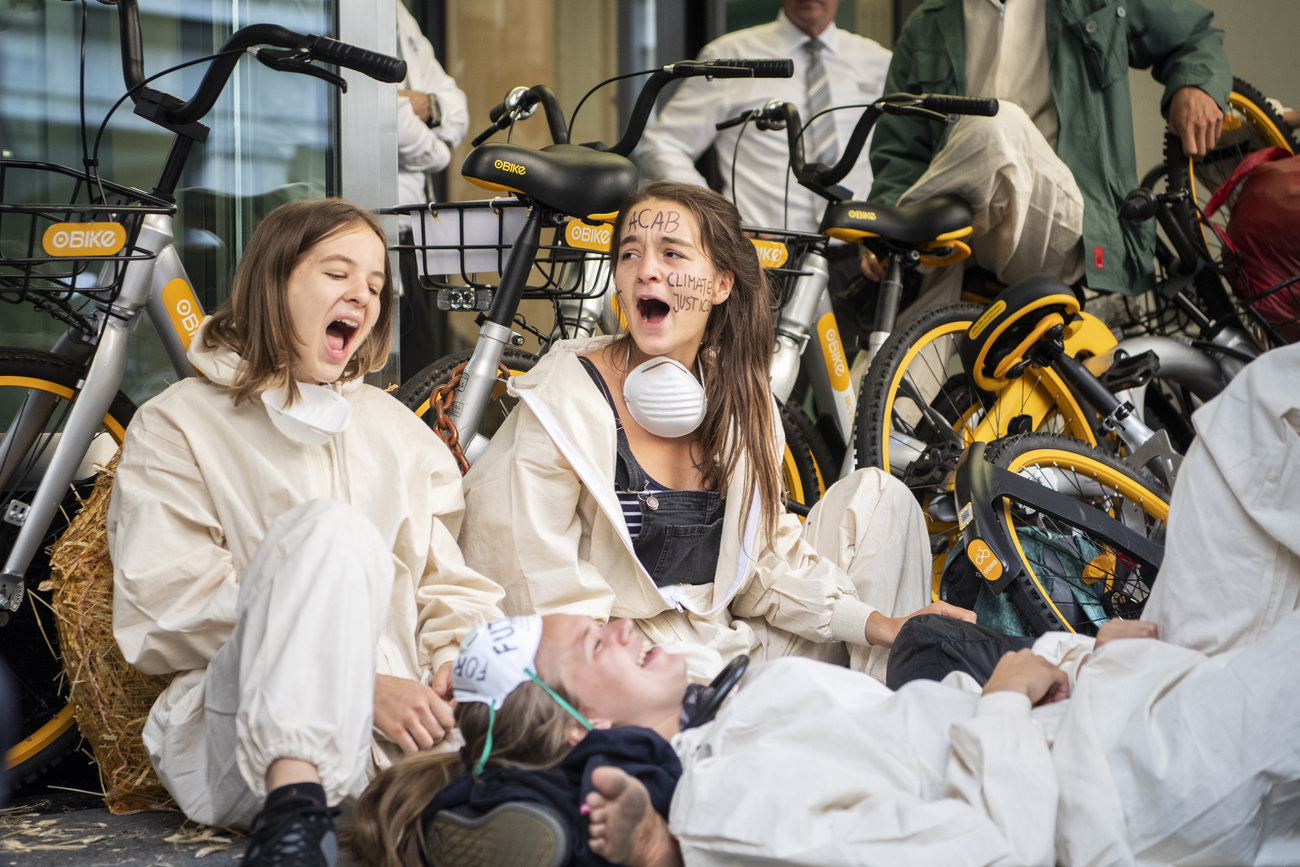
The climate activists chained themselves to one another and to bikes in front of Credit Suisse.
Keystone / Ennio Leanza
Six climate activists that demonstrated in front of Credit Suisse in 2019 are appealing their conviction for coercion to the European Court of Human Rights (ECHR) in Strasbourg. They believe their rights to freedom of expression and assembly have been violated.
+ Get the most important news from Switzerland in your inbox
In total, around 70 activists organised this demonstration to draw attention to Swiss banks’ investments in fossil fuels. In front of the Credit Suisse entrances on Paradeplatz, Bahnhofstrasse and Bärengasse, the participants chained themselves to one another, to flower boxes or bikes.
Access for customers and employees was made difficult but remained possible, according to the Federal Supreme Court’s ruling in this case. The activists explained that they had not prevented third parties from accessing the entrances.
The activists are therefore criticising their conviction for coercion and are appealing against the Federal Supreme Court’s ruling handed down in March, they announced in a statement on Thursday.
No protection
In its decision, the Federal Court did indeed recognise the importance of critical voices in the public sphere and accorded greater weight to fundamental democratic rights than in its previous rulings, the activists acknowledge. But the Court missed an opportunity to actively protect the right to freedom of expression and assembly in times of multiple crises, they lament.
“The Federal Court has made an effort but has not yet fully assumed its responsibility, particularly regarding the systematic application of Articles 10 and 11 of the ECHR,” emphasises Stephanie Motz, a representative of the collective of lawyers defending the activists.
More

More
Swiss climate activists continue to protest, but change ‘is not easy’
According to the activists’ spokesperson, Frida Kohlmann, quoted in the press release, with the numerous convictions of participants in climate actions, “an entire movement has been criminalised. For us, this is about fundamental democratic rights, the right to be able to say ‘no’ when the time comes.”
Translated from French by AI/jdp
We select the most relevant news for an international audience and use automatic translation tools to translate them into English. A journalist then reviews the translation for clarity and accuracy before publication.
Providing you with automatically translated news gives us the time to write more in-depth articles. The news stories we select have been written and carefully fact-checked by an external editorial team from news agencies such as Bloomberg or Keystone.
If you have any questions about how we work, write to us at english@swissinfo.ch.


