


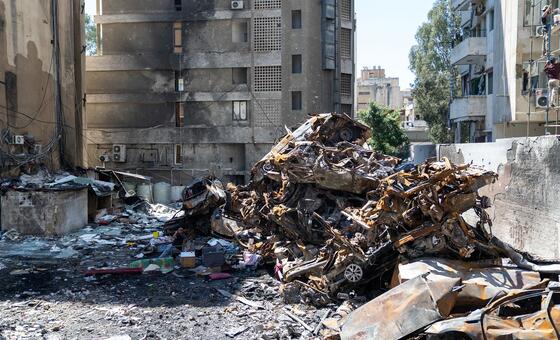
The UN relief coordination office, OCHA, cited reports from Lebanese authorities that at least 13 people were also injured in multiple airstrikes and military activity across towns in the south.
Between 17 and 28 April alone, 48 people were killed and 183 injured, bringing the total toll since the escalation began on 2 March to more than 2,500 killed and over 7,800 wounded, according to the country’s health ministry.
Despite an extended ceasefire, the situation remains “fragile and volatile,” OCHA said, with continued violence hampering humanitarian access and recovery efforts.
Aid agencies have managed to carry out 100 assisted missions to hard-to-reach areas through a UN-coordinated notification system, allowing some relief to reach communities under strain.
Hunger worsens in Lebanon
Insecurity, coupled with the economic impact of the conflict, has further strained livelihoods, while rising costs and supply disruptions are worsening food insecurity.
Estimates indicate that nearly a quarter of the population is facing acute hunger.
A new alert from the UN-backed global food security tracker IPC on Wednesday warned that the situation is deteriorating rapidly.
Around 1.2 million people could face high levels of acute food insecurity between now and August.
“Behind every number are families struggling to meet their food needs consistently,” the UN World Food Programme (WFP) said, as it continues to scale up assistance, together with partners.
Public services stretched
The humanitarian situation is further compounded by displacement and fragile public services.
In one school-turned-shelter in Jdeideh, in northern Beirut city, 377 people – around 90 families – are living in cramped conditions, the World Health Organization (WHO) reported, highlighting the pressures on basic infrastructure.
The UN health agency has been working with partners to strengthen medical treatment options including support for hospital blood banks to ensure lifesaving transfusions during emergencies.
Diplomatic efforts continue
Meanwhile, diplomatic efforts to stabilise the country are ongoing.
UN Special Coordinator Jeanine Hennis-Plasschaert met Lebanese President Joseph Aoun on Thursday to discuss efforts to consolidate the cessation of hostilities and advance stability, UN Spokesperson Stéphane Dujarric said.
She has also held talks with Israeli officials in recent days.
A UN Development Programme worker surveys damage at Al-Shifa Hospital in Gaza City.
Gaza conditions deteriorate
In Gaza, humanitarian conditions remain dire, with families facing overcrowded shelters, limited access to water and growing health risks.
OCHA said UN and partner teams visiting displacement sites in eastern Gaza city found around 600 families living in “harsh conditions,” sheltering in damaged buildings and tents with little access to clean water and virtually no sanitation services.
Rodents and insects are widespread, increasing the risk of disease, while untreated waste and overcrowding are compounding already difficult living conditions.
With few opportunities to earn a living, children are increasingly venturing into high-risk areas where Israeli forces remain deployed, collecting materials to sell, humanitarians reported.
Access constraints and ongoing insecurity continue to limit the delivery of aid, with emergency medical services largely unavailable in many areas.
Hidden dangers
The crisis is further compounded by the threat of unexploded ordnance, which continues to pose deadly risks and hinder recovery.
According to the UN Mine Action Service (UNMAS), more than 1,200 people have been killed or injured by explosive ordnance in Gaza since October 2023. Nearly half of the victims are children.
Widespread contamination
The widespread contamination is preventing families from returning home safely and obstructing humanitarian operations, as aid convoys risk detonation while attempting to reach affected communities.
“Families cannot safely return to their home places to begin rebuilding their lives without the risk of finding explosive ordnance amongst the rubble,” said Julius Van Der Walt, head of UNMAS in the Occupied Palestinian Territory.
With around 1.9 million people displaced and 60 per cent of the population without homes, the scale of destruction has set back development in Gaza by decades, he added.

