


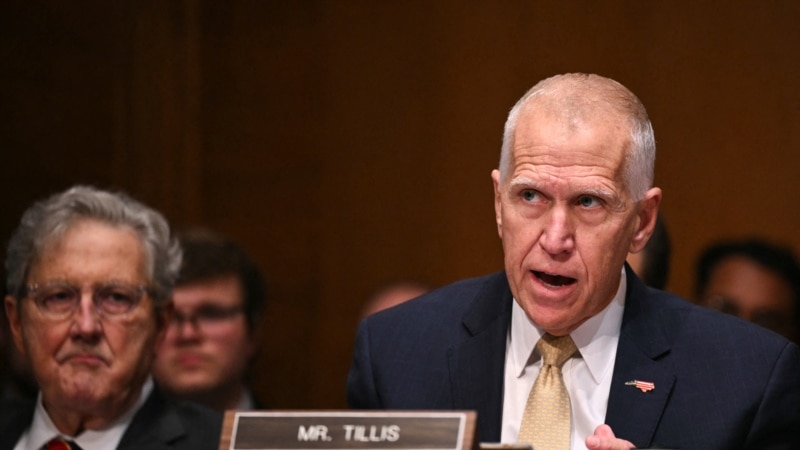
WASHINGTON — Senator Thom Tillis, a co-chair of the Senate NATO Observer Group and a self-described “plain-spoken” Republican from North Carolina, has a message for those who view the conflicts in Ukraine and the Middle East as isolated events: they are not.
In an era of shifting global alliances, Tillis argues that the world is facing a resurrected “Axis of Evil” led by Russia and Iran — a partnership he believes has moved far beyond a marriage of convenience into a deep, strategic military alliance.
In an interview with RFE/RL on April 29, Tillis, one of the few internal critics in the Republican party, discussed the high stakes of the current geopolitical landscape, the “unacceptable” prospect of a frozen conflict in Ukraine, and why he believes Vladimir Putin is personally responsible for American deaths.
RFE/RL: We are seeing a shift in the global landscape that feels more coordinated than ever. You have been watching Russia and Iran closely and how they are targeting the US and its allies. The question is, is this partnership a true alliance, or is it a tactical arrangement that could unravel?
Senator Thom Tillis: A true alliance versus a tactical arrangement — give me more to work with.
RFE/RL: Sometimes it is described as a convenient marriage between Russia and Iran.
Tillis: Oh no, I think it’s much deeper than that. And I think it became very clear when you see the material support that Iran has given Russia in Ukraine — first through their drone technology, and now in reverse, Russia providing information on how they can target American assets and the assets of our partners in the region. It is absolutely, I think, a strategic alliance, and it’s really a part of the old Axis of Evil.
I believe that China — for some reason, we’ve forgotten the fact that China has some 2 million Uyghurs in forced labor camps — so that the axis of evil is still alive and well. And I believe in some respects it’s even gotten worse in terms of the death on the battlefield and the deaths of American service members using technology that was manufactured by Iran and then optimized through the help of Russia.
RFE/RL: What’s the most dangerous thing changing hands here — intelligence, technology, or nuclear ambition?
Tillis: You know, I think that nuclear ambition is something we have to look closely at. We now know that their launch capabilities are far greater than they suggested. We know that they are literally now, based on most recent intelligence estimates, months if not weeks away from being able to enrich uranium to a point where it’s weapons-grade. So a stockpile of weapons-grade uranium and intercontinental ballistic missile capabilities is exactly why President Trump needed to do what he did in Iran.
And Russia would like nothing more than to have a nuclear-capable country in the Middle East to destabilize the region — and I think, to a certain extent, China as well — because they realize that now the United States is seen as a destabilizing force in the Middle East. And the moment that Iran had that kind of capability, it would destabilize that region at levels we’ve never seen before.
RFE/RL: If Russia is feeding Iran with intelligence against us, has Vladimir Putin effectively entered into a Middle East war?
Tillis: I feel like he has. But my gosh — Russia — that’s why I’m a bit concerned with the administration’s posture. I’ll tell you one thing that yesterday, with the King’s speech before Congress, I hope the Ukrainian people saw, was the standing ovation of every member who was on the floor when the King talked about supporting Ukraine. And so I feel like Putin is trying to do his best to have it both ways — to pretend like he could be a friend or coexist with the United States, when in fact that’s the furthest thing from his mind.
He wants to eradicate any influence of the United States from Europe and from the Middle East. And right now, he is at least having his way in the Middle East through his support — material support — for Iran. But this man is responsible. I said something that I think caught a few people by surprise: that in some respects, he’s like Soleimani. He’s responsible for the deaths of Americans. It’s only the number that makes the difference.
Soleimani was famously accused of being responsible for hundreds of American service member deaths. There’s no question that the blood of American service members is on the hands of Vladimir Putin — through his proxies, through his work with Iran, and through his work with mercenaries.
And so I feel like we need to recognize Putin for what he is. He is a vestige of the old days of communism, and he doesn’t even represent the majority of the Russian people, but he rules them with an iron fist. And he’s going to do everything he can to diminish the United States’ role and influence and try to eradicate democracy. He’s clearly anti-democratic, pro-communist, pro-totalitarian.
RFE/RL: The reference you meant was King Charles yesterday. That speech actually resonated in Eastern Europe as well, where some might see that they are not looking at two separate conflicts but one potential global war playing out on multiple fronts. Do you agree with that assessment?
Tillis: I think so. I mean, the world is small now, and so we have to recognize our adversaries are not thinking about just countries right across their border — they’re looking far beyond that. This is a struggle between the democratic world and the totalitarian world. It always has been and probably always will be. But you have to look at this patchwork.
We even have to go beyond Iran. Take a look at Russia’s activities in Africa, in particular North Africa. Take a look at what they’re doing in Ukraine. Take a look at the hybrid warfare they’re fighting right now in Moldova and the Balkans across Eastern Europe. I mean, they are fighting a war right now, and we are maybe working on containing it — but we could end this war.
There’s no way Vladimir Putin wins if we have a focus on Ukraine. Allowing him to win there just gives him a foothold on fomenting hate and anti-democratic principles across Eastern Europe and Africa — and that’s the world war that he wants to fight and win.
RFE/RL: Just to understand your broader perspective — is the West’s greatest vulnerability not its military strength, but a shrinking attention span?
Tillis: Yeah — you’re talking about in terms of sustaining the effort in Iran or Ukraine?
RFE/RL: Both.
Tillis: I think it is. I love America, obviously, but the American people can get distracted very quickly or move on. Wars are very difficult things. We run the risk of something capturing everyone’s attention for a while and then becoming something they want to move past. But you can’t move past a nuclear threat from Iran. You can’t move past the devastating impact of a loss in Ukraine. You’ve got to continue to go back to your voters and remind them that it is a threat to the United States. It’s not some country far away that doesn’t affect us — it will have a profound effect.
If Iran becomes a nuclear power, it will have a profound effect. If Russia is rewarded by defeating Ukraine, it will have a profound effect. This is a different kind of world war, but it’s one that’s going on between, I think, the good guys and the bad guys — and the American people need to constantly be reminded of that.
RFE/RL: The U.S. and its allies have relied heavily on sanctions against countries like Iran and Russia, particularly when they act in tandem. Given their growing ability to adapt and circumvent restrictions, are sanctions in general losing their effectiveness as a policy tool?
Tillis: I do. I think they are. And our saying is we’re at our best when our sanctions are coordinated. And to be honest with you, I’ve been frustrated with Europe kind of falling behind. If you remember, even with sanctions against Iran, we had various countries who are partners and allies of ours — some in NATO — who had business interests there that made it very difficult for them to move forward with a coordinated sanctions regimen. But that’s how we could win many of these wars, if we would just get people to understand the longer-term cost of allowing Iran to not be accountable.
The longer-term cost of allowing Russia to do what they do is far greater than any short-term costs they may suffer through sanctions. We have to start looking more comprehensively. Quite honestly, if Europe had been more willing to apply coordinated sanctions, particularly against Iran, then we may have avoided this conflict.
But people cannot forget: when we were trying to bring Iran to the table using economic sanctions, there were countries that equivocated. So they marginalized the effect that sanctions could have. Hopefully we can get to a point where we all understand that coordinated sanctions can shorten the time to bring about something good. We have to stop looking only at six-month or one-year economic consequences.
I think to a certain extent, that’s what the president’s doing now. He understands that the war is not popular in the United States, and people are worried about some of the economic consequences, but I think he’s right to look at the bigger picture and be willing to take that heat and continue to make the case to the American people. I also think that we have to do a better job of explaining exactly where we go from here in Iran if we want to get the American people more behind it, and I do believe that we’ve got work to do there now, in terms of public opinion.
RFE/RL: The West’s strength also lies in unity among its allies, something you have personally invested significant effort in. I saw you in Munich early this year — before The Hague, during NATO summit — engaging with allies and working to build consensus. At that time, Iran was not part of the discussion. Now, however, Iran has entered the picture. If NATO is already being tested by Russia, does Iran’s involvement raise the stakes to an entirely new level?
Tillis: Oh, I think it does. And I think you have to view Iran for what they are. They are a partner in the war in Ukraine. I mean, they decide in the same way that North Korea is. I mean, my God, we have thousands of people from North Korea now in Russia manufacturing drones that will ultimately be a part of the arsenal in North Korea.
There are several countries working together to defeat Ukraine, and Iran is one of the first among them. And I think that people need to understand that, and we have to counter it, and we have to counter it with our partners and allies, not unilaterally, not alone, because we all have shared interests, mutual interests, in defeating them.
RFE/RL: Has Putin figured out that he doesn’t need to defeat the West — just outlast it?
Tillis: Outlast. I think that they want to try and outlast us. I really do. And I believe that, you know, we have to go back — this is very, very important. I remember Obama on a hot mic famously saying, “I can be more flexible after the election” to Vladimir Putin. So we’ve had a Democrat and a Republican president over the last 20 years be accommodating to a man whose ultimate objective is to have every other nation be subservient to him. We should all view him through that lens, and if we don’t, we do so at our peril.
RFE/RL: Could this growing partnership stretch Western defenses? Is that something critical?
Tillis: Well, I think it can. I mean, the fact that we’re in Iran and that we have used stockpiles demonstrates that even the most powerful nation on Earth has its limits, and so we have to be very selective in where we expend our resources, where we position all of our assets, including men and women in uniform, because all of those resources are finite. And we have to be mindful of that in a world where we, the United States — and I think I said this in Munich — we really do have to be everywhere, all the time. The question is: at what level and to what extent do we have to expect more from our partners so that we can have that influence and not expose ourselves in any theater or any area of conflict?
RFE/RL: With allies boosting their defense, that old “free loading” argument is dead now?
Tillis: That’s why I’ve said — I know it’s uncomfortable — I always use the analogy of my family. I grew up in a family of six kids. NATO reminds me of a big family where we don’t all agree. You get into arguments, somebody gets mad and doesn’t come to Christmas or whatever. That’s a natural part of a family, but at the end of the day, we have to defend that family. I mean, it is, to me, the firewall against totalitarianism.
And if we think we can go it alone — whoever thinks we can go it alone is naive, doesn’t understand the power of our alliance. They don’t understand how threatening it is to our adversaries.
Vladimir Putin, I mean, he has, you know, maybe he’s working transactionally with Iran and North Korea and pursuing Ukraine, but they don’t have allies the way that we think about it. They don’t have the ability to fly into Kabul and execute one of the most extraordinary logistical feats in modern history with the evacuation from Afghanistan.
So regardless of what you say about retrograde in Afghanistan, I know that our allies are looking at that coordinated effort thinking that there’s no way on Earth they could possibly do it, and that’s something that only comes from a 75-year alliance and good working relationships with other freedom-loving nations.
And we’ve got to build on that, because that’s not something China can rip off. Our intellectual property and build an F-35 that kind of looks like ours, and Russia can steal technology and pretend that they’re a peer in terms of kinetic capabilities, but they know that they could not possibly sustain a war effort the way the United States, our partners, and allies can from the relationships that we have in place and all the expertise that goes with it. But our NATO allies have to invest.
The reason why I agree with the president is they allowed $2 trillion to not be spent over the last 24 years. That could have modernized our systems. It could have strengthened the industrial base. We wouldn’t be talking about rebuilding an industrial base if those NATO countries had simply spent what they all agreed that they would spend on our mutual defense. And so the president’s frustrated.
He’s created tensions within the family, but the fact of the matter is, the family members needed to be told that their behavior was unacceptable, and that’s why we are here. And the best way for us to get back to one big happy Christmas party is for them to pay their fair share and do in the future what they failed to do for nearly 50 years. I like that analogy.
RFE/RL: You have supported Ukraine’s sovereignty for years from the get-go. If the conflict freezes tomorrow, does it represent a victory for the West, or is it just halftime?
Tillis: If it freezes, it’s a push. In fact, in many respects, I think it’s a loss. No, to be honest, I don’t think it is a push. I think if it freezes, it’s a loss, because the West has essentially rewarded the behavior of a liar — somebody who started Vladimir Putin by saying it was going to be military drills and then a special military operation. The supposed great power has been held off by a country that was operating on a shoestring. They are a shell of a superpower now.
The only reason we take them seriously is that they have a nuclear arsenal. They have no conventional capabilities to match up, even against Ukraine. Can you imagine what a matchup against the United States would look like?
So allowing a win from a second-tier country that’s illegally invaded a sovereign nation, or allowing a push, to me, is a loss for the West. He needs to lose. He needs to very clearly lose and then go back and explain to the Russian people why he let hundreds of thousands of his people die in pursuit of something he should have never initiated. He needs to go back and answer to the Russian people for the devastating economic consequences that they’re living through now. He needs to go back and be held responsible for the tens of thousands of children who have been kidnapped and redeployed in Russia. You can’t reward that. It can’t be a push. A push for him is a win.
RFE/RL: Back to Iran, president Trump has suggested that other countries should step in and contribute in terms of security in the Strait of Hormuz. If the US walks away, do you think allies — Europeans, Middle Eastern allies — can do it alone?
Tillis: Well, I think it would be a horrible mistake if the US walked away. I also think it’s a mistake just for the US to say we’ve created this blockade, now you all fix it. I do think that the United States needs to play a very important role in coordinating it.
I do believe, and if you go to Taiwan, Korea, Japan, a number of other countries that rely on the Strait of Hormuz for energy and other outputs, that they could all play a role in stabilizing the Strait of Hormuz, and we should probably have a presence there to make it highly unlikely that Iran could ever just arbitrarily close it. I mean, there should be a sustained presence there, but I don’t think it’s enough to say, “Hey, y’all go fix it.”
I believe the United States has to play a leadership role, get the right partners in place. It may involve some from Europe, but I think from the Indo-PACOM area as well, so that we can sustain it over time.
RFE/RL: I was also hoping you could help our audience understand the May 1 deadline. If the War Powers deadline passes, does it make this war not legal on May 2, or what happens next?
Tillis: Well, the War Powers Resolution requires that the administration report back by day 60, which I believe will be on Friday, the status of the war and to seek at least an extension under the War Powers Resolution to continue their current activities. And we need details from the administration.
The administration, I think, would do well to go ahead and say we clearly know we need to be there for 30 more days. And there are people like me and others who are talking about an authorization for the use of military force, which I would like to do, to make it very clear to the mullahs and to those who are leading Iran right now that we’re in it for the long term. We have to succeed.
This is another example, similar to Ukraine — a push is unacceptable. We’ve lost lives in this encounter over the last 60 days. We have Iran at one of the most vulnerable points it has been in the 47 years that this regime has been in power. For us not to seek a very clear victory in a non-nuclear Iran and to expend the effort, the time, and the resources to do that, I think would be a horrible waste. It would be a mistake.
And I think that at the end of the day, even though the war is unpopular now, if you poll people, I think the thing that would be even less popular would be walking away from it and leaving Iran to continue its malign activities and to allow it to emerge as a nuclear power. We’ve got to be there. We’ve got to win it. I think that longer term, we should be talking about partners and allies sustaining it and coming up with a broader strategy for peace in the Middle East. It’s still a very dangerous place to be, and right now, it’s far more dangerous than it was 59 days ago.
RFE/RL: Finally, when you look at the Middle East and the theater of Ukraine, what does a winning Western strategy look like against this emerging axis?
Tillis: If you want a winning Western strategy, I think it’s seeking a lasting agreement with Iran that is ratified by Congress. It is seeking a lasting agreement in Ukraine that is ratified by Congress. In other words, we’ve got to end this cycle of presidents like Obama agreeing to the JCPOA [Joint Comprehensive Plan of Action, an agreement signed in 2015 between Iran and the United States, United Kingdom, France, China, Russia, and Germany designed to ensure a peaceful Iranian nuclear program].
I agree that it was a bad agreement. I was critical of it from the time it came forth, and one of the reasons it was bad is the administration didn’t do the work to get the support of Congress to ratify it.
And so I hope that the Trump administration will re-emerge as one of the leaders and supporters of Ukraine and also come to a lasting agreement with Iran that rises to the level of a treaty that must be ratified by Congress so that we can enforce it over time and not necessarily be at risk of the priorities of the next administration.


