Lori Beer, the global chief information officer at JPMorgan Chase & Co., has a long checklist of questions as she navigates the proliferation of AI agents working alongside the banking giant’s sprawling workforce of 319,000.
AI agents, Beer says, will change the way one thinks about work, the tasks to complete that work, how to break those tasks down, the tasks the bank is comfortable automating, the tasks that require human reflection, and then the proper technology ecosystem with the proper security, resiliency, and controls.
“We have been focusing very early on, on simple things, like what’s the right level to create an agent; how do you give them identity and access?” says Beer.
Her approach is fairly flexible. In HR, a human has broader license to see JPMorgan employee data than an agent. “You don’t want them to go outside the bounds of the specific tasks that they can do, because they don’t have the same thinking a human does,” says Beer. But in software engineering, there’s a bit more pliability with the permissions granted to an AI agent, because there’s a validation layer to check and correct any errors those autonomous systems could generate.
That same monitoring layer will need to be applied to other parts of the business as agents are increasingly embraced, says Beer, which involves keeping the human in the loop but also monitoring the outputs that large language models are producing.
One clear certainty when it comes to JPMorgan’s agentic AI strategy is that these tools won’t run through a third-party vendor. “This is going to be critical, because it’s the underlying flow of how we do business,” she says. “We want to secure it and we want to make sure it’s organized.”
Beer, a 12-year veteran at the No. 11-ranked Fortune 500 bank, manages a technology budget of $19.8 billion and more than 65,000 technologists who support JPMorgan’s retail, wholesale, and asset and wealth management businesses. The company’s tech spending accounts for roughly 10% of revenue, meaning that as JPMorgan’s business continues to grow—and it reported a monster first-quarter earlier in April—spending on technology and AI will also continue to rise.
“You’re moving $12 trillion a day, and you have a lot of customers and clients,” says Beer. “So this balance between innovation and risk taking is critical for us to get it right. We spend a lot of time focusing on that.”
AI tools that Beer has rolled out include LLM Suite, an internal version of OpenAI’s ChatGPT that provides asset and wealth management employees secure access to LLMs. JPMorgan said 200,000 employees were onboarded onto the tool eight months after its July 2024 debut. While some employees still use LLM Suite for simple tasks, including summarization and creating PowerPoint presentations, others are taking it further to create their own AI assistants.
Another tool is called Connect Coach, which helps asset managers pull insights quickly, like when tariff-related news was regularly shaking the stock market. This tool bolsters revenue in that advisors “can handle significantly more clients with the productivity they’re seeing out of these tools,” Beer says.
AI coding tools, meanwhile, have vastly improved and led Beer to work on rebuilding what she calls “the factory,” which encompasses efforts to rethink how product teams and engineers build. That means less time working in integrated development environments, or IDEs, which are the software applications that allow programmers to write, test, and debug code in one interface; and more time giving AI models the context they need to handle complex tasks.
“We’ve had great examples of some of our deep architects that are really great as specifications, but didn’t like to code so much,” says Beer. “Now, they’re able to spend the time up front creating the specification. And we need senior engineers reviewing the code output.”
AI’s impact on the future of work has been a recurring theme in public commentary from JPMorgan CEO Jamie Dimon. He’s acknowledged the bank already has redeployment plans in place for workers that will be displaced by AI, and even posited that these tools will reap big productivity gains that could result in a shorter work week.
Meanwhile, an internal team led by Teresa Heitsenrether, chief data and analytics officer, and Robin Leopold, head of HR, is working with other leaders to speadhead the effort to more thoroughly re-engineer workflows across JPMorgan. The bank is also working with an unnamed, large academic university for this ongoing project. This coincides with “several hundred” AI use cases already in production today, as well as future tech initiatives that the company’s operating committee—which includes Beer, Leopold, and Heitsenrether—regularly monitors to create “hard value creation.” That value has both potential to generate top-line revenue and productivity gains.
“I think the change management and how you think about the ways of working is ultimately the hardest part here, and reimagining how you can use these tools,” says Beer.
A more ominous side of AI that banks and technologists like Beer need to keep a close eye on are potential cyber threats from advancements like Anthropic’s new Mythos model. “Obviously, cybersecurity is—Jamie always talks about it too—one of our biggest threats, and it’s also been a place we’ve invested in significantly,” says Beer.
As AI models mature, JPMorgan has had to think of when to play offense versus defense, and in both cases, AI is a tool that can help. “The tools are getting better at helping you find vulnerabilities,” says Beer. “We have to make sure that we’re better at fixing them faster.”
John Kell
Send thoughts or suggestions to CIO Intelligence here.
NEWS PACKETS
As AI spending soars, Microsoft and Meta trim jobs. Last week, Meta announced it would plan to cut 10% of the company’s workforce, or roughly 8,000 employees, and would not fill 6,000 open roles. Microsoft then told employees that it would offer voluntary buyouts and that about 7% of the tech giant’s U.S. workforce would be eligible. Both are cutting jobs as they spend billions on data centers and other infrastructure needed to support their AI ambitions. But tech-related job cuts have also affected other sectors: Nike will cut about 1,400 roles from the athletic-gear giant’s global operations team, mostly focused on technology. In March, 45,800 tech employees were affected by layoffs, the worst month for tech industry job losses in at least two years, The Wall Street Journal reports, citing data from the tracking website Layoffs.fyi.
What do investors want from tech earnings? It depends. Chipmaker Intel, booted from the Dow Jones Industrial Average in November 2024, is emerging as the tech industry’s comeback kid. Shares have more than tripled since that humbling moment and the gain came last week when Intel reported strong first-quarter results due to growing demand for CPUs. It’s a big win for CEO Lip Bu Tan one year after he took that role. ServiceNow, meanwhile, is doing everything right—almost every revenue and profitability metric glowed in its latest quarterly results—and yet shares took a 14% dive as the SaaSpocalypse fears loom. ServiceNow CEO Bill McDermott told Fortune he thinks those worries are beginning to wane. “They’re learning that ServiceNow is an AI platform,” said McDermott. This week, earnings are on deck for five of the “Magnificent Seven,” where most analysts will keep a close eye on total capital expenditure spending plans.
AI’s 2026 IPOs: Trillions in value, no profits. With the global AI market projected to exceed $4.2 trillion by 2030, according to Citigroup projections, investor anticipation is running high for the largest-ever IPO market if SpaceX, OpenAI, and Anthropic all go public as expected before the end of this year. Reuters reports that the three companies (SpaceX is both a space and AI company) could add $3 trillion in combined market value, but reportedly, none are profitable. Notable news from the trio include: OpenAI is in court this week in a legal tussle with SpaceX founder Elon Musk; OpenAI wiggled out of its exclusive AI pact with Microsoft; and Anthropic is reportedly beating OpenAI on secondary share trading platforms.
DeepSeek debuts its latest LLM with little fanfare. On Friday, the Chinese AI company unveiled its V4 model, a release that comes more than a year after DeepSeek rattled markets with its lower-cost V3 and R1 models. But this time, there’s far less allure, as WSJ reports that V4’s performance matches some top-tier U.S. products released in 2025, but its performance in some areas trailed closed-source U.S. models like Anthropic’s Claude 4.6. Reuters, meanwhile, reports that while V4 exceeds previous versions unveiled by DeepSeek, it overall ranks close to other open-source models from rivals including Kimi and Qwen. “The expectation that new players will emerge is now baked into valuations,” Lian Jye Su, chief analyst at tech research firm Omdia, told Reuters.
Two very different tales about AI’s impact on law firms. The Financial Times published two legal-focused stories over the past week with vastly different takeaways. On the seemingly positive side, global law firm Freshfields announced a deal with Anthropic to build legal AI tools that could later be sold to rival firms. The pair will reportedly focus on developing products that attorneys could use to draft documents and review contracts, among other tasks. But in another FT story, Sullivan & Cromwell admitted to a U.S. federal bankruptcy court that a filing it made in one of the law firm’s cases contained multiple “hallucinations.” The firm admitted that its own AI policies had not been followed when preparing the document.
ADOPTION CURVE
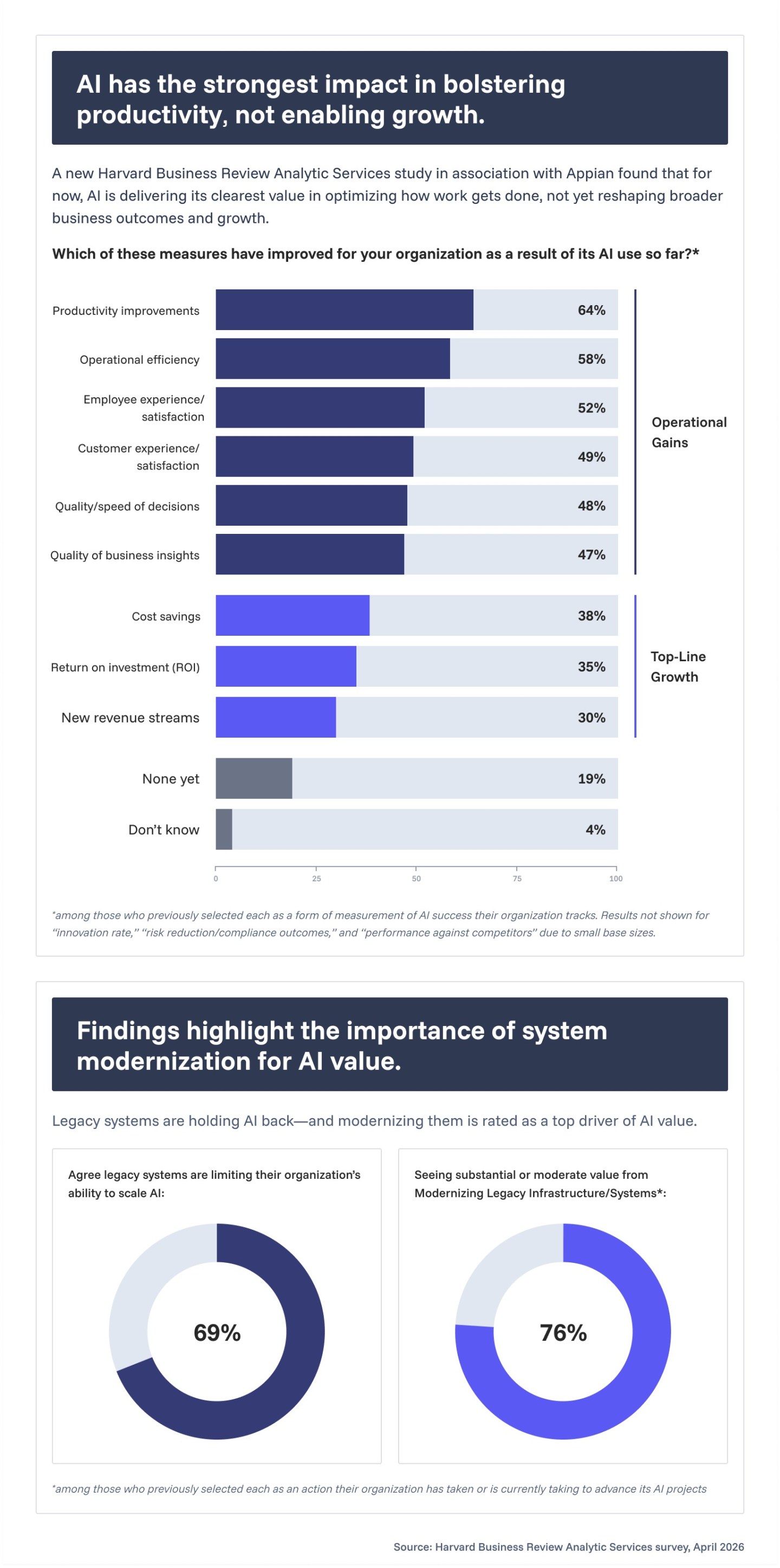
Business leaders say AI is still siloed from workflows. Only 18% of companies report that when their workers use AI, the technology is integrated into workflows, while far more (34%) report that AI remains standalone tools alongside those tasks, according to a new survey of 385 business leaders conducted by Harvard Business Review Analytic Services and funded by enterprise software provider Appian. Another 34% report a mix of both approaches, while 12% say they aren’t yet using AI in workflows at all.
Over the past few years, CIOs and their C-suite peers have worked hard to embed AI into workflows beyond the margins—merely using AI for meeting note taking, to spruce up PowerPoint slides, and other low-stakes repetitive tasks—and instead encourage managers and their teams to rethink roles with AI. But employee resistance still lingers, partly due to fear of AI-related job replacement.
That may help explain why the survey also found that only 16% of respondents report realizing a high degree of measurable value from AI. The majority describe the impact as moderate (33%), slight (36%), or say it has delivered no measurable value (8%).
“Almost everyone is out there using AI for personal efficiency purposes, instead of for the core output of their organization,” Matt Calkins, CEO of Appian, tells Fortune. He says leaders need to put more emphasis on applying AI to differentiated use cases centered on what makes each enterprise unique. “AI is just cutting costs in the back office,” adds Calkins. “We can aspire to a lot more.”
Courtesy Appian
JOBS RADAR
Hiring:
– Piedmont Health Services is seeking a CIO, based in Chapel Hill, North Carolina. Posted salary range: $147.6K-$198.4K/year.
– Saval Foodservice is seeking a chief digital officer, based in the Washington-Baltimore area. Posted salary range: $200K-$225K/year.
– The city of San Jose is seeking an assistant CIO, based in San Jose, California. Posted salary range: $185K-$298.8K/year.
– Whiteman Osterman & Hanna is seeking a CIO, based in Albany, New York. Posted salary range: $150K-$175K/year.
Hired:
– McDonald’s promoted Mustafa Husain to the role of SVP and U.S. CIO, effective May 1, succeeding Valerie Ashbaugh, who is leaving the fast-food giant at the end of April. Husain joined McDonald’s in December 2020 and most recently served as VP of restaurant technology engineering. He previously held manager roles at Amazon, Research In Motion, and GE.
– Amgen promoted Sean Bruich to serve as CTO, after originally joining the biotechnology company in 2024 as SVP of AI and data. Prior to joining Amgen, Bruich spent 11 years in technology leadership roles at Nike and early in his career, worked at Google and Facebook. Bruich succeeds David M. Reese, who will retire effective June 30 and joined Amgen in 2005 as a clinical development leader in oncology.
– Bed Bath & Beyond appointed Kyla Robinson to serve as chief technology transformation officer, reporting to President Amy Sullivan. Prior to joining the retailer, Robinson most recently oversaw digital commerce, product, engineering, and customer experience for the direct-to-consumer business at Spanx. Robinson also previously held leadership roles at Nike, Walmart, and Saks Fifth Avenue.
– Chipotle Mexican Grill announced the appointment of Arlie Sisson as chief digital officer, reporting to Curt Garner, president and chief strategy and technology officer. Previously, Sisson served as SVP and global head of digital, commercial services, at Hyatt Hotels. She also previously was founder and CEO of the SaaS company UpPurpose and held senior leadership roles at Condé Nast and Marriott.
– H&M Group named Diego Teijeiro Ruiz to serve as the retailer’s CIO, effective May 25. Teijeiro Ruiz will join H&M’s executive management team and report to CEO Daniel Ervér. He joins H&M after spending nearly two decades at rival fast-fashion retail group Inditex, who owns the Zara chain, where Teijeiro Ruiz most recently served as global chief data and analytics officer.
– Morgan Lewis announced the appointment of Michael Rinehart as CIO, where he will lead the law firm’s global IT function. At Morgan Lewis, Rinehart will work closely with Colleen Nihill, the chief AI and knowledge management officer, to align on the firm’s data and AI initiatives. Previously, Rinehart served as CIO at the law firms Dechert and Fox Rothschild.
– F&M Bank promoted Shalini Singhal to serve as the Ohio-based bank’s chief information and technology officer. Singhal joined F&M nearly six years ago, most recently serving as CIO. She previously served as CIO at two other Ohio banks, Middlefield Banking and the Commercial & Savings Bank.
– Consumer Cellular appointed Kannan Alagappan as CIO, effective April 27. Alagappan joins the senior-focused, prepaid mobile wireless provider after serving as CTO at software-as-a-service provider Circles. He also previously served as CTO at satellite TV provider Dish Network.