


In the face of a devastating US-Israeli bombing campaign, Iran’s rival political factions cast aside their differences to unite behind the country’s decision-makers.
But since a cease-fire with the United States came into force on April 8, deep-rooted political differences in the Islamic republic have spilled out into the open.
The public rupture over Tehran’s attempts to negotiate an end to the two-month-long war has pitted Iran’s small but vocal faction of ultraconservatives against more moderate conservatives, a confrontation that has been laid bare in the halls of parliament and on the front pages of state-affiliated media.
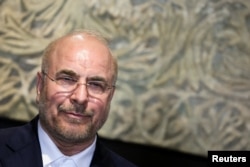
But analysts warn the fracture is not ideological. The main differences, they say, are not even over whether to cut a deal with the United States, but when to pursue peace and what concessions to make.
The dispute crystalized in the days following the first round of talks between delegations led by Parliament Speaker Mohammad Baqer Qalibaf and US Vice President JD Vance in Pakistan on April 11-12.
What had largely been friction behind closed doors erupted into an open media war when the Tasnim news agency — linked to Iran’s Islamic Revolutionary Guards Corps (IRGC) — published an editorial on April 25 mocking ultraconservatives, comparing their expectations for the talks to a “magic beanstalk.”
Ultraconservatives have said Iran should not make any concessions to the United States, including over its nuclear program, a nonstarter for Washington. They also insist any peace deal should extend to Iran’s regional proxies and must ensure the lifting of all sanctions against Tehran.
In a separate piece, Tasnim accused Raja News, a website close to the ultraconservatives, of causing “discord” and playing into US President Donald Trump’s hand by criticizing the Iranian negotiating team. Days earlier, Trump had said there was “tremendous infighting and confusion” within Iran’s leadership.
Ali Afshari, an Iranian political analyst based in Washington who spoke to RFE/RL’s Radio Farda, cautioned against reading too much into the public confrontation.
“I don’t think we yet have evidence that this dispute represents a large structural fracture,” he said.
The US-Israeli bombing campaign launched on February 28 has decapitated much of Iran’s political and military leadership. Ayatollah Ali Khamenei, the longtime supreme leader, was assassinated and succeeded by his son, Mojtaba, who has yet to appear in public since his ascent to power.
The primary target of the ultraconservatives is Qalibaf, the country’s top negotiator with the United States. Politicians linked to the Paydari Front, an influential ultraconservative faction aligned with former presidential candidate Saeed Jalili, accused the negotiating team of violating the red lines set by the new supreme leader.
Mahmoud Nabavian, a lawmaker affiliated with Paydari who accompanied the delegation to Pakistan, said talks were “pure damage” and discussing limits to Iran’s nuclear program was a “strategic mistake.”
Iran’s parliament on April 27 voted on a statement expressing support for the negotiating team. Only seven of the 261 lawmakers, all prominent Paydari figures, refused to sign.
“Iran’s oil is selling for double the pre-war price,” Nabavian wrote on X the next day, calling on “cowards” to join the public whom he suggested did not back the talks. The war has rattled international energy markets and upended the global economy, and hard-liners appear hopeful this will ultimately force Washington to make concessions.
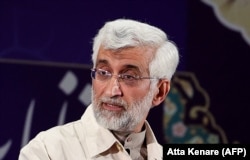
Afshari said the divide among ultraconservatives and more moderate conservatives is over the timing of peace talks.
The ultraconservatives want to continue the war and negotiate from a position of strength, he said. By contrast, Qalibaf and other more moderate conservatives want to end the war now and secure a deal while they still can.
“The disagreement exists at this level, but it doesn’t go so far that anyone in the [ultraconservative] bloc is advocating for no deal at all,” Afshari argued.
Political differences in Iran have been exacerbated by the absence of Mojtaba Khamenei, who is living in hiding and is reportedly gravely wounded. He has minimal contact with Iranian officials, according to reports.
“The lack of a decisive central authority due to Supreme Leader Mojtaba Khamenei’s absence has likely allowed these disputes to escalate into the public domain rather than remain contained within regime channels,” the Institute for the Study of War, a US-based think tank, wrote in a report on April 28.


