


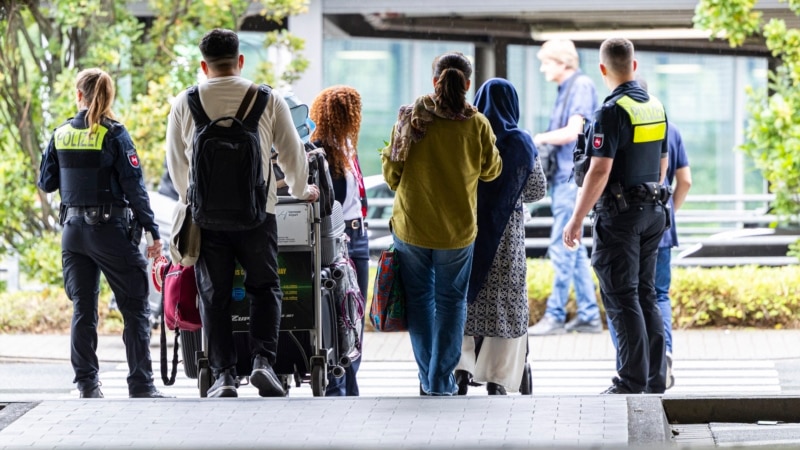
Hundreds of Afghan refugees remain in limbo at the As-Sayliyah camp in Qatar awaiting information about the countries they may be transferred to after a US State Department deadline to move them passed last month.
In interviews with RFE/RL’s Radio Azadi, several of those waiting said they were told that the camp near the capital of Doha would close by March 31 and that they might be transferred to other countries.
In the meantime, the uncertainty of not knowing where they may be headed looms over them, making it impossible to know what their future holds or if they even may be returned to Afghanistan despite the perils they could face.
“The authorities here told us that As-Sayliyah camp will be closed on March 31, and according to the newly announced US policy, you may be transferred to another country,” one Afghan refugee, who did not want their name to be published and has been living in the As-Sayliyah camp for the past 15 months, told Radio Azadi.
“People were waiting until March 31. Even after that, when asked, they said there was no news yet. People still ask, which are these second and third countries that we can go to? We are not told which countries they might send us to.”
Fleeing After Cooperating With US Forces
According to some American officials and Afghans living in the camp, about 1,100 people are currently living at the As-Sayliyah camp. Many of the refugees at the camp are civilians who cooperated with US forces during 20 years war; more than half are women and children.
They had expected to end up in the United States after international forces left Afghanistan in August 2021. Evacuation flights got them out of the country as the Taliban regained control of the war-torn country.
Those hopes were dashed, however, after all immigration requests relating to Afghanistan were halted in November 2025 after an Afghan national shot two members of the National Guard, one of whom died a day after the shooting near the White House.
A spokesperson from the US State Department told RFE/RL that work continues on “voluntary resettlement options” for the refugees at the camp and that relocation to a third country “is a positive resolution that provides safety for these remaining people to start a new life outside of Afghanistan while upholding the safety and security of the American people.”
The spokesperson did not specify any third countries that could be included in the program, but The New York Times reported on April 21 that the Trump administration is in talks to send many of them to the Democratic Republic of Congo. The report cited an aid worker briefed on the plan.
Some media outlets, including The Wall Street Journal, say Washington has held talks with two African and one Asian countries about taking in Afghan refugees living in the camp, which Qatar has reportedly asked to be closed.
US Democrat lawmakers Gregory W. Meeks, ranking member of the House Foreign Affairs Committee, and Sydney Kamlager-Dove, ranking member of the Subcommittee on South and Central Asia, issued a statement condemning the situation saying the administration “has failed to uphold America’s word to these Afghan allies.”
They added that “we made a promise to protect them after the Taliban’s takeover. Abandoning that commitment not only betrays our allies, it sends a dangerous message to future partners that U.S. promises cannot be trusted.”
Another Afghan refugee, who did not want their name to be published, said they have been waiting in the As-Sayliyah camp in Qatar for the past 18 months.
“They told us in this camp that they would transfer us to a third country by March 31, but we have not been transferred yet, and they have not promised anything, and they have not said anything,” the person said.
“We spoke to the officials, including the head of this camp, and they say that whenever there is an order, news, or instruction from Washington, we will share it with you. They say, for now, we are waiting and we will see what happens.”
Rwanda Option
Meanwhile, a number of Afghan refugees who were previously living in an Abu Dhabi camp say that 27 people were transferred to Rwanda in August last year.
They say that they were promised that they would be transferred from there to another country, but that since their arrival, no action has been taken.
“It has been about eight months since we were transferred from Abu Dhabi to Rwanda. They offered us five countries to transfer us to within three months. These countries were the US, Canada, Australia, and France,” one of the Afghan asylum seekers told Radio Azadi.
“They said that if there was a problem, they would send us to Brazil for a while and then to other countries, but so far they have kept us here. When we ask them, they say that they cannot do anything,” the asylum seeker, who asked not to be named for fear of reprisal, added.
The State Department spokesperson told RFE/RL that while Afghan nationals at the Qatar camp do not have a “viable pathway” to the United States, voluntary repatriation remains an option, with Washington offering a stipend to those who take the option.
The Taliban government says it is committed to implementing a general amnesty but reports from the United Nations Assistance Mission in Afghanistan (UNAMA) and other agencies show that a number of soldiers and people who cooperated with the Americans during the republican government have faced imprisonment, torture, and even death threats — something the Taliban has denied.
“The answer has been the same for four years. Bring them here [to the United States]. They’re vetted. They earned it on the ground, in uniform, next to our people,” said Shawn VanDiver, the head of AfghanEvac, a group dedicated to help coordinate relocation and resettlement efforts of Afghans impacted by the US mission in Afghanistan.
The US government has said that no one will be forcibly returned, nor has it released how many people have accepted the offer to receive money and return to Afghanistan.
Camp As-Sayliyah was established after the Taliban retook power in 2021 to house Afghans who had cooperated with US forces and were awaiting transfer to the United States.
Some members of Congress have called the closure of the camp a “deep betrayal.”
The State Department has said that Afghan refugees were not properly vetted under the Biden administration, which AfghanEvac and other advocacy and rights groups dispute.


